Harvard University: A Complete History from 1636 to the Modern Era
Introduction
Harvard University is one of the most famous and historically influential universities in the world. Located primarily in Cambridge, Massachusetts, Harvard has played a remarkable role in the intellectual, political, scientific, cultural, economic, and social development of the United States and the wider world. Founded in 1636, Harvard is the oldest institution of higher education in the United States and the first college established in the English colonies of North America. (Harvard University)
The story of Harvard is not simply the story of an old college. It is a story of transformation. Harvard began as a small colonial institution whose principal purpose was to educate ministers for the young Puritan society of New England. Over nearly four centuries, it developed into a comprehensive university containing schools devoted to law, medicine, business, government, education, public health, design, engineering, dentistry, and numerous other fields.
Harvard’s history is closely connected with the history of the United States itself. Its students and graduates participated in the American Revolution, the creation of the United States government, the development of American science, the growth of modern business, major social movements, and the expansion of higher education.
The institution has also experienced serious contradictions. For much of its early history, Harvard reflected the social, religious, racial, and gender limitations of its surrounding society. Women were excluded from Harvard College for centuries. Native American education was an important part of Harvard’s early mission but was also shaped by colonial attitudes. Harvard’s history was also connected to slavery and the economic and social structures surrounding it. In the modern era, the University has increasingly confronted these difficult parts of its past.
Today, Harvard University includes Harvard College and a large group of graduate and professional schools. Harvard describes its current community as including more than 24,000 undergraduate and graduate students, while more than 420,000 alumni live around the world. (Harvard University)
Understanding Harvard therefore requires looking beyond its famous name. Its history reveals how higher education itself changed—from a small religious college in colonial America into a global research university.
1. The World Before Harvard
To understand why Harvard was founded, it is important to understand seventeenth-century New England.
English settlers established permanent colonies in North America during the early seventeenth century. Among these settlers were Puritans who wanted to create communities organized around their religious beliefs. The Massachusetts Bay Colony became one of the most important of these settlements.
Education was extremely important to Puritan society. Religious leaders believed that educated ministers were necessary for interpreting the Bible and guiding communities. However, the new colony could not depend permanently on England for educated clergy.
The establishment of a college therefore became an important colonial goal.
Harvard was founded only a few years after the Massachusetts Bay Colony was established. This demonstrates how highly the colonists valued education. Harvard’s original mission was much narrower than the mission of a modern university. It was primarily designed to prepare young men for leadership in religious and civic life.
According to Harvard’s historical records, the Massachusetts government approved £400 in 1636 for the establishment of a college. The institution was initially referred to as a “schoale or colledge.” (Harvard University)
The decision was historically significant because it created the first college in the English colonies of North America.
2. The Founding of Harvard in 1636
Harvard’s official founding date is October 28, 1636.
On that day, the Great and General Court of the Massachusetts Bay Colony voted to establish a college. Harvard therefore was not originally founded by John Harvard, despite the famous statue of him on campus.
The institution was created through government action by the Massachusetts Bay Colony. Harvard himself became important shortly afterward because of his extraordinary donation.
The first years were difficult. The college did not immediately resemble the large university that exists today. It had very few students, limited facilities, a small faculty, and uncertain financial resources.
The college was located in Newetowne, a settlement that was renamed Cambridge in 1638. Harvard’s earliest campus developed around what eventually became Harvard Yard.
Harvard’s first buildings have disappeared, but the physical location of the original institution remains central to the modern university.
Harvard’s historical timeline records that in 1637 the colonial government ordered that the new college be located at Newetowne. The following year, Cambridge became the settlement’s official name. (Harvard University)
This was the beginning of an institution that would eventually survive nearly four centuries of wars, political revolutions, economic crises, cultural transformations, and technological changes.
3. John Harvard and the Naming of Harvard College
The man whose name became attached to the institution was John Harvard.
John Harvard was an English-born clergyman who had received his education at Cambridge University in England. He emigrated to Massachusetts and became a minister.
Harvard died in 1638, only a few years after the college had been established.
Although he did not establish the college himself, his contribution was enormously important. Harvard left half of his estate and his personal library to the institution.
Harvard University states that John Harvard donated approximately half of his estate and a library of more than 400 books. (Harvard University)
His gift provided the young institution with resources at a critical moment.
In 1639, the Massachusetts General Court formally ordered that the college should be called Harvard College in recognition of his contribution. (Harvard University)
This is one of the most important distinctions in Harvard’s history:
John Harvard was not the founder of Harvard University, but he was its first major benefactor and namesake.
His legacy remains visible today through the famous John Harvard statue in Harvard Yard.
4. Harvard’s First Years
Harvard began operating in 1638 under Master Nathaniel Eaton.
The early institution faced serious problems. Eaton’s administration eventually collapsed amid accusations of harsh treatment and mismanagement. Harvard temporarily closed during the academic year 1639–1640.
In 1640, Henry Dunster became Harvard’s first president.
Dunster played a crucial role in stabilizing the institution. Under his leadership, Harvard began developing a more permanent educational structure.
Harvard’s presidential history explains that although Harvard was founded in 1636, the college began operating in 1638 and reopened in 1640 under Henry Dunster after the difficulties of its first administration. (Harvard University)
Dunster helped establish the foundations of Harvard’s academic and physical development.
The college gradually acquired land, buildings, books, and educational resources.
5. The Harvard Charter of 1650
One of the most important events in Harvard’s institutional history occurred in 1650.
Harvard received a formal charter from the Massachusetts colonial government.
The Charter of 1650 created a governing body known as the President and Fellows of Harvard College, commonly called the Harvard Corporation.
The charter established a structure for governing Harvard and helped provide institutional continuity.
Remarkably, the basic corporate structure created by the charter survived for centuries. Harvard’s official history notes that major structural changes to the Corporation were not made until 2010. (Harvard University)
This continuity is one reason Harvard has been able to preserve its institutional identity across nearly four centuries.
6. Harvard’s Early Curriculum
Harvard’s early curriculum was very different from modern university education.
The curriculum emphasized classical learning.
Students studied subjects such as:
- Latin
- Greek
- Hebrew
- Logic
- Rhetoric
- Philosophy
- Theology
- Mathematics
- Classical literature
Religious education was particularly important.
The institution’s original purpose was closely connected with training ministers, but Harvard graduates eventually entered many professions.
The educational system emphasized memorization, recitation, discipline, and classical texts.
Harvard’s own historical materials describe the early curriculum as emphasizing rhetorical principles, rote learning, and intensive drilling. (FAS Registrar’s Office)
Over time, Harvard gradually expanded beyond its original religious purpose.
7. Native American History at Harvard
Harvard’s early history also includes Native American education.
The Charter of 1650 referred to educating English and Indian youth.
An “Indian College” existed in Harvard Yard between approximately 1655 and 1698.
John Sassamon, a Massachusett Indian associated with Harvard in the seventeenth century, is recognized as the first known Native American student at Harvard. (Harvard University)
However, the story is complicated.
The educational relationship between Harvard and Native American communities existed within the larger context of European colonization. The goals and expectations of colonial education were not necessarily aligned with Native communities’ own cultural and political interests.
In recent decades, Harvard has increasingly examined this history.
Today, Native American history and Indigenous scholarship form an important part of Harvard’s broader effort to understand its past.
8. Harvard in the Eighteenth Century
During the eighteenth century, Harvard became increasingly connected with the intellectual and political life of colonial America.
The college educated many important colonial leaders.
One of the most famous was John Adams, who graduated from Harvard in 1755.
Adams later became a major leader of the American Revolution and the second President of the United States.
Harvard’s graduates became ministers, lawyers, politicians, teachers, scientists, and public officials.
The institution was therefore becoming more than a religious training center.
It was becoming a major intellectual institution in colonial America.
9. The Harvard Hall Fire of 1764
A devastating event occurred in 1764 when Harvard Hall burned.
The fire destroyed approximately 5,000 volumes and almost all of John Harvard’s donated books.
Harvard’s official historical timeline records the disaster as one of the major events of eighteenth-century Harvard. (Harvard University)
The loss was enormous because books were rare and expensive in colonial America.
Yet Harvard rebuilt.
The rebuilding process demonstrated an important characteristic that would repeatedly appear throughout Harvard’s history: institutional resilience.
Harvard repeatedly experienced destruction and financial difficulty but managed to reconstruct itself.
10. Harvard and the American Revolution
Harvard’s history became closely connected with the American Revolution.
When revolutionary conflict intensified in the 1770s, Harvard’s campus was affected directly.
In 1775, Continental soldiers were quartered in Harvard buildings. (Harvard University)
Harvard students and graduates participated in revolutionary politics.
Eight Harvard alumni eventually signed the Declaration of Independence.
Among Harvard’s famous revolutionary-era graduates was John Adams.
The American Revolution changed Harvard’s environment dramatically.
The institution had been established under British colonial rule, but it now existed within an emerging independent American republic.
This transformation affected Harvard’s curriculum, political culture, and relationship with government.
11. Harvard Becomes a University
The transition from Harvard College to Harvard University occurred gradually.
The Massachusetts Constitution of 1780 officially recognized Harvard as a university.
The creation of professional education accelerated the transformation.
Medical instruction began in 1781, and Harvard Medical School was founded in 1782. (Harvard University)
This was an important turning point.
Harvard was no longer simply an undergraduate college.
It was developing into a multi-disciplinary institution capable of providing advanced professional education.
Over the following centuries, additional professional schools would transform Harvard into the comprehensive university known today.
12. The Nineteenth Century: A New Harvard
The nineteenth century was one of the most important periods in Harvard’s history.
American society was changing rapidly.
Industrialization, urbanization, immigration, scientific development, and political transformation created new demands for higher education.
Harvard responded by expanding its curriculum and professional schools.
One of the most influential figures of this period was Charles William Eliot.
Eliot became Harvard’s president in 1869 and served until 1909.
His presidency lasted forty years and transformed Harvard dramatically.
13. Charles W. Eliot and Educational Reform
Charles Eliot believed that American higher education needed greater academic freedom.
Under Eliot, Harvard moved away from a rigid fixed curriculum.
Students gradually gained greater freedom to choose courses.
The elective system became one of Harvard’s defining educational innovations.
This helped create a model that influenced universities throughout the United States.
Eliot also promoted laboratories, professional education, research, libraries, and modern academic departments.
Harvard increasingly became a research university rather than simply a traditional college.
The nineteenth century therefore established much of the institutional model that modern Harvard would later develop.
14. Harvard Law School
Harvard Law School became one of the most influential legal education institutions in the world.
Its development helped transform American legal education.
Harvard became famous for the case method, associated particularly with Christopher Columbus Langdell.
Instead of simply memorizing legal rules, students analyzed court decisions and learned to reason through legal problems.
This teaching model became highly influential and was adopted by many law schools across the United States.
Harvard Law School consequently became an important institution in the development of modern American legal education.
15. Harvard Medical School
Harvard Medical School was established in 1782.
Over time, it developed into one of the world’s leading medical education and research institutions.
Harvard’s medical development became particularly important during the nineteenth and twentieth centuries as medicine became increasingly scientific.
Medical education shifted from apprenticeship-style learning toward laboratory research, clinical training, and systematic scientific investigation.
Harvard became closely connected with hospitals and medical research centers in Boston.
The development of Harvard Medical School helped establish the university as a major center for scientific and medical education.
16. The Rise of Scientific Research
During the nineteenth century, science became increasingly important at Harvard.
Subjects such as chemistry, physics, biology, astronomy, geology, and mathematics expanded.
Harvard Observatory became an important center for astronomical research.
The university developed laboratories and research collections.
This transformation changed the meaning of a university.
Instead of merely preserving existing knowledge, Harvard increasingly became an institution dedicated to creating new knowledge.
This research mission eventually became one of Harvard’s defining characteristics.
17. Women and Harvard: The Beginning of Change
For most of Harvard’s early history, women were excluded from Harvard College.
The nineteenth century gradually began to change this situation.
In 1879, reformers created the Harvard Annex, an organization that allowed women to receive instruction from Harvard faculty.
The effort eventually developed into what became Radcliffe College.
Harvard’s Radcliffe history explains that the Harvard Annex was created in 1879 in response to demands for greater educational opportunities for women. (Radcliffe Institute)
This was a major development in American women’s education.
Women who could not attend Harvard College could now study subjects taught by Harvard-affiliated instructors.
18. The Creation of Radcliffe College
The Society for the Collegiate Instruction of Women developed into Radcliffe College.
Radcliffe was formally chartered by Massachusetts in 1894.
The institution was named in honor of Ann Radcliffe, Lady Mowlson, whose seventeenth-century bequest helped establish one of Harvard’s earliest financial-aid traditions. (Radcliffe Institute)
For decades, Radcliffe provided women with an educational experience closely connected to Harvard.
However, Harvard and Radcliffe remained separate institutions.
This arrangement gradually evolved during the twentieth century.
19. Harvard in the Early Twentieth Century
The twentieth century brought enormous growth.
Harvard expanded its academic departments, professional schools, libraries, laboratories, museums, and research programs.
New fields emerged.
The university became increasingly international.
Students and scholars arrived from different parts of the United States and from other countries.
Harvard’s reputation also expanded globally.
The university increasingly became associated with scientific research, medicine, law, government, economics, literature, history, and the social sciences.
20. Harvard Business School
Harvard Business School was established in the early twentieth century as American business education was becoming more professional.
The development of business education reflected the growth of corporations and modern management.
Harvard played a major role in creating a systematic approach to management education.
The MBA eventually became one of the world’s most recognizable graduate degrees.
Harvard Business School’s case-method teaching became particularly influential.
Business leaders from around the world came to Harvard to study management, finance, marketing, strategy, leadership, and organizational behavior.
21. Harvard Graduate School of Education
Harvard also became increasingly important in education research.
The Harvard Graduate School of Education developed research and professional programs focused on teaching, learning, leadership, policy, psychology, and educational development.
Its work contributed to debates about how children learn, how schools should be organized, and how educational systems can improve.
The expansion of education research further strengthened Harvard’s role as a university serving multiple professional fields.
22. Harvard and World War I
World War I affected Harvard students, faculty, and academic life.
Students and alumni served in military and government roles.
The university participated in national efforts connected with the war.
The conflict demonstrated how closely American universities had become connected to national life.
Harvard’s students were no longer simply scholars.
They were increasingly involved in public service, scientific research, government, medicine, and international affairs.
23. Harvard Between the World Wars
The period between World War I and World War II was another important period of growth.
Harvard expanded research.
The social sciences became more prominent.
Economics, sociology, political science, psychology, and anthropology developed as major academic fields.
The university also strengthened its libraries and research collections.
Harvard’s intellectual influence expanded beyond the United States.
International scholars increasingly saw Harvard as an important center of scholarship.
24. Harvard and World War II
World War II transformed American higher education.
Harvard participated in wartime research and training.
Scientists and researchers contributed to national defense and technological development.
Students and alumni served in the armed forces and government.
The war also accelerated the relationship between universities, scientific research, and the federal government.
After World War II, this relationship became even stronger.
Harvard entered the postwar era with an increasingly important role in American research and public life.
25. The Postwar Expansion of Harvard
After 1945, Harvard experienced significant growth.
American higher education expanded rapidly.
Government funding for research increased.
The GI Bill helped millions of veterans attend college.
Harvard’s graduate programs became increasingly important.
The university attracted leading scholars from around the world.
Research laboratories expanded.
New technologies transformed scholarship.
Harvard became deeply involved in medicine, economics, physics, biology, computer science, government, and social science research.
The postwar period helped establish the modern American research university model.
26. Harvard and the Civil Rights Era
The civil rights movement created important changes at Harvard.
American universities were increasingly challenged to address racial inequality and discrimination.
Harvard gradually became more diverse.
African American students and scholars became increasingly visible within the institution.
The process was not immediate.
Harvard, like many American universities, had a long history of exclusion and unequal opportunity.
The twentieth-century civil rights movement encouraged institutions to reconsider admissions, curriculum, faculty recruitment, and campus culture.
27. Harvard and African American History
African American students and scholars have played increasingly important roles at Harvard.
One of the most famous was W. E. B. Du Bois, who studied at Harvard and became one of the most influential African American intellectuals in American history.
Du Bois’s career demonstrated the importance of advanced education in developing scholarship and leadership.
Over time, Harvard became home to many prominent Black scholars, writers, scientists, lawyers, politicians, and public intellectuals.
African American history is now an important part of Harvard’s institutional history.
28. Harvard and the Legacy of Slavery
Harvard’s relationship with slavery is one of the most important and difficult subjects in its history.
The university’s historical record includes connections between Harvard and slavery-era society.
In recent decades, Harvard has conducted research into these connections.
In 2022, Harvard President Larry Bacow accepted the recommendations of the Committee on Harvard & the Legacy of Slavery and announced a $100 million commitment to support implementation of those recommendations. (Harvard University)
This initiative reflects a broader effort by Harvard to confront aspects of its history that had previously received insufficient attention.
Understanding this history is important because Harvard did not exist separately from American society.
Its financial networks, students, faculty, donors, and institutions were influenced by the economic structures of colonial and early American society.
29. Harvard and the Expansion of Financial Aid
Financial aid has been part of Harvard’s history for centuries.
One of the earliest examples came from Anne Radcliffe, Lady Mowlson, who left a bequest in 1643 to assist students in financial need. (Harvard College)
This tradition gradually developed into modern financial-aid programs.
Harvard has increasingly emphasized the principle that financial circumstances should not prevent qualified students from attending.
The modern financial-aid system is far more complex than the early charitable gifts of the seventeenth century, but the basic idea has a long historical foundation.
30. Harvard’s Residential House System
Harvard’s undergraduate residential system became an important part of student life.
The residential houses provide communities where students live, study, eat, participate in activities, and interact with faculty and other students.
The system was designed partly to create smaller intellectual communities within the larger university.
Over time, Harvard’s houses became central to undergraduate identity.
Students often develop strong connections with their residential houses, and many traditions developed around them.
31. Harvard Libraries
Harvard’s library system is one of the most important scholarly collections in the world.
The history of Harvard’s libraries goes back to John Harvard’s original donation.
The destruction of books in the Harvard Hall fire of 1764 demonstrated how valuable library collections were to the university.
Over the centuries, Harvard accumulated millions of books, manuscripts, maps, photographs, scientific collections, and other materials.
Widener Library eventually became one of Harvard’s most recognizable buildings.
Harvard libraries support research across virtually every major academic discipline.
32. Harvard and the Development of Modern Research
During the twentieth century, Harvard’s research mission expanded dramatically.
Faculty and students contributed to major discoveries in:
- Medicine
- Biology
- Chemistry
- Physics
- Astronomy
- Economics
- Psychology
- Computer science
- Political science
- History
- Literature
- Public health
Research became one of Harvard’s central institutional purposes.
The university’s reputation increasingly depended not only on teaching but also on discoveries and scholarship.
33. Harvard and the Nobel Prize
Harvard faculty and researchers have received numerous Nobel Prizes.
The awards cover multiple disciplines, including physics, chemistry, medicine, economics, literature, and peace.
Harvard currently states that 52 members of its faculty have received Nobel Prizes while working at the University. (Harvard University)
These achievements reflect Harvard’s long-standing emphasis on research.
34. The 1960s and Student Activism
The 1960s brought political and cultural change to American universities.
Harvard students participated in debates over:
- Civil rights
- The Vietnam War
- Academic freedom
- Social equality
- University governance
- Racial justice
Student activism challenged traditional university authority.
The period permanently changed campus culture.
Students increasingly expected universities to respond to major social and political issues.
Harvard was one of many universities where these debates became particularly visible.
35. Women Become Central to Harvard College
The relationship between Harvard and women changed dramatically during the twentieth century.
Harvard and Radcliffe increasingly coordinated their academic programs.
By the twentieth century, women had much greater access to Harvard’s educational resources.
Harvard Yard eventually became accessible to women students as residential arrangements changed.
The final transformation came with the 1999 merger between Harvard and Radcliffe.
36. The Harvard-Radcliffe Merger
In 1999, Radcliffe College and Harvard University officially merged.
The merger created the Radcliffe Institute for Advanced Study.
This marked the end of Radcliffe as a separate women’s college.
The Radcliffe Institute became a major interdisciplinary research center.
Harvard’s official Radcliffe history states that the merger occurred in 1999 and that the institute was subsequently established as a center for advanced study. (Radcliffe Institute)
The merger represented a major transformation in the history of women’s education at Harvard.
37. Drew Gilpin Faust and Harvard’s First Woman President
Drew Gilpin Faust became a major figure in Harvard’s history.
She became the founding dean of the Radcliffe Institute and later became Harvard’s 28th president.
Faust was the first woman to serve as president of Harvard University.
Her appointment represented a major symbolic milestone.
For centuries, Harvard’s leadership had been exclusively male.
Her presidency demonstrated how dramatically the university’s institutional culture had changed.
Radcliffe’s official history identifies Faust as the first woman to become president of Harvard University. (Radcliffe Institute)
38. Harvard in the Twenty-First Century
The twenty-first century has brought new challenges and opportunities.
Harvard has expanded digital education, interdisciplinary research, global scholarship, biotechnology, artificial intelligence, public health, environmental studies, and other emerging fields.
The university has also continued to debate issues involving:
- Free speech
- Academic freedom
- Diversity
- Admissions
- Campus politics
- Research ethics
- Technology
- Globalization
Harvard’s role in society has become increasingly complex.
A modern university must educate students while also conducting research, serving society, supporting innovation, and protecting academic freedom.
39. Harvard’s Modern Academic Structure
It is important to understand that “Harvard University” and “Harvard College” are not exactly the same thing.
Harvard College is Harvard’s undergraduate liberal arts and sciences institution.
Harvard University also includes graduate and professional schools.
Harvard’s official information explains that Harvard College provides four-year undergraduate education, while the University includes graduate and professional schools offering advanced degrees. (Harvard College)
The modern Harvard system therefore contains multiple academic communities.
These include major fields such as:
- Law
- Medicine
- Business
- Government
- Education
- Public health
- Design
- Dental medicine
- Engineering and applied sciences
- Arts and sciences
This structure is the result of centuries of institutional expansion.
40. Harvard’s Campus
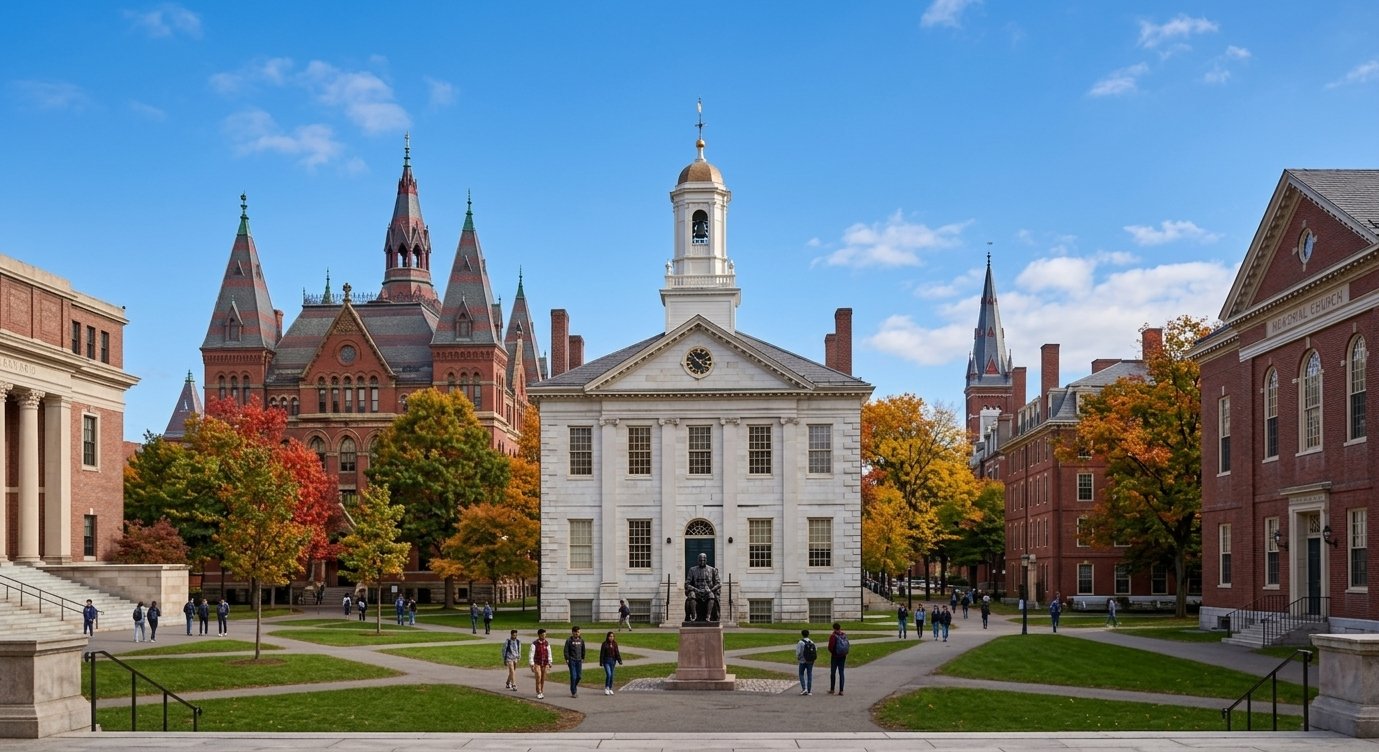
Harvard’s historic center is Harvard Yard in Cambridge.
Harvard Yard contains many of the University’s most recognizable historic buildings and landmarks.
It is associated with:
- Harvard Hall
- Massachusetts Hall
- University Hall
- Memorial Church
- Widener Library
- John Harvard Statue
- Numerous undergraduate residential and academic buildings
Harvard also has important facilities beyond Cambridge.
The University has campuses and major academic facilities in areas of Boston, including Longwood and Allston. (Harvard University)
The expansion into Boston and Allston reflects Harvard’s transformation from a small college into a major research university.
41. Harvard in Allston
Allston has become an important part of Harvard’s modern development.
The university has invested in research facilities, academic buildings, science programs, and innovation-related infrastructure in the area.
This expansion demonstrates that Harvard’s physical identity is no longer limited to historic Harvard Yard.
The university is increasingly a network of campuses and research centers.
42. Harvard’s International Influence
Harvard’s influence extends far beyond the United States.
Students and scholars from around the world have studied and worked at Harvard.
Harvard alumni have become:
- Presidents
- Prime ministers
- Judges
- Scientists
- Writers
- Entrepreneurs
- Business leaders
- Doctors
- Lawyers
- Professors
- Journalists
- Diplomats
The university’s alumni network is therefore a major part of its global influence.
Harvard currently reports more than 420,000 alumni worldwide. (Harvard University)
43. Famous Harvard Alumni
Harvard has educated many historically significant figures.
Among its notable alumni are:
John Adams
John Adams became the second President of the United States and one of the major leaders of the American Revolution.
John Quincy Adams
John Quincy Adams became the sixth President of the United States and later served in Congress.
Theodore Roosevelt
Roosevelt studied at Harvard before becoming the 26th President of the United States.
John F. Kennedy
Kennedy graduated from Harvard and later became the 35th President of the United States.
Barack Obama
Barack Obama attended Harvard Law School and later became the 44th President of the United States.
Franklin D. Roosevelt
Although Roosevelt attended Harvard, his undergraduate experience preceded his historic presidency during the Great Depression and World War II.
W. E. B. Du Bois
Du Bois became one of America’s most important scholars of race, sociology, and history.
Henry David Thoreau
Thoreau studied at Harvard and later became a major American writer and philosopher.
These individuals represent only a small part of Harvard’s enormous alumni history.
44. Harvard and American Government
Harvard has had a particularly strong relationship with American government.
Many presidents, cabinet officials, judges, senators, representatives, diplomats, and policymakers have studied at Harvard.
Harvard Kennedy School became an important center for public policy and government education.
The university has therefore influenced public administration and political thought.
Its alumni have served in democratic governments across the world.
45. Harvard and Economics
Harvard has also played a major role in the development of modern economics.
Economists associated with Harvard have contributed to debates about:
- Markets
- Government policy
- Economic growth
- International trade
- Development
- Monetary policy
- Inequality
- Labor markets
Harvard’s economics department and affiliated research institutions have influenced economic thought worldwide.
46. Harvard and Literature
Harvard has had an extraordinary literary tradition.
Students and faculty have contributed to American and international literature.
The university’s libraries contain enormous literary collections.
Writers associated with Harvard have worked in:
- Poetry
- Fiction
- Drama
- History
- Journalism
- Literary criticism
Harvard’s humanities tradition remains an important part of its identity.
47. Harvard and Science
Science has become one of Harvard’s most important areas.
Research at Harvard and affiliated institutions has contributed to understanding:
- The universe
- Human biology
- Genetics
- Disease
- Climate
- Chemistry
- Physics
- Evolution
- Neuroscience
The growth of science transformed Harvard from a classical college into a modern research university.
48. Harvard and Medicine
Harvard’s medical ecosystem is particularly extensive.
Harvard Medical School works with major hospitals and research institutions.
Medical research associated with Harvard has contributed to discoveries in:
- Cancer
- Genetics
- Immunology
- Neuroscience
- Cardiology
- Public health
- Infectious diseases
The medical side of Harvard demonstrates how modern universities increasingly combine teaching, clinical practice, and scientific research.
49. Harvard and Public Health
Public health became an increasingly important field during the twentieth century.
Harvard researchers have studied disease prevention, epidemiology, environmental health, health policy, nutrition, global health, and population health.
The COVID-19 pandemic further demonstrated the importance of universities in public health research and communication.
Harvard’s public health community participated in research, analysis, and public discussion during the pandemic.
50. Harvard and Technology
Harvard has also adapted to technological change.
Computer science and related fields have become increasingly important.
Digital technologies have transformed:
- Research
- Teaching
- Libraries
- Communication
- Data analysis
- Artificial intelligence
- Online education
Harvard Online has expanded access to educational material beyond traditional campus boundaries.
Harvard reports that more than 35 million learners have enrolled in Harvard Online courses. (Harvard University)
51. Harvard During the Digital Age
The internet changed the meaning of a university.
Previously, Harvard’s educational influence was primarily experienced by students who physically attended campus.
Today, lectures, courses, research papers, digital collections, and educational materials can reach people around the world.
This allows Harvard to extend its educational mission beyond Cambridge.
The digital transformation also creates new challenges involving artificial intelligence, intellectual property, misinformation, privacy, and academic integrity.
52. Harvard’s Academic Philosophy
Harvard College emphasizes liberal arts and sciences education.
The idea is that students should develop broad intellectual abilities rather than focusing exclusively on one narrow technical field.
Students study multiple areas before concentrating on their chosen field.
This educational philosophy reflects Harvard’s historical transformation.
The institution began with classical education and eventually developed a broad liberal arts model.
The underlying idea remains that education should help students understand the world, think critically, and contribute to society.
53. Harvard and Academic Freedom
Academic freedom is central to modern university life.
Harvard has historically been a place where scholars debate controversial questions.
Professors conduct research that can challenge established ideas.
Students debate political, cultural, scientific, and philosophical issues.
This freedom can also produce controversy.
The university must balance intellectual openness with responsibilities involving safety, discrimination, harassment, and institutional standards.
The debate over academic freedom has therefore remained a continuing part of Harvard’s history.
54. Harvard’s Governance
Harvard’s governance system developed from the seventeenth-century charter.
The Harvard Corporation is one of the University’s principal governing bodies.
The Board of Overseers is another major governing institution.
The president leads the University and works with deans, faculty, governing boards, students, and staff.
This structure reflects Harvard’s long institutional history.
The 1650 charter remains a foundational document in understanding Harvard’s governance. (Harvard University)
55. The Importance of Harvard Presidents
Harvard presidents have often played major roles in institutional transformation.
Presidents have influenced:
- Curriculum
- Research
- Financial policy
- Campus development
- Professional schools
- Internationalization
- Diversity
- Academic priorities
Some presidents served for decades.
Others governed during periods of crisis.
The presidency therefore provides an important lens through which Harvard’s history can be understood.
56. Harvard’s Reputation
Harvard’s reputation has been built over centuries.
Several factors contribute to it:
- Its age and historical continuity.
- Its research achievements.
- Its faculty.
- Its alumni.
- Its libraries and collections.
- Its professional schools.
- Its financial resources.
- Its global partnerships.
- Its academic traditions.
- Its influence on American society.
However, Harvard’s reputation also brings intense scrutiny.
Because Harvard is so influential, decisions made by the University often attract worldwide attention.
57. Harvard’s Challenges in the Modern Era
Harvard faces many challenges.
These include the rising cost of higher education, questions about admissions, debates about diversity and inclusion, political pressures, academic freedom, technological change, and the changing economics of research universities.
The university must also decide how to balance tradition with innovation.
An institution founded in 1636 cannot remain unchanged.
At the same time, its historical identity is one of its most valuable assets.
Harvard therefore constantly negotiates between its past and its future.
58. Harvard and Diversity
Modern Harvard is considerably more diverse than the Harvard of the colonial period.
Students now come from many racial, cultural, national, economic, and educational backgrounds.
This represents a dramatic transformation.
However, diversity at Harvard has developed gradually rather than appearing overnight.
The university’s history includes long periods of exclusion.
Understanding this evolution helps explain why diversity and inclusion remain important issues in contemporary higher education.
59. Harvard’s Relationship with Society
Harvard has never been isolated from society.
It has responded to major historical events including:
- The American Revolution
- The Civil War
- Industrialization
- World War I
- The Great Depression
- World War II
- The Cold War
- The civil rights movement
- The digital revolution
- The COVID-19 pandemic
At each stage, Harvard’s role changed.
The institution has been both a product of society and an influence on society.
60. The Meaning of Harvard’s Four-Century History
Harvard’s history is remarkable because of its continuity.
The university survived for nearly 400 years despite enormous changes.
When Harvard was founded in 1636:
- The United States did not exist.
- The American Revolution had not occurred.
- Modern science was in its infancy.
- Universities were rare in North America.
- Electricity was poorly understood.
- There were no modern nation-states in the Americas.
- Transportation was slow.
- Communication depended on physical letters.
Today, Harvard operates in a world of satellites, computers, biotechnology, artificial intelligence, global communication, and international research.
Yet the institution still maintains traditions that originated centuries ago.
61. Important Harvard Dates
Here is a simplified timeline of major moments:
1636 — Harvard College founded by vote of the Massachusetts Bay Colony.
1637 — The college is ordered to be located at Newetowne.
1638 — John Harvard leaves half his estate and his library to the college.
1639 — The institution is officially named Harvard College.
1640 — Henry Dunster becomes Harvard’s first president.
1642 — First Harvard commencement takes place.
1650 — Harvard receives its charter.
1655–1698 — Indian College exists in Harvard Yard.
1764 — Harvard Hall burns, destroying thousands of books.
1775 — Continental soldiers are quartered in Harvard buildings.
1776 — Eight Harvard alumni sign the Declaration of Independence.
1780 — Massachusetts Constitution recognizes Harvard as a university.
1782 — Harvard Medical School is founded.
1879 — Harvard Annex is established for women’s education.
1894 — Radcliffe College is formally chartered.
1909 — Charles W. Eliot’s long presidency ends.
1930s–1940s — Harvard expands research and professional education.
1940s — Harvard participates extensively in wartime research and training.
1960s — Student activism becomes a major part of campus life.
1999 — Harvard and Radcliffe officially merge.
2000s — Harvard expands interdisciplinary research and global education.
2022 — Harvard announces a $100 million commitment connected with recommendations concerning its legacy of slavery. (Harvard University)
2026 — Harvard continues to operate as a major global research university approaching four centuries of institutional history.
62. Why Harvard Has Survived for So Long
Harvard’s longevity can be explained by several factors.
Institutional Adaptation
Harvard repeatedly changed its curriculum and organizational structure.
Financial Support
Donations and endowment resources provided long-term financial stability.
Strong Governance
The Corporation and other governing structures helped preserve institutional continuity.
Academic Expansion
Harvard continuously added new disciplines and professional schools.
Research
The University adapted to the rise of modern science.
Globalization
Harvard increasingly attracted students and scholars from around the world.
Tradition
Historic traditions created a powerful institutional identity.
Alumni Network
Graduates became influential leaders who strengthened Harvard’s reputation.
63. Harvard’s Historical Legacy
Harvard’s greatest legacy is not simply its age.
Its deeper legacy lies in its influence on education, research, government, science, medicine, law, business, and culture.
The university helped establish models of higher education that spread throughout the United States.
Its professional schools influenced legal education, medical education, business education, public policy, and education research.
Its alumni shaped American history.
Its researchers contributed to scientific discoveries.
Its libraries preserved enormous quantities of human knowledge.
Its students and faculty participated in debates that transformed society.
64. Harvard’s Future
As Harvard approaches its fourth century, the university faces a future very different from the world of 1636.
Artificial intelligence may transform education and research.
Climate change will create new scientific and policy challenges.
Biotechnology may change medicine.
Digital education may expand access to knowledge.
International cooperation will become increasingly important.
At the same time, questions about the purpose of universities will continue.
What should students learn?
What responsibilities do universities have to society?
How should academic freedom be protected?
How should universities respond to technology?
How can access to education become more equitable?
Harvard will continue to confront these questions.
Conclusion
The history of Harvard University is one of the longest and most fascinating stories in American higher education.
Founded on October 28, 1636, by the Massachusetts Bay Colony, Harvard began as a small college designed largely to educate future ministers. John Harvard’s donation of his library and half of his estate gave the institution important early support, and the college was named in his honor in 1639. (Harvard University)
During the seventeenth and eighteenth centuries, Harvard developed from a fragile colonial college into an important center of learning. It survived administrative crises, financial difficulties, fires, political revolutions, and social change.
During the nineteenth century, Harvard transformed into a modern university. The expansion of professional schools, the development of scientific research, curriculum reform, and the rise of the elective system dramatically changed the institution.
The twentieth century brought further transformation. Harvard expanded its research programs, professional education, international connections, and scientific activities. Women gained increasing access to Harvard education, eventually culminating in the 1999 merger with Radcliffe College. (Radcliffe Institute)
Harvard also had to confront difficult parts of its past, including its relationship with slavery, colonialism, Native American education, and historical exclusion. Modern efforts to investigate and address these issues demonstrate that Harvard’s history is not simply a story of achievement but also one of reflection and institutional change. (Harvard University)
Today, Harvard University is a complex global institution containing Harvard College and numerous graduate and professional schools. Its academic work extends across the humanities, sciences, medicine, law, business, government, education, public health, design, and engineering.
Its history stretches across nearly four centuries.
Harvard began before the United States existed and survived into an age of artificial intelligence, biotechnology, digital education, and global research.
That extraordinary continuity is perhaps the most important fact about Harvard.
The University has never remained exactly the same. Its survival has depended on its ability to change while maintaining a strong sense of institutional identity.
From a small seventeenth-century college in colonial New England to one of the world’s most influential research universities, Harvard’s story is ultimately a story of adaptation, education, scholarship, ambition, and the continuing human search for knowledge.
Final Historical Summary
Harvard University was founded in 1636 and became Harvard College in 1639 after receiving the major bequest of John Harvard. It developed through the colonial period, played an important role in the intellectual life of revolutionary America, became a university recognized by the Massachusetts Constitution in 1780, and expanded through professional schools and scientific research. (Harvard University)
Its nineteenth-century transformation established the foundations of the modern research university. Its twentieth-century expansion brought women, international scholars, new academic disciplines, scientific research, and professional education into a much larger institutional framework.
The creation of Radcliffe College and its eventual merger with Harvard represented a major transformation in women’s education. (Radcliffe Institute)
In the twenty-first century, Harvard continues to combine centuries-old traditions with modern research, technology, global education, and interdisciplinary scholarship.
Nearly four hundred years after its founding, Harvard remains a powerful symbol of higher education and one of the most historically significant universities in the world.