Introduction
Peking University, commonly known as PKU, is one of the most prestigious and historically significant universities in China and Asia. Located in Beijing, the university has played an extraordinary role in the development of modern Chinese education, science, literature, philosophy, politics, culture, and intellectual life. Over more than a century, Peking University has transformed from a traditional institution established during a period of political and social change into a comprehensive research university with a global reputation.
The history of Peking University is closely connected with the history of modern China. The institution emerged during the late Qing Dynasty, when China was confronting military defeats, political instability, foreign influence, and demands for educational reform. Its development reflected China’s broader transition from traditional imperial education toward a modern university system.
Throughout the twentieth century, Peking University became a major center of intellectual activity. Its scholars and students participated in important movements that influenced Chinese society, including the New Culture Movement and the May Fourth Movement. The university became associated with debates about democracy, science, literature, philosophy, social reform, and national modernization.
Peking University also produced generations of influential scholars, writers, scientists, educators, political figures, and public intellectuals. Its academic tradition has emphasized both specialized research and broad intellectual inquiry. Today, PKU is recognized internationally for its strength across humanities, social sciences, natural sciences, medicine, engineering, economics, law, management, and numerous interdisciplinary fields.
This article explores the complete history of Peking University, from its origins in the late nineteenth century to its role as a major global research university in the twenty-first century.
1. The Historical Background of Peking University
To understand the creation of Peking University, it is necessary to understand the condition of China during the late nineteenth century.
For centuries, China’s traditional educational system had been based largely on classical learning and the imperial examination system. The examination system provided a route into government service and placed great importance on Confucian texts, classical literature, philosophy, and administrative knowledge.
By the nineteenth century, however, China faced enormous challenges. Western military and economic power was expanding, while China’s traditional political and educational institutions struggled to respond effectively.
The Opium Wars, unequal treaties, foreign concessions, and military defeats created a growing awareness among Chinese intellectuals that modernization was urgently necessary.
The defeat of China by Japan in the First Sino-Japanese War of 1894–1895 was especially important. Japan had undertaken major reforms during the Meiji period and had developed a modern education system, military, industry, and government. China’s defeat encouraged reformers to argue that China also needed modern institutions.
Education became one of the most important areas requiring reform.
Reform-minded officials and intellectuals believed China needed institutions that could teach modern science, foreign languages, law, economics, politics, engineering, and other subjects while maintaining important elements of Chinese culture.
This environment ultimately contributed to the establishment of the institution that became Peking University.
2. The Founding in 1898
Peking University traces its institutional origins to 1898, during the famous Hundred Days’ Reform of the Qing Dynasty.
The university was initially established as the Imperial University of Peking.
It was the first national comprehensive university established in China.
The founding of the Imperial University represented an important departure from the traditional educational system. Rather than focusing exclusively on classical Chinese learning and preparation for imperial examinations, the institution was intended to provide a modern form of higher education.
The reform movement associated with Emperor Guangxu and reform-minded officials sought to strengthen China through institutional modernization.
Although the Hundred Days’ Reform was eventually suppressed, the Imperial University survived.
This survival was historically important because the institution eventually became the leading university known as Peking University.
From its earliest years, the university had a special relationship with China’s national development. It was not simply established as another educational institution. It was intended to serve as an important center for modern learning and national reform.
3. Early Development Under the Qing Dynasty
The early Imperial University experienced numerous difficulties.
China was undergoing political instability, and educational reform was controversial. Traditionalists often resisted changes that appeared to challenge established intellectual traditions.
The university therefore had to operate within a society in transition.
The curriculum gradually incorporated modern subjects while maintaining traditional Chinese learning. This combination reflected the broader debate over how China could modernize without abandoning its cultural identity.
The university’s location in Beijing was also significant.
Beijing was the political and cultural center of the Qing Empire. The institution therefore had access to government officials, scholars, intellectuals, libraries, cultural institutions, and political developments.
Its students and faculty were exposed to national debates that were shaping the future of China.
The early university also benefited from the growing movement toward modern education.
As China established modern schools and universities, a new generation of students became interested in science, technology, Western philosophy, political theory, economics, and modern literature.
Peking University’s future intellectual influence developed from this environment.
4. The End of Imperial China and the 1911 Revolution
The political situation changed dramatically in the early twentieth century.
The Qing Dynasty eventually collapsed in 1911, leading to the establishment of the Republic of China.
The end of imperial rule transformed China’s political and educational environment.
Peking University entered a new historical period.
The university became increasingly important as China debated what kind of political and social system should replace the old imperial order.
Students and intellectuals were no longer concerned only with traditional scholarship. They were discussing constitutional government, republicanism, nationalism, democracy, science, social reform, women’s education, economic development, and China’s relationship with the wider world.
The university became one of the major intellectual institutions of the new republic.
5. Cai Yuanpei and the Transformation of Peking University
One of the most important figures in Peking University’s history was Cai Yuanpei, who became president of the university in 1916.
His leadership had a profound effect on the institution.
Cai Yuanpei believed that a modern university should provide intellectual freedom and encourage students and professors to explore different ideas.
He supported the principle of “freedom of thought” and promoted a broad academic environment in which different intellectual traditions could coexist.
Under his leadership, Peking University became increasingly known as a center of intellectual experimentation.
Cai encouraged the recruitment of outstanding scholars and supported new academic disciplines.
He also believed that university education should develop students intellectually and morally rather than merely prepare them for government employment.
His reforms helped transform Peking University into a modern research and teaching institution.
The university’s reputation grew rapidly.
6. The Rise of the New Culture Movement
Peking University’s historical importance became particularly visible during the New Culture Movement.
The movement emerged during the 1910s and challenged many traditional assumptions in Chinese society.
Its supporters promoted science, rational inquiry, modern literature, individual freedom, and social reform.
Peking University became one of the movement’s most important centers.
Several influential intellectuals associated with the university contributed to debates about China’s future.
Among them was Chen Duxiu, who was associated with the university and later became an important political figure.
Another major intellectual was Hu Shi, who became famous for advocating literary reform and the use of vernacular Chinese.
The university environment encouraged students to read Western philosophy, modern science, political theory, and new forms of literature.
Traditional scholarship did not disappear, but it was increasingly examined through new intellectual methods.
This atmosphere made Peking University one of the most influential intellectual institutions in early twentieth-century China.
7. The May Fourth Movement
Perhaps the most famous event associated with Peking University is the May Fourth Movement of 1919.
The movement began with student protests in Beijing on May 4, 1919.
The immediate issue involved China’s diplomatic treatment after the First World War and the decision concerning former German concessions in Shandong.
Chinese students strongly opposed the outcome and protested against what they considered foreign interference and national humiliation.
Students from Peking University played a major role in the demonstrations.
The movement quickly expanded beyond the original protest.
It became associated with nationalism, demands for modernization, intellectual reform, and criticism of traditional social structures.
Peking University became an important symbol of student activism and intellectual change.
The May Fourth Movement also helped popularize new approaches to literature, education, science, and politics.
The university’s role in the movement became an enduring part of its historical identity.
8. Literature and Language Reform
Peking University played a major role in the transformation of Chinese literature.
During the New Culture and May Fourth periods, intellectuals questioned the dominance of classical literary Chinese.
Writers and scholars promoted vernacular Chinese, making written language more accessible to ordinary readers.
Hu Shi was particularly influential in advocating literary reform.
The movement encouraged new forms of fiction, poetry, essays, journalism, and academic writing.
This transformation was not merely a literary development. It was connected to broader educational and social goals.
Supporters believed that a modern society required an education system and written language accessible to a much larger population.
Peking University’s intellectual environment therefore contributed to changes that affected Chinese literature and education far beyond the university itself.
9. Science and Modern Knowledge
Science became another central part of Peking University’s modern identity.
The early twentieth century was a period when Chinese intellectuals increasingly emphasized science as a means of strengthening the nation.
The university expanded teaching and research in subjects such as physics, chemistry, mathematics, biology, and other scientific disciplines.
Scientists associated with the university helped develop modern scientific education in China.
The university also promoted the idea that scientific knowledge should be pursued through observation, experimentation, evidence, and critical reasoning.
This approach represented a major intellectual transformation from traditional forms of scholarship.
Over subsequent decades, Peking University became increasingly important in China’s scientific development.
10. Philosophy and the Humanities
Although Peking University developed strong scientific programs, the humanities remained central to its identity.
Philosophy, history, literature, languages, sociology, economics, and political studies became important fields of scholarship.
The university became known for encouraging intellectual debate.
Chinese philosophical traditions were studied alongside Western philosophy and other intellectual traditions.
This created an environment in which scholars could compare Confucianism, Buddhism, Daoism, Western philosophy, Marxism, liberal thought, and other intellectual traditions.
The humanities at Peking University therefore became an important bridge between China’s historical cultural heritage and the modern world.
11. Peking University During Political Turmoil
The twentieth century was an extremely turbulent period in Chinese history.
War, political conflict, the Japanese invasion, and the Chinese Civil War affected universities throughout the country.
Peking University was not isolated from these events.
During periods of conflict, university operations were disrupted.
Faculty and students were sometimes forced to relocate.
One of the most important episodes occurred during the Second Sino-Japanese War, when several Chinese universities relocated inland to continue their educational work.
Peking University’s history during this period demonstrates the resilience of Chinese higher education.
Despite enormous challenges, scholars and students continued their academic work whenever possible.
12. The Southwest Associated University
During the war against Japan, Peking University joined with Tsinghua University and Nankai University to form the National Southwestern Associated University, commonly known as Lianda.
The university operated in Kunming.
This institution became one of the most remarkable educational experiments in modern Chinese history.
Despite limited resources and wartime conditions, professors continued teaching and conducting research.
The Associated University produced many outstanding scholars and scientists.
Its history demonstrated the determination of Chinese academics to preserve education even during national crisis.
The experience also strengthened intellectual connections among some of China’s leading universities.
13. The University After 1949
The establishment of the People’s Republic of China in 1949 marked another major turning point.
The country’s higher education system underwent extensive restructuring.
Peking University became an important institution within the new national education system.
The university increasingly emphasized disciplines considered important for national development.
Science and technology received particular attention.
At the same time, the humanities and social sciences were reorganized according to the new political and ideological environment.
The university remained one of China’s most important centers of higher education.
14. Expansion of Scientific Education
During the decades after 1949, Peking University expanded its scientific capabilities.
Programs in physics, chemistry, mathematics, biology, computer science, and other areas developed significantly.
Scientific research became increasingly important to China’s modernization.
The university contributed graduates and researchers to national scientific institutions, laboratories, universities, and government organizations.
As China began to invest more heavily in scientific and technological development, Peking University became an important source of highly trained scientists.
15. The Cultural Revolution
The Cultural Revolution, beginning in 1966, created severe disruption throughout Chinese education.
Universities across China experienced political campaigns, institutional instability, and interruption of normal academic life.
Peking University was deeply affected.
Academic research and teaching were disrupted, while political activities became dominant.
Many scholars experienced criticism, professional difficulties, or other forms of hardship.
The university’s history during this period illustrates how vulnerable academic institutions can become during periods of intense political upheaval.
Normal university operations eventually resumed as China entered a new period of reform.
16. Reform and Opening
After the late 1970s, China’s reform and opening policies transformed higher education.
The country increasingly emphasized science, technology, economic development, international cooperation, and modernization.
Peking University benefited greatly from this new environment.
Academic standards were strengthened.
Research programs expanded.
International academic exchanges increased.
Chinese universities began reconnecting with global scholarship after years of isolation and disruption.
Peking University became an important participant in this transformation.
17. Development of Modern Research
The modern Peking University places strong emphasis on research.
The university has developed research programs across numerous fields, including:
- Physics
- Chemistry
- Biology
- Mathematics
- Computer science
- Environmental science
- Economics
- Law
- Medicine
- Sociology
- History
- Philosophy
- Literature
- Political science
- International relations
- Business and management
This broad academic structure allows PKU to operate as a comprehensive research university.
Its research culture combines specialized expertise with interdisciplinary collaboration.
18. The Importance of Interdisciplinary Education
One of Peking University’s distinguishing characteristics is its commitment to broad intellectual education.
Many universities increasingly divide knowledge into specialized departments.
Peking University, however, has maintained strong traditions in both specialized research and general education.
Students can encounter ideas from multiple academic disciplines.
A student studying economics, for example, may also engage with history, philosophy, politics, mathematics, or sociology.
Similarly, students in the sciences may encounter questions involving ethics, society, environmental policy, or technology.
This interdisciplinary approach reflects the university’s historical tradition of intellectual breadth.
19. Peking University and Medicine
Medicine has become another major component of the university’s academic system.
Peking University’s medical programs and affiliated institutions contribute to education, research, and healthcare.
Medical research at the university encompasses areas such as clinical medicine, biomedical science, public health, pharmacology, and related fields.
The development of modern medical education demonstrates how far the university has expanded from its original role as a national institution for modern learning.
Today, medicine is an important part of its broader research ecosystem.
20. Engineering and Technology
Technology has become increasingly important in Peking University’s academic development.
The university supports research in areas related to information technology, computer science, engineering, materials, artificial intelligence, environmental technology, and other emerging fields.
China’s rapid technological development has created strong demand for advanced research universities.
Peking University has responded by strengthening scientific and technological research while maintaining its traditional strengths in the humanities and social sciences.
This combination allows it to participate in both technological innovation and broader discussions about the social impact of technology.
21. The Role of Peking University in Chinese Society
Peking University has had influence far beyond its classrooms.
Its graduates and faculty have participated in government, science, business, education, journalism, literature, medicine, technology, and public life.
The university has therefore played an important role in shaping China’s intellectual and professional elite.
Its graduates have contributed to national institutions as well as international organizations and companies.
The institution’s historical reputation also means that admission to Peking University is highly competitive.
For many students, attending PKU represents the achievement of a major educational goal.
22. Famous Scholars Associated With Peking University
Peking University’s history includes many influential intellectuals.
Among the best-known figures associated with its development are:
Cai Yuanpei
Cai Yuanpei is one of the most important presidents in the university’s history. His emphasis on academic freedom, intellectual diversity, and modern university organization helped establish PKU’s modern identity.
Hu Shi
Hu Shi was an influential scholar and advocate of literary reform. His work contributed significantly to the development of vernacular Chinese literature and modern Chinese intellectual culture.
Chen Duxiu
Chen Duxiu was an important intellectual figure of the New Culture era and was associated with Peking University’s intellectual environment.
Li Dazhao
Li Dazhao was another influential scholar and political thinker associated with the university. He played an important role in China’s intellectual and political history.
These figures demonstrate the extraordinary intellectual diversity associated with Peking University.
23. Nobel Prize and Scientific Connections
Peking University has been associated with numerous internationally recognized scientists and scholars.
Its academic community has contributed to areas including physics, chemistry, medicine, mathematics, environmental science, economics, and other fields.
The university’s scientific reputation has grown significantly as China’s research system has expanded.
Its laboratories and research centers participate in international collaborations and contribute to major scientific discussions.
The institution’s research culture encourages both fundamental research and practical applications.
24. The Peking University Campus
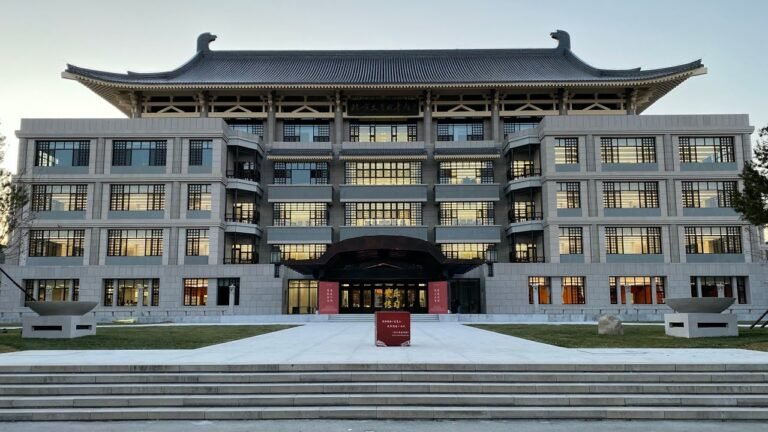
The main campus of Peking University is famous for its distinctive combination of traditional Chinese landscape design and modern academic facilities.
The campus includes historic buildings, gardens, lakes, libraries, laboratories, classrooms, research centers, and student facilities.
One of its most famous landmarks is Weiming Lake.
Weiming Lake has become a symbolic feature of campus life.
The surrounding landscape creates a unique environment in which historical architecture and modern university facilities coexist.
The campus reflects an important characteristic of Peking University: respect for China’s cultural heritage combined with a strong orientation toward modern knowledge.
25. Weiming Lake
Weiming Lake is one of the most recognizable locations at Peking University.
It has long been associated with student life, academic reflection, and campus culture.
Students and visitors often walk around the lake, especially during spring and autumn.
The area has become an important cultural symbol.
It represents not only the physical beauty of the university but also its connection with Chinese literary and intellectual traditions.
The lake and surrounding gardens contribute significantly to the distinctive atmosphere of the campus.
26. The University Library
The Peking University Library is another major part of the institution.
Academic libraries are essential to research universities because they provide access to books, journals, historical documents, databases, manuscripts, and other scholarly materials.
PKU’s library supports research across a wide range of disciplines.
Its collections include materials related to Chinese civilization as well as international scholarship.
The library therefore supports the university’s mission of connecting Chinese intellectual traditions with global academic knowledge.
27. Internationalization of Peking University
In the modern era, Peking University has become increasingly international.
The university collaborates with institutions around the world.
Students and scholars participate in exchange programs, joint research, international conferences, and collaborative academic projects.
Internationalization has strengthened the university’s position within global higher education.
At the same time, PKU continues to maintain a strong Chinese academic identity.
This balance between national heritage and international engagement is one of the institution’s defining characteristics.
28. International Students
Peking University attracts students from many countries.
International students study subjects ranging from Chinese language and culture to economics, business, science, engineering, international relations, and other disciplines.
For international students, PKU provides an opportunity to experience Chinese society while studying at a major research university.
The presence of international students also contributes to campus diversity.
It encourages cultural exchange and creates academic connections that extend beyond China’s borders.
29. Peking University and Global Rankings
Peking University is regularly recognized as one of the world’s leading universities.
International rankings use different methodologies, including research performance, academic reputation, citations, international collaboration, faculty quality, and other indicators.
PKU consistently performs strongly in many global assessments.
However, rankings represent only one measure of a university’s importance.
Peking University’s historical influence cannot be fully captured by numerical rankings.
Its role in Chinese intellectual history, especially during the New Culture and May Fourth eras, gives it a significance that extends beyond contemporary ranking systems.
30. Research and Innovation in the Twenty-First Century
The twenty-first century has brought major changes to global higher education.
Artificial intelligence, biotechnology, climate science, digital technologies, renewable energy, advanced materials, and data science have become important research areas.
Peking University has expanded research in many of these fields.
Its researchers participate in international scientific networks and collaborate across academic disciplines.
The university also supports innovation and entrepreneurship.
Students and researchers increasingly have opportunities to transform academic discoveries into practical technologies, companies, public policies, and social initiatives.
31. Peking University and Artificial Intelligence
Artificial intelligence has become one of the most important technological fields of the modern era.
Research universities have a central role in developing AI because the field requires expertise in mathematics, computer science, neuroscience, engineering, linguistics, economics, ethics, and social science.
Peking University has developed research and educational activities related to artificial intelligence and related technologies.
The university’s interdisciplinary environment is particularly valuable for understanding not only how AI works but also how it affects society.
Questions surrounding AI ethics, employment, privacy, governance, education, and human creativity require collaboration between technical and humanities scholars.
32. Environmental Research
Climate change and environmental degradation have created new challenges for universities worldwide.
Peking University has participated in research concerning environmental science, ecology, climate, sustainability, and natural resources.
China’s rapid economic development has created both opportunities and environmental challenges.
Research universities therefore have an important responsibility to develop technologies and policies that support sustainable development.
PKU’s environmental research contributes to broader discussions about China’s ecological future and global climate challenges.
33. Economics and Business Education
Economics and management have become increasingly important areas of Peking University’s academic activities.
China’s transformation into a major global economy has created demand for economists, managers, entrepreneurs, financial professionals, and policy experts.
Peking University’s academic programs in economics and related fields have contributed to the development of China’s professional and intellectual communities.
Research in economics also connects with public policy, international trade, development studies, finance, and social sciences.
34. Law and Public Policy
Peking University has a strong tradition in legal and political studies.
Law schools and research centers contribute to discussions about China’s legal system, constitutional questions, international law, commercial law, public policy, and governance.
The university’s location in Beijing provides an important environment for studying national policy and institutions.
Students interested in law and public administration can therefore engage with issues that have direct relevance to China’s rapidly changing society.
35. Peking University and Chinese Culture
Despite its modern scientific identity, Peking University remains deeply connected to Chinese cultural traditions.
The university teaches and researches Chinese literature, history, philosophy, archaeology, linguistics, and cultural studies.
This connection is particularly important because China’s modernization has created an ongoing discussion about how traditional culture can coexist with modern institutions.
Peking University provides an environment for examining this question academically.
Its scholars study both ancient texts and contemporary social developments.
36. Archaeology and Historical Research
China possesses one of the world’s longest continuous cultural histories.
Peking University researchers have contributed to archaeological and historical studies of Chinese civilization.
Archaeological research provides evidence about ancient societies, technologies, political systems, religions, trade networks, and cultural practices.
Historical research at the university also examines China’s relationships with neighboring regions and the wider world.
Such scholarship contributes to both Chinese historical understanding and international knowledge about East Asian civilization.
37. Student Life
Life at Peking University extends far beyond academic classes.
Students participate in clubs, societies, sports, cultural activities, academic organizations, competitions, volunteer programs, and artistic events.
The university’s long history has created a distinctive student culture.
Students often participate in discussions about literature, science, politics, technology, society, and global affairs.
The intellectual atmosphere is one of the features that attracts ambitious students.
For many students, university life is not simply about earning a degree but about developing an intellectual identity.
38. Academic Competition and Admission
Admission to Peking University is extremely competitive.
Because PKU is one of China’s most prestigious institutions, students typically need outstanding academic performance.
The university attracts high-achieving students from across China and around the world.
This creates a highly competitive academic environment.
At the same time, the university provides opportunities for students to work with leading researchers and participate in advanced research projects.
The combination of selective admission and strong research resources contributes to its academic reputation.
39. The Alumni Network
Peking University’s alumni community is one of its greatest strengths.
Graduates have gone on to careers in:
- Science
- Medicine
- Technology
- Education
- Government
- Business
- Journalism
- Literature
- Law
- Economics
- International relations
- Research
The alumni network extends across China and internationally.
Many graduates have held influential positions in universities, research institutions, companies, government organizations, and international institutions.
This broad alumni network strengthens the university’s influence.
40. Peking University and Entrepreneurship
Modern universities increasingly contribute to entrepreneurship and innovation.
Peking University supports an environment in which students and researchers can explore business ideas and technological applications.
The university’s location in Beijing is particularly advantageous because the city is a major center of technology, finance, government, research, and entrepreneurship.
Graduates have participated in China’s rapidly expanding technology and business sectors.
Entrepreneurship also creates opportunities to commercialize academic research.
41. Peking University and Beijing
The relationship between PKU and Beijing is central to its identity.
Beijing is China’s political capital and one of its major cultural and technological centers.
The city contains important museums, research institutions, government organizations, technology companies, cultural sites, and international organizations.
Peking University students therefore have access to an unusually rich intellectual environment.
The university’s location also makes it possible for scholars to interact with policymakers, cultural institutions, companies, and other universities.
42. Peking University Compared With Other Chinese Universities
China has many outstanding universities, including Tsinghua University, Fudan University, Shanghai Jiao Tong University, Zhejiang University, Nanjing University, and others.
Peking University’s distinctive strength lies in the breadth of its academic tradition.
It combines strong science and technology programs with exceptional traditions in the humanities and social sciences.
Its historical role in China’s intellectual transformation is also unique.
Tsinghua University is especially famous for engineering and technology, while Peking University has traditionally been particularly associated with broad intellectual scholarship.
Both institutions, however, are among China’s most prestigious universities.
43. The Relationship With Tsinghua University
Peking University and Tsinghua University are often regarded as two of China’s leading universities.
Their campuses are located relatively close to one another in Beijing.
The two institutions have competed academically while also collaborating in research and education.
Their shared history during the wartime period, especially through the National Southwestern Associated University, demonstrates that their relationship includes both competition and cooperation.
Together, they represent important pillars of modern Chinese higher education.
44. Academic Freedom and Intellectual Tradition
The historical legacy of academic freedom remains an important part of discussions about Peking University.
Cai Yuanpei’s leadership established a tradition of intellectual diversity that became particularly influential during the New Culture Movement.
The university’s history contains many examples of scholars debating different philosophical, scientific, literary, and political ideas.
This tradition contributed to the institution’s reputation as a place where major intellectual questions were discussed.
The university’s historical identity is therefore closely connected with the idea of intellectual inquiry.
45. Peking University in the Digital Age
Digital technology has transformed university education.
Peking University has adapted to changes in online learning, digital research, electronic libraries, data science, and global academic communication.
Students today have access to enormous amounts of information compared with previous generations.
Researchers can collaborate internationally almost instantly.
Digital technology also allows universities to share educational resources with people outside the traditional campus environment.
These developments have expanded the university’s potential global reach.
46. The Importance of Research Centers
Modern research universities depend heavily on specialized research centers.
Peking University hosts numerous institutes and centers dedicated to specific fields.
These centers allow researchers to work on complex problems that often cross traditional departmental boundaries.
For example, climate research may require cooperation between scientists, economists, engineers, geographers, and policy experts.
Similarly, artificial intelligence may involve computer scientists, mathematicians, psychologists, linguists, philosophers, and legal scholars.
Research centers therefore strengthen interdisciplinary collaboration.
47. Peking University’s Global Mission
The modern university has a global mission.
Its scholars contribute to international research, while international researchers collaborate with PKU academics.
The university participates in global debates about climate change, economic development, public health, technology, international relations, and cultural exchange.
As China’s international influence has expanded, the global importance of its major universities has also increased.
Peking University is one of the most visible representatives of Chinese higher education internationally.
48. Challenges Facing Peking University
Despite its achievements, Peking University faces challenges common to major research universities.
These include:
- Maintaining research excellence.
- Competing internationally for talented scholars.
- Supporting innovation while preserving academic traditions.
- Managing rapid technological change.
- Addressing environmental and social challenges.
- Expanding international collaboration.
- Preparing students for an increasingly complex global economy.
The university must balance its historical identity with the demands of the future.
49. The Future of Peking University
The future of Peking University is likely to be shaped by science, technology, internationalization, interdisciplinary research, and social change.
Fields such as artificial intelligence, biotechnology, quantum science, climate studies, advanced computing, and data science are likely to remain important.
At the same time, humanities and social sciences will remain essential.
Technological progress creates new ethical, cultural, political, and philosophical questions.
A university with strong traditions in both science and the humanities is well positioned to address these challenges.
50. Why Peking University Matters
Peking University’s significance cannot be understood simply through rankings or the number of students and professors.
Its deeper importance comes from its historical role.
The university emerged at a moment when China was searching for a path toward modernization.
It became a center of intellectual transformation during the New Culture Movement.
Its students participated in the May Fourth Movement.
Its scholars helped transform Chinese literature and scholarship.
Its scientists contributed to modern scientific education.
Its graduates have influenced Chinese society in countless ways.
Its campus remains a place where China’s cultural heritage and modern research coexist.
51. A Symbol of Modern Chinese Education
Peking University can be viewed as a symbol of China’s transformation from an imperial educational system to a modern research university system.
Its history reflects China’s broader journey through:
- Imperial reform
- Republican transformation
- Intellectual modernization
- War and national crisis
- Political revolution
- Educational restructuring
- Reform and opening
- Technological development
- Global academic integration
Few universities are so closely connected to the modern history of their country.
52. Legacy of the May Fourth Generation
The intellectual legacy of the May Fourth generation remains particularly important.
The students and scholars associated with the movement questioned old assumptions and demanded national renewal.
They promoted ideas such as science, education, cultural reform, and modernization.
Although Chinese society has changed dramatically since 1919, the questions raised during that period continue to influence discussions about education, culture, and national development.
Peking University remains closely associated with this legacy.
53. A Bridge Between Tradition and Modernity
One of the most interesting features of Peking University is its ability to connect apparently different worlds.
It connects:
Ancient and modern
Traditional Chinese scholarship continues alongside modern science and technology.
China and the world
Chinese intellectual traditions are studied alongside international scholarship.
Humanities and science
Literature and philosophy coexist with physics, biology, mathematics, and computer science.
History and innovation
The university preserves historical traditions while developing cutting-edge research.
This balance is a major reason for its enduring reputation.
54. Peking University as a Global Research University
In the modern era, Peking University operates on a global scale.
Its research is read internationally.
Its scholars collaborate with academics from many countries.
Its graduates work in international institutions and organizations.
Its scientific publications contribute to global research.
Its humanities scholars participate in international debates about Chinese history, culture, philosophy, literature, and society.
The university therefore functions not only as a national institution but also as an important global center of knowledge.
55. Conclusion
Peking University’s history is one of transformation, intellectual ambition, resilience, and academic achievement.
Founded in 1898 as the Imperial University of Peking, the institution emerged during one of the most difficult periods in China’s history. Its creation reflected the growing recognition that China needed modern education to respond to a rapidly changing world.
During the early twentieth century, Peking University became a center of intellectual modernization. Under influential leaders such as Cai Yuanpei, the university developed an environment that encouraged scholarship, debate, and new ideas.
Its role in the New Culture Movement and the May Fourth Movement gave it a unique place in Chinese history. Scholars and students associated with the university challenged traditional assumptions, promoted modern literature and science, and contributed to broader debates about China’s future.
The university also survived war, political upheaval, educational restructuring, and the Cultural Revolution. Through these difficult periods, its academic identity continued to evolve.
After China’s reform and opening, Peking University entered a new period of rapid development. Scientific research expanded, international partnerships grew, and new fields emerged. The university strengthened its position as a comprehensive research institution.
Today, Peking University represents a powerful combination of history and modernity. Its campus preserves traditional Chinese cultural elements while its laboratories and research centers participate in advanced global research.
The university’s influence can be seen in science, medicine, economics, law, literature, philosophy, technology, education, and public life. Its alumni and scholars have contributed to China’s development and to international academic communities.
Perhaps the most important part of Peking University’s legacy is its belief in the power of education and intellectual inquiry. From the reforms of the late Qing period to the challenges of the twenty-first century, the university has repeatedly adapted to changing circumstances.
More than a century after its establishment, Peking University remains one of China’s most important educational institutions and one of Asia’s most influential centers of scholarship.
Its history is ultimately not just the history of a university. It is also a reflection of China’s journey through modernization, intellectual transformation, political change, scientific development, and global engagement.
For students, scholars, researchers, and anyone interested in the history of modern China, Peking University provides a remarkable example of how an educational institution can influence the intellectual direction of an entire nation.
Frequently Asked Questions
1. When was Peking University founded?
Peking University traces its origins to 1898, when it was established as the Imperial University of Peking during the late Qing Dynasty.
2. Where is Peking University located?
Peking University is located in Beijing, China, in the northwestern part of the city.
3. What was Peking University originally called?
The university was originally established as the Imperial University of Peking.
4. Why is Peking University historically important?
It is historically important because it played a major role in China’s educational modernization and became a leading center of the New Culture Movement and May Fourth Movement.
5. Who was Cai Yuanpei?
Cai Yuanpei was one of Peking University’s most influential presidents. He promoted intellectual diversity, academic development, and modern university education.
6. What happened at Peking University during the May Fourth Movement?
Students associated with Peking University participated prominently in the May Fourth demonstrations of 1919, which became an important movement for Chinese nationalism and intellectual reform.
7. What subjects is Peking University known for?
PKU is known for a wide range of disciplines, including natural sciences, medicine, humanities, social sciences, economics, law, computer science, and technology.
8. Is Peking University a research university?
Yes. Peking University is one of China’s major comprehensive research universities, with extensive research activities across many disciplines.
9. What is Weiming Lake?
Weiming Lake is a famous landmark on Peking University’s campus and an important symbol of university life and campus culture.
10. Why is Peking University considered prestigious?
Its prestige comes from its long history, academic achievements, influential scholars and alumni, research strength, intellectual traditions, and major role in Chinese education and society.
Final Thoughts
Peking University’s extraordinary history demonstrates the lasting power of education. From its establishment during a period of national crisis to its development into a major international research university, PKU has repeatedly adapted while maintaining a strong intellectual identity.
Its story combines Chinese tradition with modern scholarship, national history with global research, and humanities with science. That combination has made Peking University one of the most recognizable names in Asian higher education.
For more than a century, the university has educated generations of students, supported important research, and provided a space for intellectual exploration. Its influence is likely to continue growing as China and the world confront new challenges in technology, science, economics, culture, and global cooperation.
Peking University therefore stands not only as an institution of higher education but also as a lasting symbol of China’s intellectual transformation and its continuing connection with the global world of knowledge.