Introduction
Nanyang Technological University, widely known as NTU Singapore, is one of Asia’s most prominent technological and research-intensive universities. Located in Singapore, NTU has developed from a specialised engineering institution into a comprehensive global university with major strengths in engineering, technology, business, computing, science, medicine, communication, education, humanities, arts and social sciences.
Although NTU was officially established in its present form in 1991, its institutional story reaches much further back. The university’s heritage is closely connected with Nanyang University, founded in 1955, and the Nanyang Technological Institute (NTI), established in 1981. This layered history gives NTU a distinctive identity: it combines Singapore’s educational development, the heritage of Nanyang University, the engineering tradition of NTI and the modern research ambitions of a global technological university. (Corporate NTU)
Today, NTU describes itself as a premier technological university dedicated to developing leaders and creating societal impact through education, research and service. The university has approximately 40,700 undergraduate and postgraduate students across its academic colleges, while its research ecosystem includes major autonomous institutes and specialised centres. (Corporate NTU)
The story of NTU is therefore not simply the story of a university founded in 1991. It is the story of how Singapore built a modern knowledge economy, how an engineering institute expanded into a comprehensive university, and how an institution rooted in Southeast Asian educational history became a major centre for research and innovation.
1. The Historical Roots of NTU
To understand Nanyang Technological University, it is important to begin with the educational movement that produced Nanyang University.
In the early 1950s, Singapore and the wider Southeast Asian region were experiencing major political, economic and social changes. Education was increasingly recognised as essential for economic development and community advancement. At the same time, there was strong interest among Chinese-speaking communities in establishing a university that could provide higher education through a Chinese cultural and educational tradition.
One of the leading figures behind this movement was Tan Lark Sye, who promoted the idea of creating a Chinese university in Singapore. The proposal received substantial community support. In 1953, the Hokkien Huay Kuan donated 523 acres of land, while Tan Lark Sye donated S$5 million toward the project. Donations and support also came from communities throughout Southeast Asia. (Corporate NTU)
This effort eventually led to the establishment of Nanyang University in 1955.
Nanyang University was historically significant because it was the first and only Chinese university established outside China. Its first students entered the university in 1956, and its initial academic structure included faculties of arts, science and commerce. Research activity began as early as 1957, demonstrating that the university was not merely focused on teaching but also intended to contribute to scholarship. (Corporate NTU)
The university became an important part of Singapore’s educational and cultural history.
2. Nanyang University and the Birth of a New Educational Tradition
Nanyang University operated from the campus that would later become strongly associated with NTU. The campus included the famous Yunnan Garden and buildings that remain important to NTU’s heritage.
During its existence, Nanyang University educated thousands of students and developed an alumni community that would later become part of NTU’s broader historical identity.
By the 1960s, the university had expanded significantly. According to NTU’s official historical account, student enrolment reached 2,324 in 1963, while the first 437 graduates had been produced in 1959. (Corporate NTU)
However, Singapore’s higher education system was undergoing major restructuring. In 1980, Nanyang University was legislated to merge with the University of Singapore. The merger eventually produced the institution that became the National University of Singapore.
The physical campus of the former Nanyang University did not disappear from Singapore’s educational landscape. Instead, it became the foundation for the next stage of institutional development.
3. Creation of Nanyang Technological Institute
In 1981, the Nanyang Technological Institute (NTI) was established on the former Nanyang University campus.
The creation of NTI reflected Singapore’s changing economic priorities. The country was developing rapidly and needed highly trained engineers and technical professionals. NTI was therefore designed primarily as a practical engineering institution.
NTI’s official mission was ambitious: it was established to train approximately three-quarters of Singapore’s engineers. (Corporate NTU)
The institute began teaching in 1982 with only 582 undergraduate students. At that time, students were enrolled in three major engineering disciplines:
- Civil and Structural Engineering
- Electrical and Electronic Engineering
- Mechanical and Production Engineering
This was a relatively narrow academic focus compared with the multidisciplinary university that NTU would later become.
The early NTI model was strongly practice-oriented. It aimed to produce graduates who could immediately contribute to Singapore’s industrialisation and technological development.
4. Rapid Growth of NTI
NTI grew remarkably quickly.
From its initial 582 students, the undergraduate population reached 6,832 by the 1990/91 academic year. Graduate education also began during this period, with the first graduate students admitted in 1986. (Corporate NTU)
The institution also gained international recognition for the quality of its engineering education. NTU’s official history notes that the Commonwealth Engineering Council singled out NTI as one of the best engineering institutions in the world after a four-year assessment of engineering programmes internationally. (Corporate NTU)
The success of NTI demonstrated that Singapore could build a high-level technological education system in a relatively short period.
The institute’s development also laid the academic and cultural foundations for NTU.
5. From NTI to Nanyang Technological University
The next major milestone came in 1991.
The Singapore government transformed NTI into a full university, creating Nanyang Technological University. The Nanyang Technological University Act established the university and came into operation on 1 July 1991. The legislation also dissolved the Nanyang Technological Institute. (AGC)
The new university was more ambitious than its predecessor.
NTU was not intended to remain simply an engineering school. It was designed to become a comprehensive university offering broader areas of higher education and research.
The transformation also involved the National Institute of Education (NIE). NTU incorporated NIE as part of its structure, giving the new university a strong education and teacher-training dimension. (Corporate NTU)
This was a crucial stage in NTU’s development because it combined technological education with broader academic and professional fields.
6. The Importance of the Nanyang University Legacy
NTU’s historical connection with Nanyang University remains an important part of its identity.
In 1996, the alumni rolls of the former Nanyang University were transferred to NTU. This meant that NTU’s alumni heritage came to include graduates associated with both Nanyang University and Nanyang Technological Institute. (Corporate NTU)
Consequently, NTU can be viewed as having several historical layers:
- Nanyang University’s cultural and educational heritage.
- NTI’s engineering and technological tradition.
- NTU’s comprehensive university model.
- Its modern transformation into a global research institution.
This combination gives the university an unusually rich institutional history.
7. Development into a Comprehensive University
After its establishment in 1991, NTU expanded beyond its original engineering foundations.
Engineering remained central to the university, but academic programmes gradually developed across business, science, communication, humanities, social sciences and other disciplines.
The university increasingly recognised that technological development could not be separated from human society.
For example, engineering solutions require business management. Artificial intelligence requires ethical and social understanding. Environmental technology requires knowledge of biology and public policy. Medical innovation requires engineering, computing and biological sciences.
This interdisciplinary approach became one of the defining characteristics of NTU.
8. Nanyang Business School
Business education became an important component of NTU’s academic structure.
The history of Nanyang Business School is closely connected to the development of NTU itself. In the 1980s, the School of Accountancy associated with the National University of Singapore was relocated to NTI. In 1991, when NTI became NTU, the institution gained the authority to award its own university degrees. (Corporate NTU)
Business education expanded over subsequent decades.
Today, Nanyang Business School is an important part of NTU’s academic ecosystem. It represents the university’s recognition that technological expertise must be combined with leadership, management, entrepreneurship, finance, economics and organisational knowledge.
9. College of Engineering
Engineering remains one of NTU’s strongest historical and academic foundations.
The current College of Engineering covers several major disciplines, including:
- Chemical, Chemical Engineering and Biotechnology
- Civil and Environmental Engineering
- Electrical and Electronic Engineering
- Materials Science and Engineering
- Mechanical and Aerospace Engineering
These areas reflect the university’s original engineering mission while also demonstrating how much the institution has expanded.
Modern engineering at NTU is connected to areas such as advanced materials, robotics, aerospace, energy, electronics, environmental sustainability, biomedical technologies and artificial intelligence.
The university’s engineering tradition can therefore be traced directly from NTI’s original mission to train engineers for Singapore’s economy.
10. Computing and Data Science
The rise of computing and artificial intelligence has transformed universities worldwide, and NTU has placed increasing emphasis on computing and data-driven technologies.
The university now has a College of Computing and Data Science, reflecting the growing importance of computer science, artificial intelligence, data analytics and digital technologies. (Corporate NTU)
Computing at NTU intersects with almost every other field.
For example:
- AI can support healthcare research.
- Data science can improve urban planning.
- Machine learning can support climate research.
- Robotics can transform manufacturing.
- Computer vision can improve transportation.
- Cybersecurity can protect digital infrastructure.
- Computational methods can accelerate scientific discovery.
This interdisciplinary approach fits closely with Singapore’s ambitions to build a highly digital and innovation-driven economy.
11. College of Science
Science has become another major pillar of NTU.
The university’s scientific academic structure includes areas such as:
- Biological Sciences
- Physical and Mathematical Sciences
- Environmental science
The Asian School of the Environment is particularly important because environmental problems require interdisciplinary research.
Climate change, biodiversity, urbanisation, water security and sustainable development cannot be solved through one academic discipline alone.
Scientists must work with engineers, economists, policymakers, businesses and communities.
NTU’s research structure reflects this reality.
12. Humanities, Arts and Social Sciences
A major sign of NTU’s transformation from a technical institute into a comprehensive university is its strong humanities, arts and social sciences presence.
The College of Humanities, Arts, and Social Sciences includes areas such as:
- Art, Design and Media
- Humanities
- Social Sciences
- Communication and Information
These disciplines contribute to a broader understanding of society.
Technology can change how people communicate, work and live, but technology alone cannot answer questions about culture, ethics, history, politics, communication and human behaviour.
For this reason, NTU’s multidisciplinary structure allows technical and humanistic perspectives to interact.
13. Lee Kong Chian School of Medicine
Medicine represents another important phase in NTU’s evolution.
The Lee Kong Chian School of Medicine was established through a partnership between NTU and Imperial College London.
The school represents a distinctive model of medical education that combines NTU’s strengths in areas such as engineering and business with Imperial College London’s medical expertise. NTU has described the school as a model designed to prepare students for the changing needs of modern healthcare. (Corporate NTU)
This development significantly broadened NTU’s academic identity.
A university that began primarily as an engineering institution had become active in medical education and biomedical research.
The medical school also demonstrates the importance of interdisciplinary education. Modern healthcare increasingly relies on medical science, biomedical engineering, artificial intelligence, data analytics, advanced imaging, medical devices and health management.
14. National Institute of Education
The National Institute of Education, or NIE, is another major component of NTU.
NIE plays an important role in teacher education and educational research in Singapore.
Its presence means NTU has responsibilities not only for producing engineers, scientists, doctors and business leaders but also for supporting the education system through teacher preparation and research.
This reflects the broader philosophy of a comprehensive research university.
Education is itself a major field of research, involving psychology, technology, curriculum development, communication, policy and learning sciences.
15. Research as a Core Mission
One of the biggest changes in NTU’s history has been its transformation from a teaching-focused institution into a research-intensive global university.
The university now describes research as a major component of its mission. Its research activities cover fields ranging from biomedical sciences and medicine to engineering, artificial intelligence, sustainability and environmental science. (Corporate NTU)
NTU’s research environment includes academic schools as well as specialised research institutes and centres.
Some major research organisations associated with the university include:
- Earth Observatory of Singapore
- Nanyang Environment & Water Research Institute
- Energy Research Institute at NTU
- Singapore Centre for Environmental Life Sciences Engineering
- National Institute of Education
- S Rajaratnam School of International Studies
The combination of academic schools and specialised institutes allows researchers to work across disciplinary boundaries.
16. Environmental Research
Environmental sustainability is one of the areas in which NTU has developed a strong research identity.
Singapore is a densely populated city-state with limited natural resources. Issues such as water security, energy, waste management, climate change and urban sustainability are therefore especially important.
NTU researchers work on technologies and scientific approaches that can address these challenges.
Environmental research at NTU can involve:
- Water treatment
- Sustainable energy
- Climate science
- Biodiversity
- Environmental engineering
- Urban sustainability
- Waste reduction
- Sustainable materials
The university’s own campus also serves as an environment in which sustainability technologies can be developed and tested.
17. The Earth Observatory of Singapore
The Earth Observatory of Singapore is an important example of NTU’s research focus.
Its work relates to natural hazards and environmental processes in Southeast Asia.
The region faces risks associated with earthquakes, volcanic activity, sea-level change and other natural phenomena.
Research in these areas can help governments and communities understand risks and improve resilience.
This illustrates a broader principle behind NTU research: universities can contribute not only to theoretical knowledge but also to practical solutions affecting society.
18. Innovation and Entrepreneurship
NTU has increasingly emphasised innovation and entrepreneurship.
Research discoveries can have significant social value, but they often need to be translated into practical technologies, products, companies or public solutions.
The university therefore supports innovation through research, entrepreneurship and partnerships.
Its research ecosystem includes innovation and enterprise activities intended to help researchers and students move ideas beyond the laboratory.
This is especially important in technological fields.
A discovery in artificial intelligence, materials science, biotechnology or engineering may become far more valuable when researchers collaborate with industry or entrepreneurs.
19. NTU as a Smart Campus
One of NTU’s most interesting modern developments is its concept of the Smart Campus.
A smart campus uses technology and data to improve university operations, education, research, sustainability and student experience.
NTU has presented its campus as a living test bed for Singapore’s Smart Nation ambitions. (Corporate NTU)
A smart university environment can involve:
- Intelligent buildings
- Energy monitoring
- Digital learning
- Smart transportation
- Data analytics
- Automation
- Internet of Things technologies
- Artificial intelligence
- Sustainable infrastructure
The campus therefore becomes more than a place where students attend lectures. It becomes a real-world laboratory.
20. Yunnan Garden Campus
The main NTU campus is located around the historic Yunnan Garden area.
The campus combines modern architecture with important historical sites.
This is particularly significant because the same land has been associated with multiple generations of higher education.
The old Nanyang University Administration Building is one of the most important heritage structures.
It was gazetted as a national monument of Singapore in 1998 and now houses the Chinese Heritage Centre. The Nanyang University Memorial and original Nanyang University Arch were also declared national monuments in 1998. (Corporate NTU)
This makes NTU unusual among modern universities: its contemporary research environment exists alongside protected historical monuments.
21. The Chinese Heritage Centre
The Chinese Heritage Centre occupies the former Nanyang University Administration Building.
The centre contributes to research and public understanding of the history of Chinese communities and Chinese overseas culture.
Its location is especially meaningful because the building itself represents the history of Nanyang University.
The preservation of this heritage demonstrates how NTU connects its modern global identity with its Southeast Asian historical roots.
The university does not simply look forward toward artificial intelligence, biotechnology and advanced engineering. It also maintains institutions dedicated to understanding history, culture and heritage.
22. NTU’s Global Character
Although NTU is based in Singapore, it has developed a strongly international character.
The university attracts students, academics and researchers from many countries.
Earlier NTU institutional statistics highlighted a diverse community of students and staff from dozens of countries, alongside a large international alumni network. (Corporate NTU)
Internationalisation is important for a research university because modern scientific problems are global.
Climate change, pandemics, artificial intelligence, energy security and food systems cannot be solved by one country alone.
International students also contribute to campus diversity by bringing different experiences, languages, perspectives and academic traditions.
23. International Partnerships
NTU has developed partnerships with universities and research institutions around the world.
One example is the Lee Kong Chian School of Medicine partnership with Imperial College London.
NTU has also developed joint and dual degree programmes and international research collaborations.
Such partnerships can provide students with opportunities to experience different academic environments while allowing researchers to combine expertise.
International collaboration is especially valuable in areas where research infrastructure is expensive or highly specialised.
24. Student Life at NTU
University life at NTU extends beyond lectures and laboratories.
Students participate in clubs, societies, sports, cultural activities, leadership programmes and student organisations.
A large residential campus also allows many students to experience a strong community environment.
Earlier official NTU statistics listed more than twenty halls of residence, demonstrating the importance of residential life in the university’s student experience. (Corporate NTU)
Residential education can help students develop skills that are difficult to learn solely through classroom teaching.
These include:
- Leadership
- Teamwork
- Communication
- Time management
- Cultural understanding
- Problem solving
- Community responsibility
25. Halls of Residence
The halls of residence form an important part of NTU’s campus culture.
For many students, university accommodation becomes a major part of their social experience.
Living with students from different programmes and nationalities can encourage friendships across academic boundaries.
Engineering students may live alongside business students, scientists, artists, medical students and international students.
This creates an informal interdisciplinary environment.
Ideas can be exchanged outside classrooms, and students can develop collaborations that would not necessarily emerge from formal courses.
26. Academic Philosophy
NTU’s educational philosophy has changed considerably since its origins.
NTI was established mainly to train engineers for Singapore’s economic needs.
Modern NTU has a much broader mission.
The university seeks to educate graduates who can work across disciplines and respond to complex global problems.
This requires more than technical knowledge.
A successful modern graduate may need:
- Technical competence
- Critical thinking
- Communication skills
- Ethical awareness
- Creativity
- Entrepreneurship
- International understanding
- Digital literacy
- Teamwork
This broader approach reflects the changing demands of the global economy.
27. Artificial Intelligence and the Future
Artificial intelligence is becoming increasingly important across universities, industries and governments.
NTU has identified the development of an AI-enabled future as a major strategic direction.
The university aims to combine global talent, technology and human creativity to prepare graduates for AI-driven environments. (Corporate NTU)
AI is not limited to computer science.
At NTU, it can intersect with:
- Engineering
- Medicine
- Business
- Environmental science
- Communication
- Materials science
- Education
- Social sciences
This multidisciplinary approach is likely to remain central to the university’s future.
28. Research in Medicine and Health
Healthcare is increasingly dependent on technology.
Modern medical research uses advanced imaging, computational biology, artificial intelligence, biomedical engineering and data analytics.
NTU’s medical and biomedical research environment allows researchers to explore these connections.
Research can address problems such as:
- Ageing
- Neurological diseases
- Cancer
- Infectious diseases
- Medical devices
- Digital healthcare
- Biomedical engineering
The combination of engineering and medicine gives NTU opportunities to develop technologies that can eventually be applied in clinical environments.
29. Materials Science and Advanced Engineering
Materials science is another area with enormous technological importance.
Modern society depends on advanced materials for electronics, aerospace, energy systems, construction and medical technologies.
NTU’s materials research builds upon its historical engineering foundation while incorporating modern scientific techniques.
Researchers can investigate:
- Nanomaterials
- Energy materials
- Electronic materials
- Sustainable materials
- Biomedical materials
- Structural materials
The field demonstrates how traditional engineering disciplines have evolved into highly sophisticated research areas.
30. Energy Research
Energy is one of the biggest challenges facing modern society.
Singapore’s geographical and economic conditions make energy efficiency and sustainability particularly important.
NTU researchers work in areas connected with energy technologies and sustainability.
Research may involve renewable energy, energy storage, efficiency, materials and systems.
The university’s Energy Research Institute is part of this broader effort.
The long-term objective is not simply to produce new technologies but to contribute to cleaner, more secure and more sustainable energy systems.
31. Water Research
Water security is another major issue for Singapore.
Because Singapore has limited natural freshwater resources, water management has strategic importance.
NTU’s environmental and engineering researchers contribute to water-related research, including technologies for treatment and resource recovery.
Water research can involve:
- Filtration
- Membranes
- Desalination
- Wastewater treatment
- Water recycling
- Environmental monitoring
The university’s work in this field demonstrates the close relationship between scientific research and national needs.
32. Communication and Media Studies
Technology has transformed communication.
The internet, social media, artificial intelligence and digital platforms have changed how societies receive information.
NTU’s communication and information education therefore addresses issues extending beyond traditional media.
Students and researchers can study:
- Journalism
- Digital communication
- Media
- Information
- Public communication
- Technology and society
This is another example of NTU combining technological development with human-centred disciplines.
33. Art, Design and Media
The inclusion of art, design and media is significant for a technological university.
Innovation does not always begin with an engineering calculation.
Design can determine how people interact with technology, how products are experienced and how complex information is communicated.
Creative disciplines therefore complement engineering and computing.
The presence of the School of Art, Design and Media demonstrates NTU’s broader commitment to creativity.
34. Social Sciences and Society
Technological progress can create social changes.
Artificial intelligence can influence employment. Social media can affect political communication. Automation can transform industries. Climate change can affect migration and public policy.
Understanding these changes requires social sciences.
NTU’s social sciences contribute research into human behaviour, society, politics and related issues.
This makes the university better equipped to address complex problems where technology and society overlap.
35. Leadership and Governance
NTU has had several presidents during its history.
According to the university’s official history, the presidents include:
- Professor Cham Tao Soon, 1991–2002
- Professor Su Guaning, 2003–2011
- Professor Bertil Andersson, 2011–2017
- Professor Subra Suresh, 2018–2022
- Professor Ho Teck Hua, 2023–present (Corporate NTU)
Each leadership period contributed to different stages of NTU’s transformation.
The institution moved from a newly established university to an internationally recognised research university.
36. Professor Cham Tao Soon Era
The first president, Professor Cham Tao Soon, led NTU during its foundational years.
The early 1990s were a period of transition.
NTU had to establish itself as a full university while maintaining the strong engineering culture inherited from NTI.
The institution needed to develop new academic programmes, research capabilities and university structures.
This period was therefore critical for establishing NTU’s identity.
37. Professor Su Guaning Era
Professor Su Guaning became president in 2003.
During this period, NTU continued expanding its academic and research ambitions.
A major institutional milestone occurred in 2006, when NTU became an autonomous university. (Corporate NTU)
Autonomy was an important development in the university’s institutional maturity.
It provided a stronger framework for the university to manage its academic and strategic development.
38. Professor Bertil Andersson Era
Professor Bertil Andersson served as president from 2011 to 2017.
This period was associated with continued internationalisation and research expansion.
NTU increasingly presented itself as a global research university.
The institution also strengthened its interdisciplinary research profile.
39. Professor Subra Suresh Era
Professor Subra Suresh served as president from 2018 to 2022.
His tenure included NTU’s 30th anniversary celebrations.
In 2021 and 2022, the university highlighted its transformation over three decades, emphasising the institution’s growth from its engineering roots into a major global research university. (Corporate NTU)
The 30th anniversary also reinforced the connection between NTU and its predecessors.
40. Professor Ho Teck Hua
Professor Ho Teck Hua became NTU president in 2023.
Under current leadership, NTU continues to emphasise research, innovation, interdisciplinary collaboration and preparation for an AI-enabled future.
The university’s current direction reflects broader technological and social changes.
Rather than focusing only on traditional engineering, NTU is positioning itself around emerging fields that will influence the next generation of society and industry.
41. NTU and Singapore’s Economic Development
The history of NTU is closely connected with Singapore’s economic transformation.
In the early years of independence, Singapore needed skilled workers and engineers.
NTI was established specifically to address that demand.
As Singapore became a major international centre for finance, manufacturing, technology, logistics and biomedical research, the university expanded alongside the economy.
This created a mutually reinforcing relationship.
Singapore needed advanced skills.
NTU trained professionals.
NTU needed industry partnerships.
Singapore’s growing economy provided opportunities for collaboration.
The university therefore became part of the country’s broader knowledge economy.
42. Contribution to Industry
NTU graduates work across many industries.
Engineering graduates contribute to manufacturing, construction, electronics, aerospace, energy and technology.
Business graduates work in finance, consulting, management and entrepreneurship.
Computing graduates contribute to software, AI, cybersecurity and data science.
Science graduates enter research, healthcare, education and industry.
Humanities and social science graduates contribute to communication, public policy, media and cultural sectors.
This broad graduate base reflects NTU’s transformation from a specialised engineering institution into a comprehensive university.
43. Alumni Network
NTU has a large and diverse alumni community.
Its alumni history is unusual because it incorporates graduates connected with Nanyang University and NTI as well as NTU itself.
Official NTU materials have highlighted an alumni community representing many nationalities. (Corporate NTU)
Alumni contribute to society in many ways.
They become:
- Engineers
- Scientists
- Entrepreneurs
- Business leaders
- Academics
- Doctors
- Government officials
- Teachers
- Designers
- Researchers
The success of graduates is an important measure of a university’s influence.
44. NTU’s Role in Asia
NTU occupies a strategic position in Asia.
Singapore is located at the intersection of major economic and cultural networks.
The university therefore has opportunities to collaborate with institutions across Southeast Asia, East Asia and beyond.
Regional challenges such as climate change, urbanisation, environmental sustainability and public health require international cooperation.
NTU’s geographical position allows it to contribute to research relevant not only to Singapore but to the wider Asian region.
45. A University Built Around Interdisciplinary Research
Perhaps one of the most important characteristics of modern NTU is interdisciplinarity.
Traditional universities often divide knowledge into departments.
Modern problems do not respect these boundaries.
For example, climate change requires:
- Climate science
- Engineering
- Economics
- Policy
- Communication
- Social sciences
Artificial intelligence requires:
- Computer science
- Mathematics
- Engineering
- Ethics
- Business
- Psychology
Healthcare innovation requires:
- Medicine
- Biology
- Engineering
- Computing
- Data science
- Business
NTU’s academic structure provides opportunities for these fields to interact.
46. Sustainability on Campus
NTU has also worked to make its campus a model for sustainable development.
Official university materials have described NTU as one of the world’s greenest campuses, with a high proportion of building projects receiving Singapore Green Mark certification. (Corporate NTU)
Sustainable campus development can include:
- Energy efficiency
- Green buildings
- Water conservation
- Landscape management
- Smart energy systems
- Sustainable transport
- Environmental monitoring
The campus therefore becomes a practical demonstration of the principles researchers study.
47. Architecture and Identity
NTU’s architecture has become part of its global image.
The campus combines historic structures with contemporary buildings.
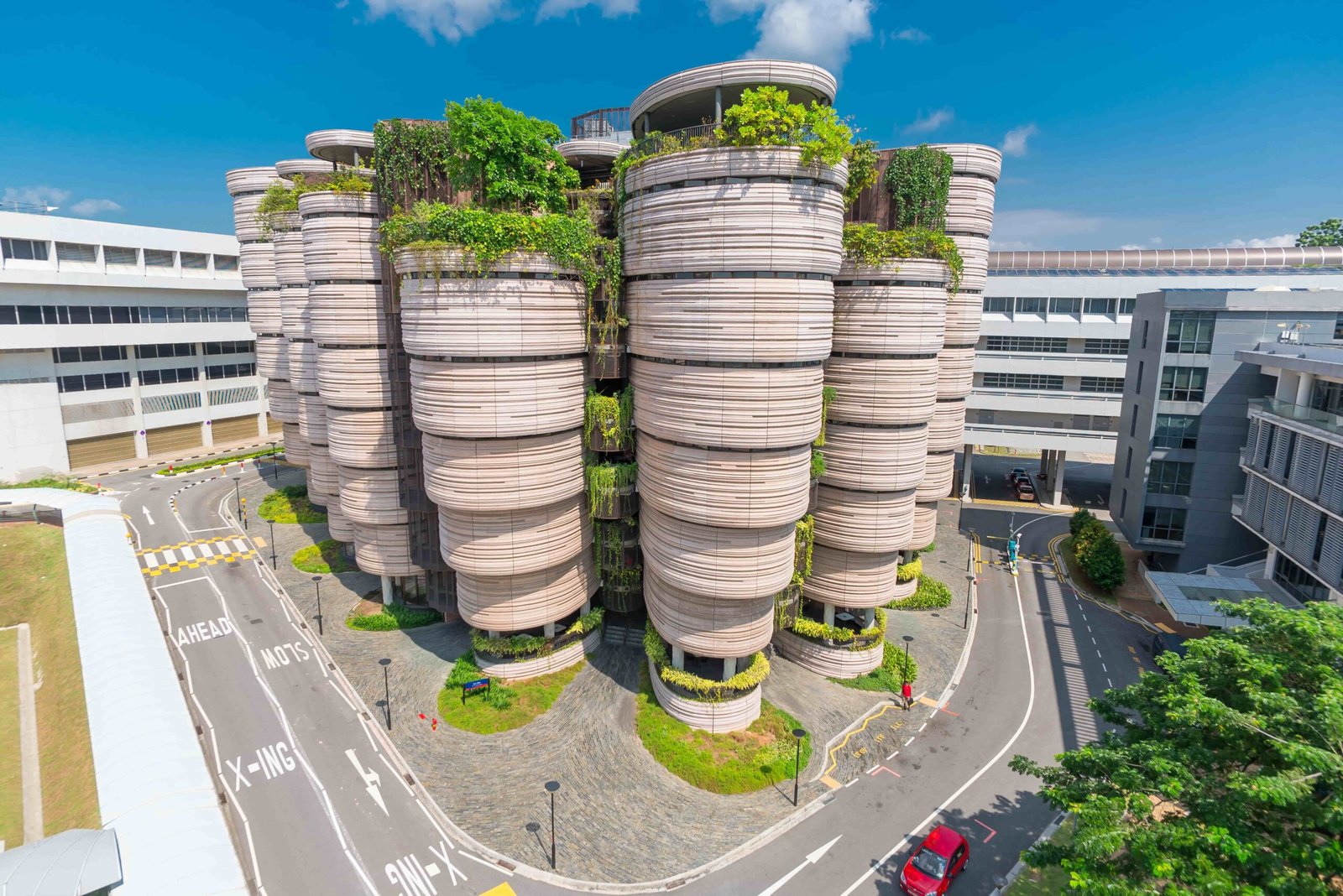
One of its best-known modern structures is The Hive, a distinctive building associated with collaborative learning and modern university design.
At the same time, historic structures such as the former Nanyang University Administration Building connect the campus with its past.
This architectural contrast represents NTU’s broader identity:
heritage combined with innovation.
48. The Importance of Heritage
A university that is focused heavily on future technology could easily neglect its past.
NTU has instead preserved important historical landmarks.
The preservation of the Nanyang University Arch, Memorial and former Administration Building ensures that students can physically encounter the university’s heritage.
This is educationally valuable because history becomes part of everyday campus life.
Students studying AI, engineering or business are walking through a campus with roots dating back to the 1950s.
49. Education for the Fourth Industrial Revolution
The term “Fourth Industrial Revolution” is commonly used to describe the convergence of AI, robotics, advanced manufacturing, biotechnology, data science and digital systems.
NTU’s evolution makes it well positioned for this environment.
Its historical engineering foundation provides technical strength.
Its modern computing programmes provide digital expertise.
Its science schools provide fundamental research.
Its business school provides management knowledge.
Its humanities and social sciences provide understanding of people and society.
Its medical school connects technology to healthcare.
This combination is one of NTU’s greatest strengths.
50. Student Opportunities in Research
Modern universities increasingly encourage students to participate in research before graduation.
NTU provides opportunities for undergraduate research as part of its broader research ecosystem. Its research platform specifically highlights undergraduate research opportunities alongside graduate programmes and research careers. (Corporate NTU)
Research experience can help students develop:
- Scientific thinking
- Data analysis
- Problem solving
- Laboratory skills
- Academic writing
- Innovation
- Collaboration
Such experiences can also prepare students for postgraduate education.
51. Graduate Education
NTU offers postgraduate education across many disciplines.
Graduate students can pursue master’s and doctoral programmes involving both specialised and interdisciplinary research.
The university has also developed joint and dual PhD programmes with international universities.
Postgraduate education is particularly important for a research university because doctoral students contribute directly to the creation of new knowledge.
52. NTU as a Research Ecosystem
A research university is more than its classrooms.
NTU’s research ecosystem consists of:
- Faculty members
- Research scientists
- Graduate students
- Laboratories
- Research institutes
- Industry partners
- Government organisations
- International universities
- Innovation programmes
This network enables ideas to move between different parts of society.
A laboratory discovery can become a prototype.
A prototype can become a startup.
A research finding can influence government policy.
A new technology can be adopted by industry.
This is how universities create impact beyond their campuses.
53. Industry Collaboration
Singapore has a highly developed technology and business ecosystem.
NTU therefore has opportunities to collaborate with companies in engineering, electronics, finance, biotechnology, healthcare, computing and other sectors.
Industry collaboration can provide students with internships and real-world experience.
For researchers, companies can provide practical problems that require academic expertise.
For companies, universities can provide access to advanced research and highly trained talent.
This creates a mutually beneficial relationship.
54. Entrepreneurship at NTU
Entrepreneurship is increasingly important for technological universities.
Students and researchers may identify a problem and develop a technology-based solution.
The university can help through:
- Mentorship
- Research support
- Business education
- Incubation
- Industry connections
- Intellectual property support
- Funding opportunities
Entrepreneurship transforms university knowledge into economic and social value.
55. Global Recognition
NTU has developed a strong international reputation.
The university is frequently included among leading global universities in major international rankings.
Its reputation has been particularly strong in engineering and technology-related subjects, reflecting its historical foundations.
However, the university’s modern identity extends well beyond engineering.
It is now recognised across business, science, computing, medicine, communication and other disciplines.
56. Challenges Facing NTU
Despite its achievements, NTU faces the same major challenges confronting leading universities worldwide.
These include:
Artificial intelligence
AI is changing education and research.
Universities must teach students how to use AI responsibly while ensuring that fundamental reasoning and creativity remain strong.
Climate change
Research institutions must contribute to solutions while reducing their own environmental impact.
Global competition
Universities compete internationally for talented students, researchers and funding.
Rapid technological change
Academic programmes must evolve quickly enough to remain relevant.
Ethics
Technologies such as AI, biotechnology and genetic engineering raise difficult ethical questions.
NTU’s interdisciplinary structure can help address these challenges.
57. The Future of NTU
The future direction of NTU is likely to be strongly shaped by technology, interdisciplinary research and global collaboration.
AI will increasingly influence education and research.
Robotics may transform engineering and manufacturing.
Biotechnology may change medicine.
Sustainable technologies may help address environmental challenges.
Data science will influence nearly every academic field.
The university’s challenge will be to combine these technologies with human creativity and social responsibility.
58. Why NTU’s History Matters
NTU’s history demonstrates how universities can evolve alongside society.
In 1955, the Nanyang University project represented a community-driven effort to create higher education.
In 1981, NTI represented Singapore’s need for engineers.
In 1991, NTU represented the transition toward a broader university.
After 2006, autonomous status supported further institutional development.
In the twenty-first century, NTU became increasingly focused on research, innovation, sustainability and global impact.
Each stage reflects the needs of its time.
59. The Transformation in Perspective
The transformation can be summarised in four major stages:
Stage One: Nanyang University
The focus was higher education, culture, scholarship and community development.
Stage Two: Nanyang Technological Institute
The focus shifted strongly toward engineering and Singapore’s industrial needs.
Stage Three: Nanyang Technological University
The institution became a comprehensive university.
Stage Four: Global Research University
NTU developed major international research strengths across technology, science, medicine, business and the humanities.
This transformation is one of the most remarkable aspects of the institution’s history.
60. NTU’s Distinctive Identity
What makes NTU different from many other universities?
Several characteristics stand out.
First, it has a relatively young modern institutional history but a much older heritage.
Second, engineering remains central to its identity.
Third, it has expanded rapidly into interdisciplinary research.
Fourth, it operates in a country known for technological innovation and economic development.
Fifth, it combines modern architecture and technology with protected historical heritage.
Sixth, it has built international partnerships and a diverse community.
These characteristics have helped create NTU’s distinctive position in global higher education.
61. The Meaning of “Nanyang”
The name “Nanyang” carries historical and cultural significance.
“Nanyang” traditionally refers to the southern seas and has long been used in Chinese contexts to describe Southeast Asia.
For NTU, the word connects the university with the history of Chinese communities in Southeast Asia and with the legacy of Nanyang University.
At the same time, modern NTU is an international institution.
Its identity therefore combines Southeast Asian heritage with global education and research.
62. NTU and Cultural Diversity
Singapore itself is multicultural, and NTU reflects this environment.
Students encounter classmates from different cultural, linguistic and national backgrounds.
This diversity can improve learning because complex problems benefit from different perspectives.
Cultural diversity is particularly important for global businesses and research collaborations.
A graduate who understands how people from different backgrounds communicate and work can be better prepared for international careers.
63. Role in Knowledge Creation
The ultimate purpose of a research university is not simply to distribute existing knowledge.
It is to create new knowledge.
NTU’s laboratories, research centres and postgraduate programmes contribute to this mission.
Researchers ask questions for which there are no established answers.
They test theories.
They design experiments.
They develop new materials.
They build computational models.
They study societies.
They investigate diseases.
They explore environmental processes.
Through this process, universities contribute to humanity’s understanding of the world.
64. NTU and Societal Impact
NTU’s mission emphasises societal impact.
Research becomes especially valuable when it addresses real-world challenges.
For example:
- Better water technologies can improve resource security.
- Medical research can improve healthcare.
- AI can improve services.
- Sustainable engineering can reduce environmental damage.
- Education research can improve schools.
- Social research can support public policy.
This impact-oriented approach connects academic excellence with practical outcomes.
65. A Model for Rapid University Development
NTU is also an example of how a university can develop quickly.
The institution moved from an engineering institute in 1981 to a major comprehensive research university within several decades.
That development was supported by Singapore’s strong commitment to education, science, technology and economic development.
The NTU experience demonstrates that university development depends not only on buildings and programmes but also on:
- Talent
- Research investment
- Government support
- Industry partnerships
- International collaboration
- Institutional leadership
- Academic culture
66. NTU in the Twenty-First Century
The twenty-first century has been particularly important for NTU.
The university has expanded its research portfolio, strengthened international partnerships, developed new schools and invested in advanced infrastructure.
It has also increased its involvement in medicine, environmental research, computing and interdisciplinary technologies.
This reflects a fundamental change from its original identity.
NTU is no longer simply a technological university in the narrow sense.
It is a broad research institution whose technological strengths connect with almost every field of knowledge.
67. Lessons from NTU’s Development
There are several lessons that can be drawn from NTU’s history.
First: Universities must adapt
NTU changed as Singapore changed.
Second: Technology needs human knowledge
Engineering and computing become more powerful when combined with business, social science and humanities.
Third: Research needs collaboration
Modern problems are too complex for isolated disciplines.
Fourth: Heritage matters
NTU has preserved important parts of its history while building a modern future.
Fifth: Universities can drive national development
NTI was created specifically to support Singapore’s engineering needs, showing the direct relationship between higher education and economic development.
68. Conclusion
The history of Nanyang Technological University is a remarkable story of transformation.
Its roots reach back to Nanyang University, founded in 1955, an institution created through strong community support and designed to provide higher education within a distinctive Southeast Asian Chinese cultural context. In 1981, the former Nanyang University campus became home to the Nanyang Technological Institute, which was established to train engineers for Singapore’s rapidly developing economy. (Corporate NTU)
In 1991, NTI was transformed into Nanyang Technological University. The new university incorporated the National Institute of Education and began a journey from a primarily engineering-focused institution toward a comprehensive university. (Corporate NTU)
Over the following decades, NTU expanded into business, computing, science, medicine, humanities, arts, social sciences and education. At the same time, it developed major research capabilities in areas such as artificial intelligence, biomedical science, environmental sustainability, energy, water, advanced engineering and digital technology.
The university’s transformation has been closely connected with Singapore’s own development. When Singapore needed engineers, NTI supplied them. When the country developed into a knowledge-based economy, NTU expanded its research and academic capabilities. As the world enters an era dominated by artificial intelligence, climate challenges, biotechnology and advanced digital technologies, NTU is again adapting to new demands.
Perhaps the most important feature of NTU is the way it combines heritage and innovation. The university’s modern laboratories and technology-driven research exist alongside the historic Yunnan Garden, the former Nanyang University Administration Building, the Nanyang University Memorial and the original university arch. Several of these historic structures were recognised as national monuments in 1998. (Corporate NTU)
Today, NTU stands as a major public university in Singapore with a broad academic and research mission. Its current focus on an AI-enabled future, interdisciplinary collaboration and societal impact demonstrates that the university is continuing the process of transformation that began decades ago. (Corporate NTU)
From a community-supported university founded in the 1950s, to an engineering institute established in 1981, to a comprehensive university inaugurated in 1991, and finally to a global research institution, NTU’s history reflects a central principle of higher education: the strongest universities do not simply preserve the past—they use their history as a foundation for building the future.
For students, researchers, businesses and international partners, NTU represents an environment where engineering can meet medicine, computing can meet humanities, science can meet sustainability, and technology can meet human creativity. Its continuing development will likely remain closely connected to the major challenges facing Singapore, Asia and the wider world.
Key Historical Timeline
| Year | Major Event |
|---|---|
| 1953 | The idea of establishing a Chinese university in Singapore gained strong community support. |
| 1955 | Nanyang University was founded. |
| 1956 | The first batch of Nanyang University students was admitted. |
| 1957 | Research activities began at Nanyang University. |
| 1980 | Nanyang University was legislated to merge with the University of Singapore. |
| 1981 | Nanyang Technological Institute was established on the former Nanyang University campus. |
| 1982 | NTI began teaching with 582 undergraduate students in three engineering disciplines. |
| 1986 | NTI admitted its first graduate students. |
| 1991 | Nanyang Technological University was officially established. |
| 1996 | Alumni records of the former Nanyang University were transferred to NTU. |
| 1998 | Key former Nanyang University heritage structures were gazetted as national monuments. |
| 2006 | NTU became an autonomous university. |
| 2011–2017 | Professor Bertil Andersson served as president. |
| 2018–2022 | Professor Subra Suresh served as president. |
| 2021–2022 | NTU celebrated its 30th anniversary. |
| 2023–present | Professor Ho Teck Hua has served as president. |
Final Perspective
Nanyang Technological University is a powerful example of how higher education can evolve alongside a nation and a changing world. Its historical foundations in Nanyang University provided cultural and educational heritage; NTI established its engineering identity; NTU transformed that foundation into a comprehensive university; and its modern research ecosystem has expanded the institution into fields that define the future.
Its story is therefore much larger than the history of a single university. It is also part of the history of Singapore’s transformation from a developing economy into a global centre for education, technology, research and innovation.
NTU’s future will depend on how successfully it continues to combine its traditional strengths in engineering and science with emerging capabilities in artificial intelligence, medicine, sustainability, computing, entrepreneurship and the humanities. If its history is an indication, the university’s greatest strength will remain its ability to evolve while preserving the heritage that gave it its identity.
Nanyang Technological University is, ultimately, a university built on three powerful ideas: heritage, technology and transformation.