Introduction
Cornell University is one of the most distinctive institutions of higher education in the United States. Founded in 1865 in Ithaca, New York, Cornell emerged from an unusually ambitious idea: higher education should combine practical knowledge with the liberal arts and should be available to people interested in many different fields of study. Its founders, Ezra Cornell and Andrew Dickson White, wanted to create a university that was different from the traditional colleges of nineteenth-century America. Rather than limiting education to a narrow classical curriculum or tying the institution to a particular religious denomination, they imagined a broad, nonsectarian university devoted to knowledge, research, practical education, and public service. (Cornell University)
Cornell officially opened its doors in 1868. At its inauguration, Ezra Cornell expressed the philosophy that became inseparable from the university’s identity: he wanted to establish an institution “where any person can find instruction in any study.” This vision was revolutionary in its historical context. Cornell was established as New York’s land-grant institution while simultaneously functioning as a private endowed university. Its combination of public mission and private governance became one of the most important features of its identity. (Cornell University)
More than a century and a half later, Cornell remains a major research university with a remarkably broad academic structure. Its colleges and schools span agriculture and life sciences, engineering, architecture, arts and sciences, hotel administration, veterinary medicine, human ecology, business, law, medicine, labor relations, and many other fields. The university’s history is therefore not simply a story of one campus. It is a story about changing ideas of higher education, scientific research, social mobility, technology, public service, and the relationship between universities and society.
1. America Before Cornell
To understand why Cornell was considered revolutionary, it is important to understand American higher education during the nineteenth century.
Before Cornell was founded, many American colleges were strongly connected with religious denominations. Their curricula were frequently based on classical education, with Greek, Latin, philosophy, theology, rhetoric, and other traditional subjects occupying central positions. Access to higher education was also much narrower than it is today.
The United States was changing rapidly during the nineteenth century. Industrialization, technological innovation, westward expansion, agriculture, transportation, communications, and scientific discovery were transforming American society. Yet the traditional college system did not always provide the practical education required by this changing economy.
The Morrill Act of 1862 created an important opportunity to change this situation. The federal government provided land to states so that they could establish institutions dedicated particularly to agriculture and the mechanical arts. Cornell eventually became New York State’s land-grant university under this framework. (eCommons)
The founders of Cornell did not want to treat practical education as separate from the liberal arts. Instead, they believed that agriculture, engineering, science, literature, history, and other subjects could exist together in one university.
This was one of Cornell’s defining ideas from the beginning.
2. Ezra Cornell: The Founder
Ezra Cornell was a remarkable nineteenth-century American entrepreneur, inventor, farmer, mechanic, politician, and philanthropist.
Cornell was not born into an elite academic family. His background was closely connected with practical work. He developed skills as a carpenter and mechanic and later became involved in the rapidly developing telegraph industry. His business success eventually provided him with a substantial fortune. Cornell’s experience convinced him that technology and practical knowledge could dramatically improve people’s lives. (Cornell University)
His involvement with telegraphy was particularly important. The expansion of the telegraph was transforming communication in the United States, and Cornell became connected with the industry that eventually contributed to the creation of Western Union.
His wealth gave him an opportunity to support a major educational project.
But money alone did not create Cornell University. Cornell needed a philosophical partner who understood education and politics. That partner was Andrew Dickson White.
3. Andrew Dickson White
Andrew Dickson White was an educator, historian, politician, diplomat, and scholar.
Born in 1832 in Homer, New York, White attended Geneva College and later Yale University. He developed a strong interest in history and education. He became a professor and later entered politics, serving in the New York State Senate. It was through New York politics that White encountered Ezra Cornell. (Cornell University President’s Office)
White had a vision of a modern university that would be devoted to knowledge and research. He believed that education should not be restricted by sectarian boundaries.
His intellectual interests were broad. He supported the study of history, political science, literature, science, engineering, and technology.
The meeting of Cornell’s practical entrepreneurial outlook with White’s educational and intellectual vision produced the basic concept of Cornell University.
4. The Founding of Cornell University
Cornell’s charter was signed into law by New York Governor Reuben E. Fenton on April 27, 1865. The legislation established Cornell as New York’s land-grant educational institution. Ezra Cornell pledged substantial financial support, including an initial endowment of $500,000, along with land and other resources. (Cornell University President’s Office)
The founding process was not effortless. Several communities wanted New York’s land-grant institution. Cornell and White had to work through political debates before Ithaca became the university’s home.
Cornell’s personal contribution was crucial. His land and financial resources helped make the university possible.
White, meanwhile, worked on the educational structure and recruitment of faculty.
The founders were attempting something new: a university that would combine practical education with traditional academic disciplines.
5. Why Ithaca Was Chosen
Cornell University was established in Ithaca, a community in New York’s Finger Lakes region.
The campus was developed on East Hill, overlooking the city and surrounded by the natural landscape that would later become one of Cornell’s most recognizable characteristics.
The physical geography of Ithaca became part of Cornell’s identity. The university’s campus included hills, gorges, waterfalls, forests, and extensive natural areas.
This setting helped create a university environment that was visually and intellectually distinctive.
The early campus was dramatically different from today’s large university. Buildings were limited, infrastructure was still developing, and much of the land was rural.
Cornell and White nevertheless believed that a great university could be built there.
6. Cornell Opens Its Doors in 1868
Cornell University officially opened in 1868.
Students arrived in Ithaca in October, and the first inauguration took place on October 7, 1868. The opening ceremonies represented the transformation of a legislative idea into a functioning university. (Cornell Chronicle)
The first campus buildings included Morrill Hall and White Hall. Before the university opened, considerable work had to be completed: buildings needed to be constructed, faculty recruited, books purchased, laboratories equipped, and other supplies obtained. (Cornell Chronicle)
The university began with an unusually large entering class for its time. Historical Cornell material records 412 students at the 1868 inauguration. (eCommons)
This was a remarkable beginning.
Cornell was not simply another small college. From the start, its founders intended it to become a comprehensive university.
7. “Any Person, Any Study”
Perhaps no phrase is more closely associated with Cornell’s founding philosophy than the statement:
“I would found an institution where any person can find instruction in any study.”
The statement captured several principles simultaneously.
First, Cornell was intended to be academically broad.
Second, the university was meant to be accessible beyond a narrow social elite.
Third, it rejected the idea that practical subjects were intellectually inferior.
Fourth, it supported academic exploration and elective study.
Cornell introduced an elective system that gave students greater freedom to choose courses. This approach differed substantially from the rigid curricular structures common at many nineteenth-century colleges. (history.cornell.edu)
The idea became one of Cornell’s most enduring characteristics.
8. A Nonsectarian University
Cornell’s nonsectarian character was controversial in the nineteenth century.
Many universities and colleges had strong relationships with churches and religious denominations. Cornell’s founders deliberately chose a different path.
The university was designed to welcome students and faculty from different religious backgrounds.
This approach reflected White and Cornell’s belief that education should be devoted to knowledge rather than religious conformity.
Cornell’s nonsectarian character was therefore not merely an administrative detail. It was part of the institution’s founding philosophy.
The university’s commitment to intellectual diversity helped distinguish it from many older American colleges.
9. The First President: Andrew Dickson White
Andrew Dickson White became Cornell’s first president.
His presidency lasted from 1866 to 1885, making him one of the most influential figures in the university’s early development. (Cornell University President’s Office)
White was responsible for recruiting faculty, developing academic programs, expanding the library, and acquiring important collections.
He believed that Cornell should be a serious research and teaching institution.
His European travels influenced his ideas about universities and technical education. He examined educational developments abroad and brought ideas back to Ithaca.
White also supported laboratories and workshops.
His leadership helped establish Cornell’s reputation as an innovative university rather than simply a conventional college.
10. The Growth of Engineering
Engineering became one of Cornell’s major academic strengths from an early period.
The university’s founders believed that practical knowledge and scientific education were essential to modern society.
Mechanical and civil engineering were taught from Cornell’s beginning. Later, the Sibley College of Mechanical Engineering and Mechanic Arts was established with financial support from Hiram Sibley. (Cornell Duffield Engineering)
Engineering education at Cornell emphasized practical experimentation.
Students were not expected merely to memorize theories. They were encouraged to understand how scientific principles could be applied to real problems.
This philosophy helped establish Cornell as an important center of engineering education.
11. The Rise of Electrical Engineering
Cornell also became an important institution in the development of electrical engineering.
Andrew Dickson White promoted what Cornell describes as the first university Department of Electrical Engineering in the United States. (Cornell University President’s Office)
This was especially significant because electricity was transforming American society.
Telegraphy, electric lighting, power systems, transportation, and communications were creating new industries.
Cornell’s willingness to develop academic programs around emerging technologies demonstrated the university’s commitment to modern education.
Instead of waiting for new disciplines to become traditional, Cornell often helped create the academic structures necessary to study them.
12. Agriculture and the Land-Grant Mission
Agriculture was central to Cornell’s original public mission.
As New York’s land-grant university, Cornell had a responsibility to provide education related to agriculture and the mechanical arts.
This mission eventually developed into a broad agricultural research and outreach system.
Cornell’s agricultural programs connected academic research with farms, communities, food systems, environmental science, and rural development.
This public-service orientation remains one of the university’s distinguishing characteristics.
Cornell therefore occupies an unusual position: it is both a private university and New York’s land-grant institution.
13. The Development of the Liberal Arts
Although Cornell emphasized practical education, the founders did not want to create a purely vocational school.
They believed students should study literature, history, languages, philosophy, social sciences, and other liberal disciplines.
This balance between practical and liberal education became central to Cornell’s identity.
Andrew Dickson White strongly supported history and political science. He also encouraged modern literature.
Cornell’s English department, for example, developed under a philosophy that emphasized interpretation and aesthetics rather than simple memorization. The university also pioneered small discussion-based classes, known at the time as seminars. (english.cornell.edu)
This combination of practical education and liberal learning helped define Cornell’s academic model.
14. Women at Cornell
Cornell’s founding philosophy was unusually broad for its time.
The university developed a reputation for opening educational opportunities to groups that were often excluded or limited by traditional institutions.
Over time, women became an important part of Cornell’s student body and academic community.
The university’s history reflects the broader transformation of American higher education from an institution largely designed for men toward a more inclusive system.
Cornell’s commitment to educational access was therefore connected to broader social changes.
15. Diversity and Inclusion
From its earliest years, Cornell’s founders promoted an educational philosophy that was less restrictive than many contemporary institutions.
Historical Cornell materials describe the university as explicitly nonsectarian and committed to equal educational opportunities. Its charter included language emphasizing eligibility regardless of religious denomination. (eCommons)
Cornell’s history nevertheless must also be understood in the context of nineteenth- and twentieth-century America, when discrimination and unequal access remained widespread.
Like other major universities, Cornell’s development was not perfectly linear.
Its ideals sometimes advanced faster than social reality.
Nevertheless, the principle that education should be broadly accessible became an important part of Cornell’s institutional identity.
16. The Cornell Campus
Cornell’s campus is one of the most visually recognizable university environments in America.
Located on Ithaca’s East Hill, the campus developed around quads, academic buildings, laboratories, libraries, residence halls, and natural landscapes.
The Arts Quad became one of the symbolic centers of the university.
Buildings such as Morrill Hall, McGraw Hall, White Hall, and later structures created a distinctive architectural character.
Cornell’s natural surroundings also became part of its educational environment.
The gorges around campus provided opportunities for geological, ecological, and environmental study.
Today, Cornell’s campus combines historic buildings with modern research facilities.
17. Libraries and Knowledge
Libraries were important to Andrew Dickson White from the beginning.
White personally purchased books and encouraged others to donate collections. He viewed a strong library as essential to a serious university. (Cornell University President’s Office)
Cornell’s library system eventually became one of the largest academic library networks in the world.
The library supports research across humanities, social sciences, sciences, engineering, agriculture, and many other disciplines.
Cornell’s rare books and manuscripts are also valuable resources for historians and scholars.
The university’s commitment to collecting and preserving knowledge reflects White’s original belief that a university should be a place where students and researchers can explore many fields.
18. Science and Research
Research became increasingly important as Cornell developed.
The nineteenth century was an era of major scientific change. Universities were beginning to transform from institutions primarily focused on teaching into research centers.
Cornell participated actively in this transformation.
Laboratories, scientific collections, observatories, agricultural research facilities, and engineering workshops became increasingly important.
The university’s research culture eventually expanded into areas such as physics, chemistry, biology, astronomy, computer science, materials science, medicine, environmental science, and many others.
19. Cornell and the Modern Research University
Cornell’s founders had created a model that anticipated many characteristics of the modern research university.
The university combined:
- Liberal arts education
- Scientific research
- Engineering
- Agriculture
- Practical training
- Professional education
- Public service
- International scholarship
- Interdisciplinary study
This broad structure allowed Cornell to evolve as new fields emerged.
When new technologies appeared, the university could create new programs.
When new social problems emerged, researchers from different disciplines could collaborate.
That flexibility became one of Cornell’s greatest strengths.
20. The Twentieth Century
The twentieth century brought enormous changes to Cornell.
The university expanded its faculty, student population, research programs, physical campus, and professional schools.
The two world wars, the Great Depression, industrialization, technological development, and the rise of modern science all influenced Cornell.
The university participated in national research efforts and developed stronger connections with government, industry, agriculture, and other institutions.
The postwar period brought particularly rapid growth.
American higher education expanded dramatically after World War II, and Cornell was part of this transformation.
21. Cornell and World War II
World War II changed American universities.
Universities became deeply involved in scientific and technical research related to national defense.
Cornell participated in the broader national mobilization of scientific expertise.
Engineering, physics, chemistry, medicine, agriculture, and other disciplines became increasingly connected to wartime needs.
The war demonstrated the strategic importance of universities as centers of scientific knowledge.
After the war, research funding and scientific infrastructure expanded dramatically.
Cornell benefited from these developments and strengthened its position as a major research university.
22. Postwar Expansion
After World War II, Cornell entered a period of substantial growth.
The university expanded academic programs and constructed new facilities.
Scientific research became increasingly sophisticated.
New areas of study emerged, including computer science, molecular biology, environmental science, and advanced engineering disciplines.
The university also expanded its international relationships.
The postwar period transformed Cornell from a major American university into an increasingly global institution.
23. Cornell’s Presidents and Leadership
Cornell’s history has been shaped by successive presidents.
After Andrew Dickson White, presidents guided the university through different eras of expansion, social change, scientific development, and institutional challenges.
The twentieth century included presidents such as Edmund Ezra Day, Edmund Ezra Day, Deane Waldo Malott, James A. Perkins, Dale Corson, and Frank H. T. Rhodes, among others. Cornell’s official presidential history records these administrations and their different contributions. (Cornell University President’s Office)
Each administration faced different circumstances.
Some focused heavily on construction and academic expansion.
Others emphasized research, educational innovation, financial stability, internationalization, or social responsibility.
The changing priorities of Cornell’s presidents reflect the changing role of universities in American society.
24. Student Activism
Like many American universities, Cornell experienced significant student activism during the 1960s and 1970s.
The Vietnam War, civil rights movement, debates about race, freedom of speech, and changing social values affected campus life.
Student activism challenged university authorities and forced broader discussions about the role of higher education.
Cornell’s history during this period illustrates a larger national transformation.
Universities were no longer isolated academic communities. Students increasingly demanded that institutions address political and social questions.
25. The Vietnam War Era
The Vietnam War generated particularly intense debates on American campuses.
Cornell students participated in demonstrations and political activities.
The university’s leadership had to balance freedom of expression, academic responsibilities, campus safety, and competing political perspectives.
These debates helped shape modern ideas about student rights and university governance.
They also reinforced Cornell’s historical emphasis on intellectual debate.
26. The Rise of Computer Science
Cornell became increasingly involved in computing and computer science during the second half of the twentieth century.
As computers changed from specialized machines into essential tools for research and business, universities created dedicated academic programs.
Cornell’s computer science community became an important part of its research ecosystem.
Today, computing intersects with almost every field at Cornell.
Computer science contributes to artificial intelligence, robotics, data science, medicine, economics, biology, engineering, agriculture, and the humanities.
This interdisciplinary approach is consistent with Cornell’s original philosophy of allowing students and scholars to explore many fields.
27. Architecture and Design
Cornell developed a strong reputation in architecture and design.
The College of Architecture, Art, and Planning became internationally recognized.
Its programs reflect Cornell’s broader philosophy of combining theoretical education with practical application.
Architecture students study design, history, technology, environmental systems, urban planning, and social questions.
The field demonstrates how Cornell’s academic structure encourages connections between creative and technical disciplines.
28. Cornell and Veterinary Medicine
Veterinary medicine became another major component of Cornell’s identity.
The Cornell University College of Veterinary Medicine developed into an important center for veterinary education, research, animal health, and public service.
Its work connects animal medicine with agriculture, public health, biology, environmental science, and biomedical research.
This is another example of how Cornell’s land-grant mission developed into sophisticated modern research.
29. Cornell Agriculture
Agriculture remains deeply connected with Cornell.
The university’s agricultural programs extend far beyond traditional farming.
Researchers work on crop science, plant biology, animal science, food systems, environmental sustainability, agricultural economics, soil science, climate-related challenges, and rural communities.
Cornell’s agricultural research contributes to New York State and to global conversations about food security.
This fulfills one of the central purposes of the land-grant university system.
30. Cornell and Public Service
Public service has always been part of Cornell’s identity.
The university’s land-grant mission requires engagement beyond the traditional campus.
Cornell’s outreach programs connect research with farmers, businesses, communities, schools, government agencies, and other organizations.
This creates a two-way relationship.
Research helps communities solve problems, while real-world problems provide new questions for researchers.
This relationship between university and society is one of Cornell’s most important contributions.
31. Cornell Law School
Cornell Law School became an important part of the university’s professional education.
Legal education at Cornell combines traditional legal study with interdisciplinary approaches.
Students can explore connections between law and economics, technology, politics, business, international relations, and public policy.
The law school contributes to Cornell’s broader mission of preparing graduates for professional leadership.
32. Cornell’s Hotel School
Cornell’s hospitality program is internationally famous.
The School of Hotel Administration created a specialized academic model for studying hospitality management.
The program combines business education with hospitality operations.
Students learn about finance, marketing, leadership, real estate, operations, tourism, and service management.
Cornell’s hospitality graduates have gone on to leadership roles in hotels, restaurants, tourism companies, real estate, consulting, and other industries.
The school demonstrates Cornell’s willingness to create academic programs around practical professional fields.
33. Human Ecology
The College of Human Ecology focuses on the relationship between people and their social, economic, biological, and physical environments.
Its interdisciplinary approach brings together subjects that might traditionally have been separated.
Students and researchers can study human development, design, nutrition, policy, psychology, economics, and related fields.
This interdisciplinary structure reflects the same broad educational philosophy that existed at Cornell’s founding.
34. Business Education
Cornell’s business education developed into a significant part of the university.
The Samuel Curtis Johnson Graduate School of Management offers management education and research.
Business at Cornell connects with technology, entrepreneurship, economics, finance, hospitality, agriculture, and other areas.
This multidisciplinary environment provides opportunities for students to study business problems from multiple perspectives.
35. Medicine and Weill Cornell Medicine
Cornell’s medical education has a distinctive structure because of its connection with Weill Cornell Medicine in New York City.
This relationship gives Cornell a presence beyond Ithaca.
Medical education and research connect the university with hospitals, physicians, biomedical researchers, and public-health institutions.
The New York City connection significantly expands Cornell’s role in medicine and biomedical science.
36. Cornell in New York City
Although Ithaca is Cornell’s traditional home, the university has developed an important presence in New York City.
Weill Cornell Medicine is located in Manhattan.
Cornell Tech, located on Roosevelt Island, represents another major expansion of the university’s mission.
Cornell Tech focuses strongly on technology, entrepreneurship, innovation, and the connection between academic research and industry.
This creates an interesting contrast between Cornell’s historic rural campus and its modern technology-focused urban campus.
37. Cornell Tech
Cornell Tech represents Cornell’s commitment to technological innovation.
Located in New York City, the campus focuses on computer science, engineering, business, entrepreneurship, and emerging technologies.
Its creation reflected the importance of technology in New York’s economic future.
Cornell Tech also demonstrates how the university continues to adapt to changing educational needs.
The original Cornell philosophy was based on combining knowledge with practical application.
Cornell Tech can be viewed as a modern expression of that same idea.
38. Cornell in Washington
Cornell also has a presence in Washington, D.C.
The Cornell in Washington program provides students with opportunities to study government, public policy, politics, and national institutions.
The program began in 1980 and has provided thousands of Cornell students with immersive experiences in the nation’s capital. (history.cornell.edu)
Students can connect classroom learning with government institutions, policy organizations, journalism, and public service.
This reflects Cornell’s continuing commitment to practical education.
39. International Connections
Cornell has developed extensive international relationships.
Students and researchers participate in study abroad programs, international research, global development projects, academic partnerships, and international conferences.
Agriculture, engineering, medicine, business, environmental science, and other fields increasingly require global cooperation.
Cornell’s international presence therefore reflects the changing nature of research.
Many of today’s major challenges—climate change, food security, disease, technology, economic inequality, and energy—cross national borders.
Universities must therefore operate globally.
40. Research at Cornell
Research is one of Cornell’s defining characteristics.
The university supports research across a remarkable range of fields.
Researchers investigate fundamental scientific questions as well as practical problems.
Examples include:
- Artificial intelligence
- Robotics
- Computer science
- Physics
- Chemistry
- Biology
- Agriculture
- Food science
- Climate science
- Environmental studies
- Engineering
- Medicine
- Economics
- Political science
- History
- Literature
- Architecture
- Materials science
The breadth of research allows Cornell scholars to collaborate across disciplines.
41. Interdisciplinary Education
Cornell’s structure encourages students to cross academic boundaries.
A student interested in technology, for example, may combine computer science with business.
An agriculture student may study environmental science and economics.
An architecture student may explore engineering and urban policy.
A political science student may study history and data analysis.
This interdisciplinary approach is increasingly important because real-world problems rarely fit neatly into one academic department.
Cornell’s founding philosophy anticipated this flexibility.
42. The Meaning of the Ivy League
Cornell is one of the eight institutions commonly known as the Ivy League.
The Ivy League developed as an athletic conference but became strongly associated with academic prestige and historic universities in the northeastern United States.
Cornell joined this group while maintaining a somewhat different institutional identity.
Unlike several other Ivy League universities, Cornell has a major land-grant mission and a significant public-service orientation.
Its combination of private and public characteristics makes it distinctive within the Ivy League.
43. Cornell’s Student Experience
Student life at Cornell includes academics, research, athletics, organizations, cultural activities, community service, entrepreneurship, and social events.
The university’s large academic structure provides students with numerous opportunities to explore different subjects.
Students can participate in clubs, publications, artistic organizations, sports, research projects, volunteer programs, and professional societies.
The campus environment also encourages interaction among students from different colleges.
This creates an unusually diverse intellectual community.
44. Traditions
Cornell has developed many traditions throughout its history.
One of the most famous is the Cornell Chimes.
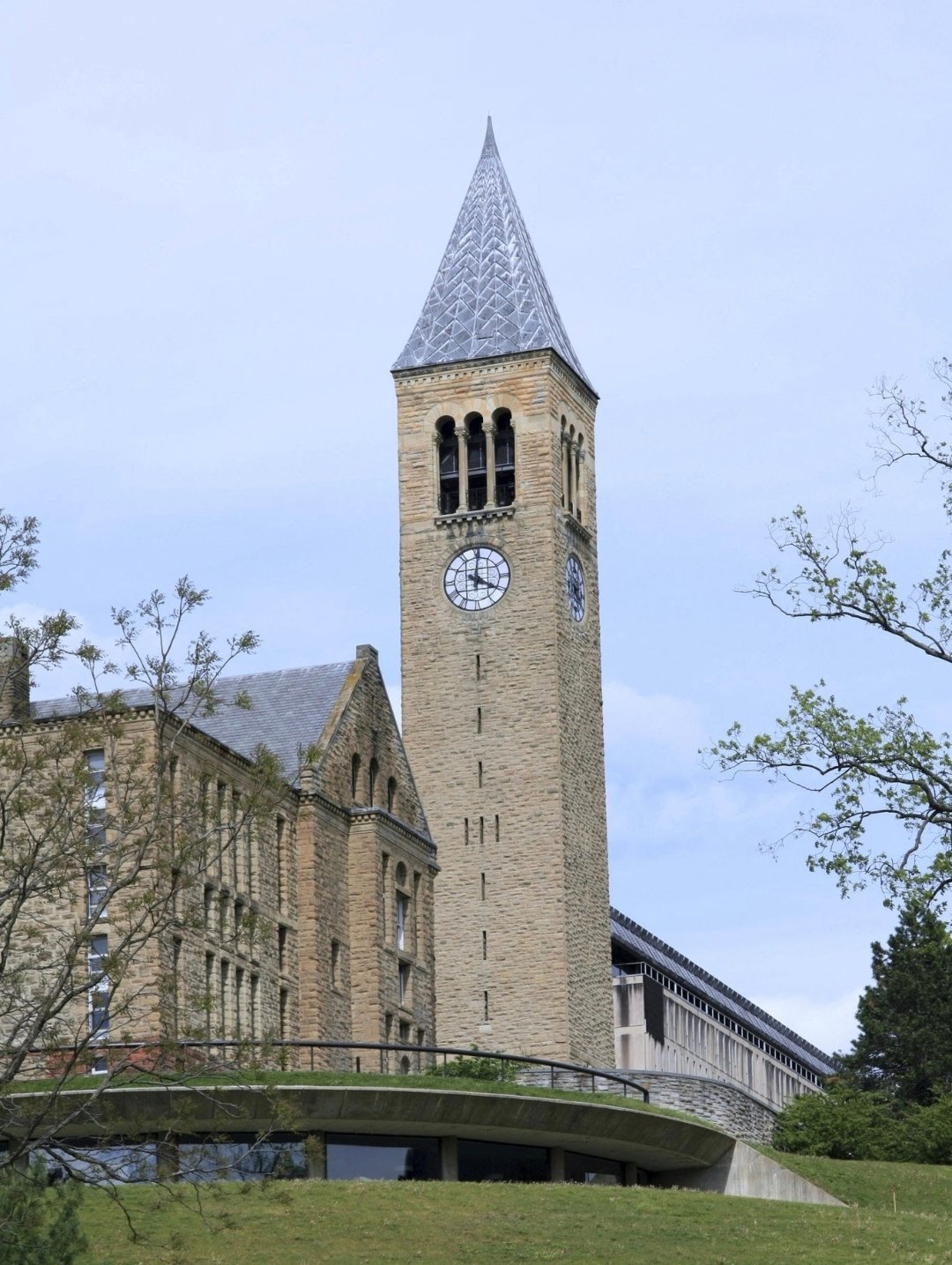
McGraw Tower and its chimes have become symbols of the university.
Students and visitors can hear performances from the tower, creating a distinctive soundscape across campus.
Other traditions include Homecoming, Reunion, commencement ceremonies, athletic events, and various student celebrations.
These traditions connect current students with generations of Cornell alumni.
45. Cornell Colors and Symbols
Cornell’s colors are carnelian and white.
The colors became associated with the university during its earliest days.
Cornell’s seal and other symbols also reflect its history.
The university’s official symbols have developed over time, but the original charter and seal played important roles in the institution’s early ceremonies. (Cornell University President’s Office)
Symbols help create continuity.
Although Cornell has changed enormously since 1868, its visual identity connects modern students with the university’s founders.
46. Cornell Alumni
Cornell has produced graduates who have contributed to science, government, business, literature, engineering, medicine, law, entertainment, journalism, and many other fields.
The university’s broad curriculum allows graduates to enter diverse professions.
Cornell alumni form a global network.
Many graduates continue to participate in university activities through mentoring, philanthropy, research, lectures, and alumni organizations.
This relationship between university and alumni contributes to Cornell’s long-term institutional strength.
47. Cornell’s Role in American Education
Cornell influenced American higher education in several ways.
Its elective curriculum challenged traditional models.
Its combination of practical and liberal education anticipated modern comprehensive universities.
Its land-grant relationship demonstrated how private institutions could carry public educational responsibilities.
Its emphasis on research contributed to the development of the American research university.
Its interdisciplinary structure anticipated modern approaches to complex problems.
For these reasons, historians have sometimes described Cornell as one of the first truly modern American universities. Cornell’s own historical materials note that historian Frederick Rudolph called it “the first American university.” (Cornell Chronicle)
48. Challenges in Cornell’s History
Cornell’s history has not been without difficulties.
Like other universities, Cornell has faced financial pressures, political controversy, debates about academic freedom, student protests, changing demographics, and questions about the cost and purpose of higher education.
Universities must constantly balance competing priorities.
They must support research while teaching students.
They must preserve historical traditions while adopting new technologies.
They must remain academically independent while interacting with government, industry, donors, and society.
Cornell’s long history demonstrates how difficult these balances can be.
49. Academic Freedom
Academic freedom is central to a research university.
Cornell’s founding philosophy emphasized the pursuit of knowledge.
That principle requires scholars to investigate difficult questions and sometimes challenge established ideas.
Throughout its history, Cornell has experienced debates over controversial subjects.
Such debates are not necessarily weaknesses.
In a university, disagreement can encourage deeper investigation.
The challenge is to maintain an environment in which evidence, scholarship, respectful debate, and intellectual freedom can coexist.
50. Cornell in the Twenty-First Century
The twenty-first century has brought new challenges and opportunities.
Artificial intelligence, biotechnology, climate change, digital technology, cybersecurity, public health, global food systems, and economic transformation have changed the research landscape.
Cornell has responded by expanding research and interdisciplinary collaboration.
Technology has also changed education itself.
Students can now access enormous amounts of information online.
The role of the university increasingly involves helping students evaluate information, conduct research, solve problems, collaborate, and create new knowledge.
Cornell’s founding philosophy remains relevant in this environment.
51. Artificial Intelligence and Technology
Artificial intelligence is transforming universities and society.
Cornell researchers work across computer science, engineering, information science, biology, business, law, and other areas that intersect with AI.
The university’s interdisciplinary structure provides an environment for examining not only how AI works but also how it affects society.
Questions surrounding AI include:
- How can intelligent systems be made reliable?
- How should AI be regulated?
- How will AI change employment?
- How can AI support scientific discovery?
- How can AI be used responsibly?
- What are the ethical implications of automated decision-making?
These questions demonstrate why universities need both technical and humanistic education.
52. Climate and Environmental Research
Climate change is another major research area.
Cornell’s location, agricultural mission, and scientific expertise make environmental research especially significant.
Researchers investigate agriculture, forests, ecosystems, water, energy, climate modeling, sustainable food systems, and environmental policy.
The university’s land-grant tradition gives this research a practical dimension.
The goal is not simply to understand environmental systems but also to develop solutions that can benefit communities.
53. Food and Global Agriculture
The world faces complex food challenges.
Population growth, climate change, soil degradation, water scarcity, changing diets, economic inequality, and agricultural technology all affect food security.
Cornell’s agricultural research addresses many of these issues.
Its programs combine biology, economics, engineering, nutrition, policy, and environmental science.
This is a modern expression of the university’s original commitment to agriculture.
54. Entrepreneurship
Cornell also supports entrepreneurship.
Students and researchers can transform ideas into companies, products, services, and social ventures.
Technology and business programs provide opportunities to study innovation.
Cornell Tech has strengthened this aspect of the university’s identity.
Entrepreneurship also connects naturally with Cornell’s historical relationship with practical education.
Ezra Cornell himself was an inventor and entrepreneur.
In that sense, innovation has been part of the university’s story since its founding.
55. Cornell’s Educational Philosophy Today
The exact meaning of “any person, any study” has evolved.
In the nineteenth century, it meant breaking away from rigid curricula and narrow educational traditions.
Today, it can be interpreted as an invitation to explore.
Students can combine disciplines that previous generations might have considered unrelated.
A modern Cornell education can involve engineering and music, computer science and public policy, agriculture and biotechnology, business and environmental science, or history and digital technology.
The phrase remains powerful because it expresses intellectual curiosity.
56. The Importance of the Land-Grant Mission
Cornell’s land-grant status continues to influence its identity.
Land-grant universities were created to make higher education useful to broader society.
The mission includes teaching, research, and outreach.
Cornell’s agricultural programs, extension activities, public engagement, and research partnerships continue this tradition.
This makes Cornell different from universities whose missions are primarily centered on residential education and research.
Cornell’s relationship with New York State remains an important part of its institutional character.
57. Cornell as a Private University
Although it has a land-grant mission, Cornell is a private university.
This combination gives Cornell an unusual structure.
It has private governance and an extensive endowment, while also carrying public responsibilities through its land-grant colleges and programs.
This hybrid character has influenced Cornell’s development.
It allows the university to participate in the Ivy League while maintaining a strong public-service identity.
58. Why Cornell Is Unique
Several characteristics make Cornell distinctive.
First, its founding vision was unusually broad.
Second, it combined liberal education with practical education.
Third, it became New York’s land-grant university.
Fourth, it developed strong programs across agriculture, engineering, science, business, law, medicine, architecture, hospitality, and the humanities.
Fifth, it has major academic locations in Ithaca and New York City.
Sixth, its natural campus environment is part of its identity.
Finally, its founding motto continues to influence how the university understands education.
59. Cornell’s Historical Legacy
The legacy of Cornell University extends beyond its buildings and famous graduates.
Its most important contribution may be the idea that different forms of knowledge should coexist.
Agriculture and philosophy can belong in the same university.
Engineering and literature can belong in the same intellectual community.
Scientific research and public service can reinforce one another.
Professional education and liberal learning do not have to be enemies.
This was the radical idea behind Cornell.
60. Cornell and the Future
The future of Cornell will depend on how effectively it responds to changing conditions.
Universities now face questions about affordability, technology, research funding, climate change, academic freedom, workforce transformation, and the social responsibilities of higher education.
Cornell’s history suggests that adaptation is part of its identity.
The university was founded as an experiment.
Its founders did not simply reproduce an existing college model.
They created something new.
That willingness to experiment may remain one of Cornell’s greatest strengths.
61. Frequently Asked Questions About Cornell University
When was Cornell University founded?
Cornell University was founded in 1865 by Ezra Cornell and Andrew Dickson White. It officially opened its doors in 1868. (Cornell University)
Who founded Cornell University?
The principal founders were Ezra Cornell and Andrew Dickson White.
Where is Cornell University located?
Cornell’s historic main campus is located in Ithaca, New York.
What is Cornell famous for?
Cornell is known for its broad academic programs, research, engineering, agriculture, architecture, hospitality management, veterinary medicine, business, law, medicine, and its distinctive land-grant mission.
Is Cornell an Ivy League university?
Yes. Cornell is one of the eight Ivy League universities.
What is Cornell’s motto?
Cornell is strongly associated with the phrase: “I would found an institution where any person can find instruction in any study.”
Why is Cornell a land-grant university?
Cornell was established as New York State’s land-grant institution under the educational framework created by the Morrill Act.
When did Cornell open?
Cornell opened in 1868, with its first inauguration taking place on October 7 of that year. (Cornell University President’s Office)
Who was Cornell’s first president?
Andrew Dickson White was Cornell’s first president.
Why is Cornell different from other universities?
Its combination of private university status, land-grant responsibilities, broad academic programs, practical education, research, and public service gives Cornell a distinctive identity.
Conclusion
Cornell University’s history is the story of an ambitious educational experiment that became one of America’s leading research universities.
Founded in 1865 by Ezra Cornell and Andrew Dickson White, Cornell was created during a period when American society was being transformed by technology, industrialization, scientific discovery, and political change. Its founders believed that higher education had to change as well.
They rejected the idea that universities should focus only on narrow classical education. Instead, they wanted students to study agriculture, engineering, science, literature, history, and other subjects within the same institution.
They also rejected sectarian restrictions and promoted a nonsectarian educational environment.
When Cornell opened in 1868, it introduced a bold philosophy. Students were given greater freedom to explore subjects, and the university combined practical training with liberal education. The famous statement associated with Ezra Cornell—his desire to establish an institution where any person could find instruction in any study—captured this philosophy.
Over the following decades, Cornell expanded into engineering, agriculture, science, literature, political science, architecture, veterinary medicine, business, hospitality, law, medicine, computer science, and many other fields.
Its research mission became increasingly important.
Its land-grant responsibilities connected it with communities throughout New York State.
Its presence expanded beyond Ithaca into New York City and Washington, D.C.
Its students and alumni became part of a global network.
Today, Cornell stands as a university where different forms of knowledge meet. Its history explains why engineering and agriculture can exist alongside literature and philosophy, why scientific research can coexist with public service, and why professional education can be integrated with broad intellectual exploration.
The university has changed enormously since the first students arrived in 1868. Its buildings are larger, its research facilities are more advanced, its academic disciplines are more numerous, and its global connections are far stronger.
Yet the fundamental idea remains recognizable.
Cornell was founded as an experiment in what a modern university could become.
Its continuing challenge is to preserve the intellectual openness of its founders while responding to the problems of a rapidly changing world.
That is why Cornell University’s history remains important—not simply because of its age, prestige, or famous alumni, but because the questions raised by its founders are still relevant today:
What should a university teach?
Who should have access to education?
How should practical knowledge relate to liberal learning?
What responsibilities does a university have toward society?
And how can knowledge be used for the greatest possible good?
More than 150 years after its founding, Cornell continues to explore those questions.
Its history is therefore not finished. It is an ongoing story of education, research, innovation, public service, and the continuing pursuit of knowledge.