Introduction
The University of Pennsylvania, commonly known as Penn or UPenn, is one of the most historic and influential universities in the United States. Located in Philadelphia, Pennsylvania, the university has played an important role in American education, business, medicine, law, science, technology, politics, and culture. Founded by Benjamin Franklin in 1740, Penn is widely recognized as one of the oldest institutions of higher education in the United States and one of the historic institutions associated with the American colonial era.
What makes the University of Pennsylvania especially distinctive is its emphasis on combining different areas of knowledge. Benjamin Franklin envisioned an institution that would prepare students not only through traditional classical education but also through practical learning. This philosophy helped shape Penn’s identity as a university where academic disciplines could interact and where education could be connected with real-world problems.
Over more than two and a half centuries, Penn has transformed from a small educational institution in colonial Philadelphia into a major global research university. Its schools include the Wharton School, the Perelman School of Medicine, Penn Carey Law, the School of Engineering and Applied Science, the School of Nursing, the School of Arts and Sciences, the Weitzman School of Design, the School of Social Policy & Practice, and the Annenberg School for Communication.
The university has also developed a powerful global reputation through its alumni, faculty, researchers, entrepreneurs, physicians, lawyers, scientists, economists, artists, public servants, and business leaders. Its location in Philadelphia provides students with access to one of America’s most historically significant cities while also placing Penn within a major academic and professional environment.
This article explores the complete history and development of the University of Pennsylvania, its founder Benjamin Franklin, academic structure, famous schools, research contributions, campus, student life, traditions, notable alumni, global influence, and continuing role in higher education.
1. The Origins of the University of Pennsylvania
The story of the University of Pennsylvania begins in eighteenth-century Philadelphia. At that time, Philadelphia was one of the most important cities in Britain’s North American colonies. It was a center of commerce, publishing, politics, religious diversity, and intellectual activity.
Benjamin Franklin was one of the city’s most prominent citizens. He was a printer, publisher, inventor, scientist, writer, civic leader, and political thinker. Franklin believed strongly in education and public institutions. Rather than limiting education to classical subjects, he supported practical knowledge that could help students contribute to society.
In 1740, Franklin and other supporters became involved in an educational project connected with the establishment of a public building that would eventually become associated with the Academy and Charitable School of Philadelphia. Franklin’s educational ideas were expressed clearly in his famous proposal for an academy.
The institution developed over time and eventually became the College of Philadelphia. This organization is considered an important predecessor of the modern University of Pennsylvania.
Franklin’s educational vision was revolutionary for its era. Many traditional European institutions placed strong emphasis on classical languages, theology, and philosophy. Franklin believed students should also study subjects such as mathematics, science, geography, history, commerce, and practical arts.
His philosophy helped establish an educational culture that valued useful knowledge and interdisciplinary learning.
2. Benjamin Franklin’s Educational Vision
Benjamin Franklin is central to Penn’s history. Although he did not serve as a conventional university president in the modern sense, his influence on the institution was profound.
Franklin believed education should prepare individuals for active participation in society. He wanted students to become useful citizens, professionals, and community leaders.
His ideas reflected the intellectual atmosphere of the Enlightenment. The Enlightenment encouraged reason, scientific investigation, debate, individual achievement, and the expansion of knowledge.
Franklin’s approach to education was therefore different from the traditional model of simply preserving established knowledge. He supported experimentation and practical learning.
This philosophy can still be seen in Penn’s modern identity. The university has developed a reputation for connecting disciplines. Business students can work with engineers, medical researchers can collaborate with designers, and social scientists can cooperate with public-health experts.
The university’s famous emphasis on interdisciplinary education has deep historical roots in Franklin’s original vision.
3. The College of Philadelphia
The College of Philadelphia received its charter in 1755. It became one of the earliest institutions in colonial America to receive a formal college charter.
The College of Philadelphia grew during a period of enormous political and social change. The American colonies were becoming increasingly independent in their intellectual and political thinking.
Students and faculty were educated during the years leading to the American Revolution. Philadelphia itself became the center of major political events.
The College of Philadelphia developed a reputation for intellectual seriousness and practical education. Its curriculum reflected the growing importance of scientific and mathematical knowledge.
The institution also became connected with prominent figures of colonial Philadelphia.
4. Philadelphia and the American Revolution
Philadelphia played a central role in the founding of the United States. The city hosted the Continental Congress, the Constitutional Convention, and other important political gatherings.
The educational institution associated with Penn existed during this extraordinary period.
Students and scholars were therefore surrounded by debates about independence, government, citizenship, law, economics, and science.
The American Revolution created significant challenges for educational institutions. Political instability affected many organizations, and Philadelphia experienced periods of military occupation and disruption.
Despite these difficulties, the institution survived and continued developing.
Penn’s history is consequently closely connected with the early history of the United States.
5. The Development of the University
Over the following decades, the institution underwent significant changes.
In the late eighteenth and nineteenth centuries, American higher education was expanding. Universities were increasingly expected to provide specialized professional education.
Penn responded by creating and strengthening programs in medicine, law, engineering, business, and other fields.
This expansion eventually helped establish the modern university model at Penn.
Rather than remaining simply a traditional liberal arts college, Penn developed into a comprehensive university with multiple professional schools.
This transformation became one of the defining characteristics of the institution.
6. The University of Pennsylvania Name
The modern name “University of Pennsylvania” reflects the institution’s development from the College of Philadelphia and its later relationship with the University of the State of Pennsylvania.
The university became increasingly recognized as a major educational institution in Philadelphia.
Today, Penn is often referred to simply as “Penn.” The nickname “UPenn” is also commonly used, particularly to distinguish the institution from Pennsylvania State University, which is generally called Penn State.
The official identity remains the University of Pennsylvania.
7. The Medical School
One of Penn’s most important historical achievements was the development of medical education.
The University of Pennsylvania established the first medical school in North America in 1765. This was a major milestone in American medical history.
At a time when formal medical education in the colonies was limited, Penn created an organized academic environment for the study of medicine.
The medical school became an important center for medical teaching and research.
Over time, it developed into what is now the Perelman School of Medicine at the University of Pennsylvania.
The medical school’s history is deeply connected with the evolution of modern American medicine.
8. The Perelman School of Medicine
The Perelman School of Medicine is one of Penn’s most internationally recognized schools.
Its activities include medical education, biomedical research, clinical care, and scientific discovery.
Researchers at Penn have contributed to important areas including genetics, immunology, cancer research, neuroscience, cardiovascular medicine, infectious disease, and personalized medicine.
The school has also played an important role in translating scientific discoveries into medical treatments.
Its connection with the University of Pennsylvania Health System provides an environment where research, education, and patient care can interact.
9. The Development of Law Education
Penn also developed an important tradition in legal education.
The University of Pennsylvania Carey Law School has become a prominent center for legal education and research.
The school prepares students for careers in law, government, business, public policy, academia, and nonprofit organizations.
Penn’s location in Philadelphia is particularly valuable for students interested in American legal history because the city played a major role in the development of the United States Constitution and legal institutions.
10. The Wharton School
One of Penn’s most famous institutions is the Wharton School.
Founded in 1881 through the generosity of Joseph Wharton, Wharton became the world’s first collegiate business school.
Its creation represented a significant shift in higher education.
Business and commerce were becoming increasingly important in the industrial economy, yet many universities did not provide specialized academic training for business careers.
Joseph Wharton believed business could be studied systematically and that business leaders should receive formal education.
Wharton’s founding therefore represented a major innovation in higher education.
11. Wharton’s Global Influence
Today, Wharton is one of the world’s best-known business schools.
It offers education and research in areas including finance, management, marketing, entrepreneurship, accounting, economics, operations, and business analytics.
Wharton alumni have become executives, entrepreneurs, investors, economists, consultants, public officials, and leaders of major organizations.
The school has also influenced how business education is taught internationally.
Its research programs contribute to debates about markets, corporate governance, leadership, finance, entrepreneurship, and economic policy.
12. Engineering and Applied Science
The School of Engineering and Applied Science is another important part of Penn.
Engineering education became increasingly important as industrialization transformed the American economy.
Penn developed programs that connected engineering knowledge with practical applications.
Today, the school covers areas such as computer science, electrical engineering, mechanical engineering, bioengineering, materials science, systems engineering, and data-related disciplines.
Modern engineering at Penn also benefits from collaboration with medicine, business, design, and other schools.
13. Penn Engineering and Innovation
Penn Engineering has become increasingly involved in technological innovation.
Researchers work on artificial intelligence, robotics, biotechnology, medical devices, cybersecurity, materials, energy, and computational systems.
The university’s interdisciplinary environment makes it possible for engineers to collaborate with physicians, entrepreneurs, designers, and social scientists.
This approach reflects Franklin’s original belief that knowledge should be useful and connected to real-world problems.
14. The School of Arts and Sciences
The School of Arts and Sciences is the intellectual foundation of many undergraduate and graduate programs at Penn.
It includes disciplines such as history, philosophy, economics, psychology, sociology, political science, biology, chemistry, physics, mathematics, languages, literature, and anthropology.
The school emphasizes both specialized study and broad intellectual development.
Students can explore subjects outside their primary major, allowing them to create interdisciplinary academic paths.
15. The School of Nursing
The University of Pennsylvania School of Nursing is another internationally recognized part of the university.
Nursing education combines scientific knowledge with clinical practice and patient-centered care.
The school conducts research on healthcare delivery, nursing practice, public health, health equity, aging, chronic illness, and other areas.
Its work demonstrates the university’s broader commitment to healthcare education and research.
16. The Weitzman School of Design
Penn also has a distinguished tradition in architecture and design.
The Weitzman School of Design has programs in architecture, city and regional planning, landscape architecture, historic preservation, and fine arts.
Its work reflects Philadelphia’s rich architectural and urban history.
Students examine how buildings, landscapes, transportation systems, neighborhoods, and cities affect human life.
Design education at Penn therefore extends beyond individual buildings to larger questions about society and the environment.
17. Communication and Social Sciences
The Annenberg School for Communication is another important part of Penn.
Communication research examines how information moves through societies and how media influences individuals and communities.
The school studies journalism, political communication, media, technology, culture, and social behavior.
Penn also has a strong tradition in social sciences through economics, political science, sociology, psychology, anthropology, and related disciplines.
These fields contribute to understanding human behavior and social institutions.
18. The School of Social Policy & Practice
Penn’s School of Social Policy & Practice focuses on social work, social policy, community development, and related issues.
Its mission reflects the university’s broader commitment to addressing real-world social challenges.
Students and researchers explore issues such as poverty, inequality, community development, healthcare access, education, and social services.
The school combines academic research with practical engagement.
19. Campus Development
Penn’s campus has evolved considerably over time.
The university eventually moved from its earlier location in the historic center of Philadelphia toward West Philadelphia.
The move to the West Philadelphia campus was an important turning point.
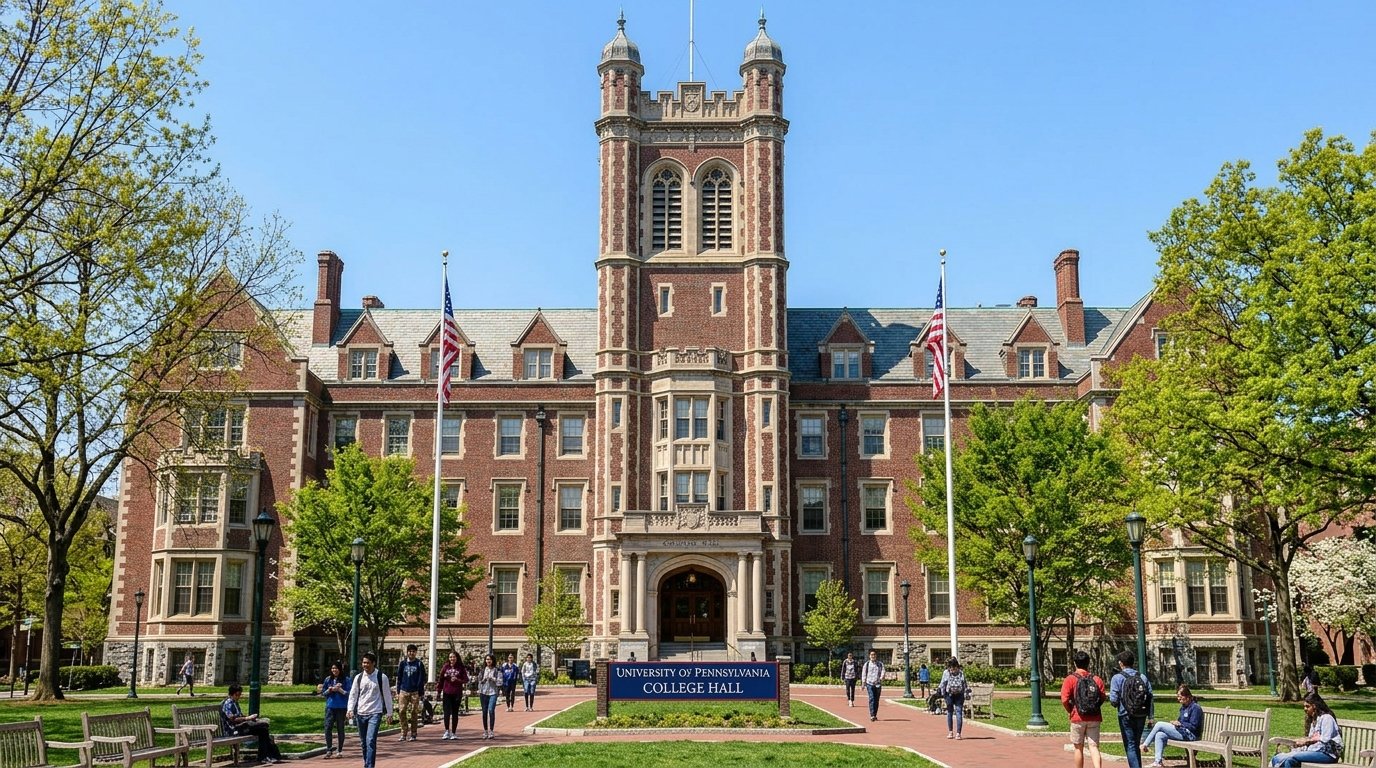
Today, Penn’s campus contains a mixture of historic buildings, modern research facilities, libraries, laboratories, residence halls, student centers, athletic facilities, and green spaces.
The campus environment combines traditional academic architecture with modern research infrastructure.
20. College Green
College Green is one of Penn’s most recognizable campus areas.
The space provides an important gathering point for students and visitors.
Historic buildings surrounding the area contribute to Penn’s distinctive architectural identity.
The green spaces across campus also provide students with places to relax, study, socialize, and participate in events.
21. Van Pelt Library
The University of Pennsylvania Libraries form an important part of the academic environment.
The Van Pelt-Dietrich Library Center serves as a major research and study facility.
Penn’s libraries contain extensive collections covering humanities, social sciences, sciences, professional disciplines, rare books, manuscripts, and special collections.
Digital resources have also become increasingly important.
Students can access academic databases, electronic journals, digital archives, research guides, and other scholarly resources.
22. Research at Penn
Research is one of the university’s defining strengths.
Penn researchers work across numerous disciplines and often collaborate across schools.
Research areas include:
- Medicine
- Biotechnology
- Artificial intelligence
- Computer science
- Engineering
- Business
- Economics
- Psychology
- Neuroscience
- Public health
- Cancer research
- Genetics
- Immunology
- Communication
- Urban planning
- Social policy
The university’s research culture encourages faculty and students to investigate complex problems.
23. Penn and Medical Innovation
Penn has made major contributions to biomedical research.
One especially important area has been immunotherapy.
Researchers associated with Penn have contributed to the development of CAR T-cell therapy, an approach that uses genetically modified immune cells to target certain cancers.
This work demonstrated how university research can move from laboratory science into clinical treatment.
The development of advanced cellular therapies has helped strengthen Penn’s reputation as a major center for biomedical innovation.
24. Nobel Prize Recognition
Members of the Penn community have received major international recognition for their research and scholarship.
The university has been associated with Nobel laureates and other highly honored scholars.
Awards in fields such as economics, medicine, physics, and other disciplines reflect the institution’s research influence.
These achievements have contributed to Penn’s international academic reputation.
25. Student Life
Student life at Penn is diverse and active.
Students participate in hundreds of clubs and organizations.
These include:
- Academic organizations
- Cultural groups
- Sports clubs
- Performing arts groups
- Political organizations
- Volunteer organizations
- Entrepreneurship groups
- Student publications
- Professional societies
The large range of organizations allows students to explore interests outside the classroom.
26. Penn Athletics
Penn participates in NCAA Division I athletics as a member of the Ivy League.
The university has a strong tradition in sports such as basketball, football, rowing, soccer, lacrosse, fencing, wrestling, and track and field.
Penn’s basketball program has a particularly historic connection to the Palestra, one of the most famous college basketball arenas in the United States.
The Palestra has hosted generations of college basketball competition and is an important part of Philadelphia’s sports culture.
27. The Ivy League
Penn is one of the eight universities that make up the Ivy League.
The Ivy League includes:
- Brown University
- Columbia University
- Cornell University
- Dartmouth College
- Harvard University
- Princeton University
- University of Pennsylvania
- Yale University
Membership in the Ivy League contributes to Penn’s academic and athletic identity.
However, Penn’s institutional history is distinct from that of the other Ivy League universities.
28. Admissions and Academic Competition
Admission to Penn is highly competitive.
Applicants are evaluated through a broad review process that considers academic preparation, intellectual interests, extracurricular activities, leadership, personal qualities, and other aspects of an application.
Different schools within Penn may have distinct academic cultures.
For example, students applying to Wharton may demonstrate strong interests in business and entrepreneurship, while students applying to engineering may emphasize technical and scientific interests.
The competitive admissions environment reflects Penn’s strong global demand.
29. Financial Aid
Penn has developed significant financial aid programs designed to make education more accessible.
Financial aid may include grants, scholarships, work opportunities, and other forms of assistance depending on a student’s circumstances.
The university has made affordability and access important parts of its educational mission.
Financial aid policies can change over time, so prospective students should consult Penn’s official financial aid information for current requirements and policies.
30. International Students
Penn attracts students from around the world.
International students contribute to the cultural diversity of campus.
They bring different perspectives, languages, experiences, and academic interests.
The university also maintains international partnerships and research relationships.
This global environment helps students prepare for careers that cross national boundaries.
31. Penn Alumni
Penn has an extensive alumni community.
Graduates have become leaders in:
- Business
- Medicine
- Law
- Politics
- Science
- Technology
- Journalism
- Entertainment
- Academia
- Public service
- Entrepreneurship
The alumni network provides professional and social connections around the world.
32. Famous Alumni
One of Penn’s notable alumni is Donald Trump, who attended the Wharton School and graduated in 1968.
Other prominent alumni and associated figures include entrepreneurs, business leaders, physicians, lawyers, writers, politicians, scientists, and artists.
Penn’s alumni network reflects the university’s broad academic structure.
33. Penn and American Politics
Because of its Philadelphia location and long history, Penn has been connected with American political life for centuries.
Students and graduates have entered government, diplomacy, law, journalism, public policy, and political leadership.
The university’s academic programs in political science, economics, history, communication, and law provide students with tools for understanding political institutions.
Penn’s broader intellectual culture encourages debate and analysis of public issues.
34. Entrepreneurship at Penn
Entrepreneurship is a major part of modern Penn culture.
The university provides programs, competitions, incubators, mentorship, and educational opportunities for students interested in starting businesses.
Wharton has played a particularly significant role in entrepreneurship education.
Penn’s engineering and design programs also contribute to technology-based entrepreneurship.
The university encourages students to transform ideas into products, services, organizations, and social ventures.
35. Innovation and Technology
Penn’s technology ecosystem includes researchers, entrepreneurs, investors, students, alumni, and industry partners.
The university has produced innovations in medicine, engineering, computing, business, and design.
Philadelphia’s growing technology and healthcare economy provides additional opportunities for collaboration.
Penn students can therefore gain experience through research laboratories, internships, startups, hospitals, and professional organizations.
36. Penn’s Relationship with Philadelphia
Penn and Philadelphia have a close relationship.
The university is not isolated from the city. Instead, it is embedded within one of America’s largest metropolitan areas.
Philadelphia offers opportunities in healthcare, finance, government, education, technology, arts, culture, and nonprofit work.
The city also provides historical resources, museums, libraries, hospitals, courts, businesses, and cultural institutions.
Students can use the city as an extension of their educational experience.
37. Community Engagement
Penn participates in community initiatives in West Philadelphia and beyond.
The university’s relationship with neighboring communities has involved education, healthcare, economic development, public safety, housing, and social programs.
Community engagement remains an important area of discussion for large urban universities.
Penn has developed programs intended to connect university resources with local needs.
38. Diversity and Inclusion
Penn’s student body includes people from a wide variety of backgrounds.
The university supports cultural organizations, identity-based student groups, academic programs, and initiatives intended to promote inclusion.
Diversity contributes to the educational experience by exposing students to different perspectives.
The university continues to evolve its policies and programs in response to changing social conditions.
39. Libraries and Historical Collections
Penn possesses valuable historical collections.
Its libraries preserve rare books, manuscripts, photographs, maps, archival documents, and other materials.
These collections are useful for researchers studying American history, world history, literature, science, medicine, architecture, religion, and other fields.
Penn’s historical connection to Benjamin Franklin makes its archival resources especially significant.
40. Benjamin Franklin’s Continuing Legacy
Benjamin Franklin remains one of the most important symbols of Penn.
His image and philosophy appear throughout university traditions.
Franklin’s emphasis on practical knowledge continues to influence Penn’s academic culture.
The university’s combination of liberal arts and professional education reflects the educational model he supported.
Franklin’s legacy also appears in Penn’s commitment to innovation and public service.
41. The University as a Research Institution
Modern Penn is not simply a teaching institution.
It is a major research university.
Faculty members conduct research while teaching undergraduate and graduate students.
Doctoral students contribute to research in sciences, humanities, social sciences, and professional disciplines.
Research funding supports laboratories, clinical studies, fieldwork, archives, and technological development.
42. Graduate Education
Penn offers a wide range of graduate degrees.
Graduate students can study areas such as:
- Business
- Medicine
- Law
- Engineering
- Education
- Social sciences
- Humanities
- Natural sciences
- Architecture
- Nursing
- Social policy
- Communication
Graduate education contributes substantially to the university’s research mission.
43. Professional Education
Penn is particularly distinctive because of the strength of its professional schools.
The university offers professional education in medicine, business, law, nursing, design, engineering, communication, and social policy.
Students can combine professional education with liberal arts study.
This creates opportunities for interdisciplinary career preparation.
44. Interdisciplinary Education
Interdisciplinary education is one of Penn’s defining characteristics.
Modern challenges rarely fit into a single academic discipline.
For example, climate change involves science, economics, policy, engineering, urban planning, and communication.
Healthcare requires medicine, nursing, engineering, data science, business, ethics, and public policy.
Penn’s structure allows scholars from different fields to collaborate on such problems.
45. Arts and Culture
Penn also supports arts and culture.
Students can participate in music, theater, dance, visual arts, writing, filmmaking, and other creative activities.
Philadelphia itself has a vibrant arts scene.
Students therefore have opportunities to experience museums, galleries, theaters, concerts, festivals, and historical sites.
46. Traditions at Penn
Universities survive not only through academic programs but also through traditions.
Penn students participate in events that connect current students with alumni and earlier generations.
Class traditions, athletic competitions, student organizations, graduation ceremonies, and campus celebrations contribute to institutional identity.
These traditions help create a sense of belonging.
47. Graduation and Alumni Connections
Graduation represents an important transition from student life to alumni life.
Penn graduates join a large international community.
Alumni may return to campus for reunions, lectures, sporting events, professional activities, and other programs.
The university maintains relationships with graduates through alumni organizations and events.
48. Penn’s Global Reputation
The University of Pennsylvania is recognized internationally for academic excellence.
Its reputation is supported by its history, research achievements, faculty, professional schools, alumni, and global partnerships.
International rankings frequently place Penn among the world’s leading universities, although rankings vary according to methodology.
A university’s true academic quality cannot be measured by a single ranking.
Penn’s impact is better understood through its research, graduates, educational programs, and contributions to society.
49. Challenges Facing Penn
Like other major universities, Penn faces challenges.
These include rising educational costs, debates over accessibility, campus safety, academic freedom, political pressure, research funding, technological change, and maintaining relationships with surrounding communities.
The university must also adapt to changes in higher education.
Online learning, artificial intelligence, biotechnology, and changing labor markets are reshaping universities.
Penn must balance its historic traditions with future innovation.
50. The Future of the University of Pennsylvania
Penn’s future will likely be shaped by technology, medicine, business, climate challenges, artificial intelligence, data science, and social change.
The university’s interdisciplinary structure gives it opportunities to address complex problems.
Its connection with Philadelphia provides a large urban environment for experimentation and community engagement.
Its global alumni network provides additional opportunities for international collaboration.
51. Why the University of Pennsylvania Matters
The University of Pennsylvania matters because of its extraordinary combination of history and innovation.
It began in the eighteenth century, when Benjamin Franklin imagined an educational institution designed to prepare people for practical life.
More than two centuries later, Penn continues to pursue that idea through medicine, engineering, business, law, design, communication, social policy, and the liberal arts.
Its history demonstrates how American higher education evolved from small colonial colleges into complex research universities.
52. Penn’s Educational Philosophy
The university’s educational philosophy combines intellectual exploration with practical application.
Students are encouraged to develop specialized expertise while understanding the broader world.
A business student may study psychology.
An engineer may study entrepreneurship.
A medical researcher may work with computer scientists.
A designer may study urban policy.
This interdisciplinary approach helps explain Penn’s distinctive identity.
53. The Importance of Location
Location is another important advantage.
Philadelphia provides a combination of history, culture, healthcare, government, business, and education.
The city is close enough to major northeastern economic centers to provide career opportunities while maintaining its own distinctive identity.
Students can explore professional opportunities beyond campus.
54. Penn and the Future of Medicine
Penn’s medical and biomedical research programs may play an increasingly important role in future healthcare.
Areas such as gene therapy, cellular therapy, immunology, artificial intelligence, precision medicine, and genomics are transforming healthcare.
Penn’s combination of medical expertise, engineering, computing, and business creates opportunities for innovation.
55. Penn and the Future of Business
The Wharton School continues to shape business education.
Future business leaders must understand technology, sustainability, international markets, entrepreneurship, ethics, data, and social responsibility.
Business education is therefore becoming increasingly interdisciplinary.
Penn’s broader university structure provides opportunities for Wharton students to interact with other academic fields.
56. Penn and Artificial Intelligence
Artificial intelligence is becoming important across the university.
AI can influence healthcare, finance, education, engineering, communication, design, and scientific research.
Penn researchers and students are increasingly exploring how AI can be used responsibly.
The university’s future research will likely include questions about both technological capability and ethical responsibility.
57. Sustainability
Universities have important roles in addressing environmental challenges.
Penn participates in sustainability initiatives involving energy, buildings, transportation, research, education, and community engagement.
Students and faculty can contribute to climate-related research through engineering, environmental science, economics, architecture, urban planning, and public policy.
58. A University Built on Innovation
From Benjamin Franklin’s educational philosophy to modern biomedical research, innovation has been central to Penn’s history.
The university repeatedly adapted to changing conditions.
It expanded from a colonial college into a comprehensive university.
It created professional schools when new industries and professions emerged.
It developed modern research programs as scientific knowledge expanded.
Today, it continues to adapt to digital technology and global challenges.
59. Conclusion
The University of Pennsylvania is one of America’s most historically significant and academically influential universities.
Its story began with Benjamin Franklin’s vision of practical and useful education in eighteenth-century Philadelphia. From those early beginnings, the institution developed into a major research university with internationally recognized programs in business, medicine, law, engineering, nursing, design, communication, social policy, and the arts and sciences.
Penn’s history is closely connected with the history of Philadelphia and the United States. It existed during the colonial period, survived the upheavals of the American Revolution, expanded during industrialization, and adapted to the technological and scientific transformations of the modern world.
The university’s schools have produced important contributions to medicine, business, engineering, law, science, social research, and public policy. Its alumni have entered nearly every major field of professional life.
Perhaps the most enduring aspect of Penn’s identity is its commitment to connecting knowledge with action. Benjamin Franklin believed education should prepare people to contribute meaningfully to society. That philosophy remains visible in Penn’s interdisciplinary culture.
Today, the University of Pennsylvania combines historic traditions with modern research and innovation. Its campus in Philadelphia serves as a center for education, discovery, entrepreneurship, culture, and community engagement.
As the university moves into the future, its greatest challenge will be maintaining the values that have defined it for centuries while responding to new developments in technology, medicine, business, education, and society.
The University of Pennsylvania’s long history demonstrates that great universities are not simply collections of buildings or academic programs. They are communities of students, teachers, researchers, alumni, and citizens whose ideas can influence generations.
From Benjamin Franklin’s eighteenth-century educational vision to twenty-first-century research in medicine, engineering, business, and technology, Penn continues to represent an important part of America’s intellectual history.
For students seeking a university with historic roots, strong professional schools, extensive research opportunities, an international community, and a deep connection with one of America’s most important cities, the University of Pennsylvania remains a remarkable institution.
Its legacy is therefore not limited to its past. Penn’s greatest significance lies in its continuing ability to educate people, create knowledge, encourage innovation, and contribute to society.