Introduction
The University of Cambridge is one of the oldest and most influential universities in the world. Located in the historic city of Cambridge in England, the university has played a remarkable role in the development of education, science, mathematics, literature, philosophy, politics, economics, medicine, and technology. For more than eight centuries, Cambridge has attracted students and scholars from Britain and from countries across the globe.
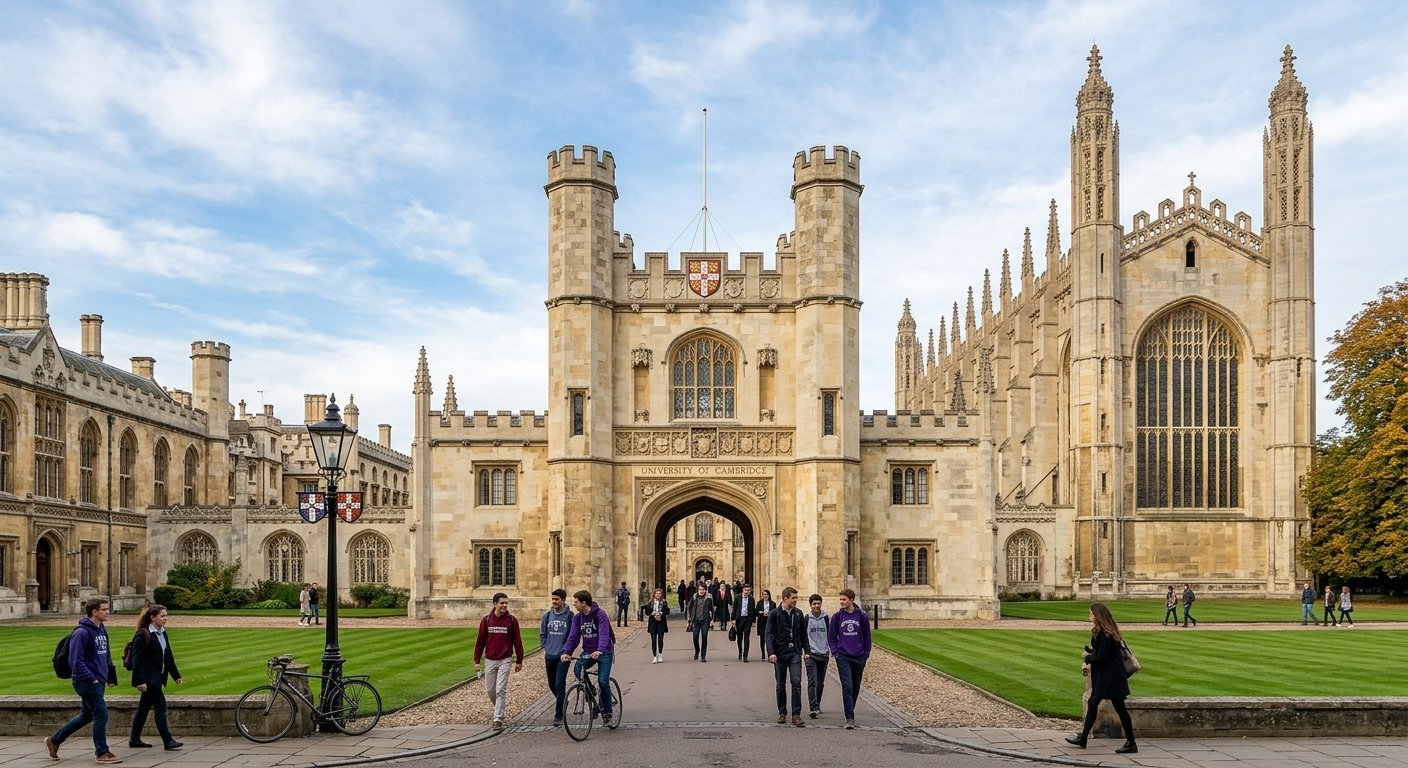
Cambridge is not simply a single campus. It is a collegiate university made up of the central University and numerous independent colleges. Its historic buildings, libraries, laboratories, chapels, museums, gardens, and courts reflect centuries of intellectual and architectural development. The university’s history is closely connected with some of the most important changes in European and world history, from the medieval period and the Reformation to the Scientific Revolution, the Industrial Revolution, the expansion of modern science, and the digital age.
Among Cambridge’s most famous scholars and alumni are Isaac Newton, Charles Darwin, James Clerk Maxwell, Alan Turing, Stephen Hawking, John Milton, Lord Byron, Francis Bacon, and many other figures who transformed their fields. Cambridge has also educated numerous British prime ministers, political leaders, writers, artists, scientists, economists, judges, and entrepreneurs.
The story of Cambridge began in the early thirteenth century. It developed from a community of scholars into a complex academic institution with a worldwide reputation. Understanding its history requires looking not only at famous individuals but also at the colleges, students, teachers, traditions, social changes, and scientific discoveries that shaped the university.
1. The Origins of Cambridge University
The exact date on which the University of Cambridge was founded is not known. Unlike some modern institutions, Cambridge did not begin with a single foundation ceremony. Instead, it developed gradually from a community of scholars who came to Cambridge during the early thirteenth century.
Cambridge was already an important settlement before the university appeared. Its location beside the River Cam made it a useful center for trade and transportation. The town was also connected to important roads and commercial routes.
During the medieval period, universities were developing in several European cities. Bologna, Paris, Oxford, and other centers became important places for advanced study. Students and teachers often moved between universities in search of better opportunities.
Around 1209, scholars associated with Oxford appear to have moved to Cambridge. Historical tradition connects the emergence of Cambridge as a university center with disputes and disturbances at Oxford. Some scholars sought a new place where they could study and teach.
By the early thirteenth century, Cambridge had therefore become home to an organized academic community. The university’s early development was strongly influenced by the medieval university model, in which scholars studied subjects such as theology, law, medicine, philosophy, grammar, rhetoric, and logic.
The early university did not initially possess the magnificent buildings that visitors associate with Cambridge today. Teaching took place in rented rooms, churches, halls, and other available spaces. Over time, permanent institutions and colleges developed.
2. Medieval Cambridge
The medieval university was very different from the modern University of Cambridge.
Students generally entered university at a young age. Education was based heavily on texts, lectures, debates, memorization, and formal examinations. Latin was the principal language of academic communication.
One of the most important elements of medieval education was the study of the liberal arts. Students learned grammar, rhetoric, logic, arithmetic, geometry, music, and astronomy. Those who advanced further could study theology, law, or medicine.
Cambridge gradually gained legal recognition and privileges from the English monarchy and the Church. Royal and ecclesiastical support helped establish the university as a permanent institution.
The university’s relationship with the town was not always peaceful. Students and local residents sometimes disagreed over prices, rents, legal authority, and behavior. Medieval universities were powerful corporate communities, and university members often possessed special legal privileges.
These tensions became an important part of Cambridge’s early history.
3. The Foundation of Peterhouse
One of the most important developments in Cambridge’s history occurred in the thirteenth century with the foundation of Peterhouse.
Peterhouse was founded in 1284 by Hugh de Balsham, Bishop of Ely. It is generally regarded as the oldest Cambridge college.
The creation of Peterhouse established a model that would become central to Cambridge’s identity: the collegiate system.
A college provided students and scholars with accommodation, dining facilities, religious services, supervision, and an academic community. Over subsequent centuries, additional colleges were founded.
The collegiate structure eventually became one of Cambridge’s defining characteristics.
Rather than being a university composed only of departments and classrooms, Cambridge developed as a federation of colleges operating alongside the central University.
4. The Growth of the College System
Following Peterhouse, other colleges were established.
Clare College developed from an earlier foundation and became an important part of Cambridge’s history. Pembroke College was founded in the fourteenth century. Gonville Hall, later Gonville and Caius College, also has medieval origins.
The fifteenth and sixteenth centuries saw further expansion. King’s College, Queens’ College, St John’s College, and Trinity College became particularly prominent.
Each college developed its own traditions, buildings, libraries, chapels, academic communities, and alumni networks.
The college system allowed Cambridge to expand while preserving small communities within the larger university.
5. King’s College and the Medieval Transformation
King’s College was founded in 1441 by King Henry VI.
The college was originally established with a relatively small number of scholars. Henry VI wanted the college to serve as an institution connected with the education of young men from Eton College.
The magnificent King’s College Chapel became one of the most recognizable buildings in Cambridge. Construction began in the fifteenth century and continued for many decades.
The chapel’s Gothic architecture, enormous windows, stone vault, and stained glass became symbols of Cambridge itself.
The King’s College Chapel choir also developed an internationally respected musical tradition.
The history of King’s College illustrates how royal patronage influenced Cambridge. Medieval monarchs could use educational institutions to strengthen religious, cultural, and political goals.
6. The Renaissance and Humanism
During the Renaissance, European intellectual life changed dramatically.
Classical Greek and Roman texts were rediscovered and studied with renewed interest. Humanism emphasized language, history, literature, philosophy, and the study of classical civilization.
Cambridge participated in these intellectual developments.
Scholars increasingly examined ancient texts and questioned traditional interpretations. The growth of printing also transformed education.
Books became easier to reproduce and distribute, allowing scholars to access a much larger body of knowledge.
Cambridge gradually became an important center for Renaissance scholarship in England.
7. The Reformation and Religious Change
The sixteenth century brought enormous religious changes to England.
The English Reformation under Henry VIII transformed the relationship between the English Crown and the Roman Catholic Church. Later monarchs introduced further religious changes.
Cambridge was deeply affected by these events.
Religious debates influenced teaching, college life, university politics, and academic appointments. Some Cambridge scholars supported Protestant reform, while others defended Catholic traditions.
During the reigns of Henry VIII, Edward VI, Mary I, and Elizabeth I, the religious environment changed repeatedly.
Cambridge also became associated with important Protestant thinkers.
The university’s intellectual environment allowed religious arguments to circulate, although political and religious authorities could punish scholars who challenged official beliefs.
8. The Rise of Protestant Cambridge
During the Elizabethan period, Cambridge became increasingly important to Protestant intellectual life.
Many scholars who studied or taught at Cambridge participated in the development of English Protestantism.
The university also contributed to literature during this period. Writers associated with Cambridge helped shape English Renaissance culture.
The growth of printing, scholarship, and education contributed to Cambridge’s reputation as an important intellectual center.
9. Francis Bacon and New Approaches to Knowledge
Francis Bacon, who studied at Trinity College, became one of the most influential thinkers connected with Cambridge.
Bacon criticized certain traditional approaches to knowledge and argued for systematic observation and experimentation.
Although the modern scientific method cannot be attributed to one individual, Bacon’s emphasis on empirical investigation became important in the history of modern science.
His ideas reflected a broader transformation taking place across Europe.
Scholars increasingly wanted to understand nature through observation, measurement, mathematics, and experiment.
Cambridge would become one of the major centers of this scientific transformation.
10. The Scientific Revolution
The seventeenth century was a crucial period in Cambridge’s history.
European thinkers such as Galileo Galilei, Johannes Kepler, René Descartes, and others were transforming ideas about astronomy, physics, and mathematics.
Cambridge became increasingly connected to this new scientific culture.
One of its greatest figures was Isaac Newton.
11. Isaac Newton at Cambridge
Isaac Newton entered Trinity College, Cambridge, in 1661.
His time at Cambridge became one of the most important chapters in the history of science.
Newton studied mathematics, philosophy, astronomy, and natural philosophy. During periods of isolation caused by the plague in the 1660s, he developed many of his most important ideas.
Newton’s work transformed mathematics and physics.
He developed the mathematical techniques that became calculus, investigated light and color, studied motion, and formulated his laws of motion and universal gravitation.
His great work, Philosophiæ Naturalis Principia Mathematica, published in 1687, changed humanity’s understanding of the physical universe.
Newton later became Lucasian Professor of Mathematics at Cambridge.
The Lucasian Professorship would become one of the world’s most famous academic positions.
12. Cambridge and the Enlightenment
During the eighteenth century, Cambridge participated in the intellectual movement commonly known as the Enlightenment.
Reason, scientific inquiry, political philosophy, mathematics, and natural history became increasingly important.
The university’s academic culture continued to evolve.
Mathematics became particularly important at Cambridge, eventually producing the famous Mathematical Tripos.
The Tripos developed into a rigorous system for studying and examining mathematics. It became one of the most influential academic traditions in the university.
13. The Mathematical Tradition
Cambridge developed an exceptional reputation for mathematics.
The Mathematical Tripos became highly competitive and demanding. Students preparing for the examinations underwent intensive training.
Success in the Tripos could bring considerable prestige.
The mathematical tradition helped create an environment in which Cambridge scholars contributed to astronomy, mechanics, physics, engineering, probability, economics, and other disciplines.
This mathematical culture would later become essential to Cambridge’s achievements in modern science.
14. The Nineteenth Century
The nineteenth century transformed Cambridge.
Britain was undergoing rapid industrialization, urbanization, political reform, and scientific development.
The university itself was changing.
New academic disciplines developed. Scientific laboratories became increasingly important. The study of natural sciences expanded.
The relationship between traditional classical education and modern scientific education became a major issue.
Cambridge gradually moved from a university dominated by classical and mathematical studies toward a broader institution supporting modern scientific research.
15. Charles Darwin at Cambridge
Charles Darwin studied at Christ’s College, Cambridge.
Darwin initially considered a career in medicine and later studied theology, but his interests in natural history became increasingly important.
Cambridge helped provide the intellectual environment that contributed to his development as a naturalist.
After Cambridge, Darwin joined HMS Beagle on its famous voyage.
His observations during the voyage contributed to his theory of evolution by natural selection.
In 1859, Darwin published On the Origin of Species.
The theory of evolution transformed biology and became one of the most influential scientific ideas in modern history.
Darwin’s connection with Cambridge remains an important part of the university’s scientific heritage.
16. Cambridge and Natural Sciences
During the nineteenth century, natural sciences became increasingly institutionalized at Cambridge.
Researchers studied geology, chemistry, biology, astronomy, physics, and other subjects.
Laboratories and museums supported teaching and research.
The university became an increasingly important center for scientific investigation.
This transition helped establish the foundations for Cambridge’s twentieth-century scientific achievements.
17. James Clerk Maxwell
James Clerk Maxwell was one of the most important physicists associated with Cambridge.
Maxwell studied at Cambridge and later became Cavendish Professor of Experimental Physics.
His work transformed the understanding of electricity, magnetism, and light.
Maxwell’s equations demonstrated that electricity and magnetism were interconnected aspects of a broader electromagnetic field.
His theories became fundamental to modern physics and eventually contributed to technologies ranging from radio communication to electronics.
18. The Cavendish Laboratory
One of the most important developments in Cambridge’s scientific history was the creation of the Cavendish Laboratory.
The laboratory was established in 1874 and named after the scientist and benefactor Henry Cavendish.
James Clerk Maxwell became its first director.
The Cavendish Laboratory became one of the world’s leading centers for experimental physics.
Over the following decades, researchers working there made discoveries that transformed modern science.
19. J. J. Thomson and the Electron
J. J. Thomson became director of the Cavendish Laboratory in 1884.
In 1897, he demonstrated evidence for the existence of the electron.
The discovery showed that atoms were not indivisible units but contained smaller components.
This was a major development in the history of physics.
Thomson’s work helped open the way to modern atomic and particle physics.
He later received the Nobel Prize in Physics.
20. Ernest Rutherford and Nuclear Physics
Ernest Rutherford became another major figure connected with the Cavendish Laboratory.
Rutherford’s experiments contributed to the discovery of the atomic nucleus.
His work demonstrated that the atom had a tiny, dense central nucleus surrounded by electrons.
The development of nuclear physics eventually led to profound advances in science and technology.
Rutherford’s work at Cambridge helped establish the laboratory’s reputation as a global center of experimental physics.
21. The First World War
The First World War affected Cambridge deeply.
Students, graduates, and staff joined the armed forces or contributed to wartime work.
Many members of the university lost their lives.
Academic life was disrupted, although research continued in areas considered important to the war effort.
The war also changed British society, creating pressure for broader access to higher education and new professional opportunities.
22. Women and Cambridge
For much of its history, Cambridge was primarily an institution for men.
Women began studying at Cambridge in the nineteenth century through new women’s colleges.
Girton College was founded in 1869.
Newnham College was founded in 1871.
These institutions provided women with access to university-level education at a time when opportunities were severely restricted.
However, women did not initially receive full membership of the University.
They could study for examinations and achieve outstanding academic results, but their formal status remained limited.
This inequality continued for decades.
23. Women Receive Degrees
The struggle for equal recognition continued throughout the twentieth century.
Women at Cambridge demonstrated academic excellence but were often excluded from the same privileges as male students.
The situation eventually changed.
In 1948, women were admitted to full membership of the University and could receive Cambridge degrees.
This was a major milestone in the history of the university.
It reflected broader changes in British society and higher education.
24. Cambridge Between the Wars
The period between the First and Second World Wars was highly productive for Cambridge research.
Physics, mathematics, biology, economics, anthropology, and other fields developed rapidly.
The university attracted scholars who were contributing to major international intellectual movements.
Cambridge increasingly became a research university in the modern sense.
Its laboratories and research groups developed global reputations.
25. The Second World War
The Second World War again transformed university life.
Cambridge scholars participated in scientific and technological research related to the war.
Research in physics, mathematics, engineering, communications, and other fields became strategically important.
One of the most famous Cambridge-associated wartime figures was Alan Turing.
26. Alan Turing and Computing
Alan Turing studied mathematics at King’s College, Cambridge.
He became one of the foundational figures in computer science.
Turing developed theoretical ideas about computation and created the concept now associated with the Turing machine.
During the Second World War, he worked at Bletchley Park on codebreaking.
His work contributed significantly to the Allied effort.
After the war, Turing continued research in computing and mathematical biology.
His connection with Cambridge represents the university’s transition from traditional mathematics into the emerging world of computer science.
27. Cambridge and Modern Computer Science
The intellectual traditions of mathematics, logic, physics, and engineering created fertile conditions for computer research.
Cambridge eventually became an important center of computing research.
The university and associated institutions contributed to developments in programming, computer architecture, artificial intelligence, networking, and software engineering.
Cambridge also became connected with the development of the British technology industry.
28. The Postwar University
After 1945, higher education expanded rapidly.
Britain increasingly recognized the importance of universities for economic development, scientific research, and social mobility.
Cambridge expanded its academic activities.
New departments and research centers developed.
The university continued to preserve its historic colleges while adapting to modern educational requirements.
Student numbers increased, and the social background of students became more diverse.
29. Stephen Hawking and Cosmology
One of the most famous modern Cambridge scientists was Stephen Hawking.
Hawking studied at Oxford before moving to Cambridge for postgraduate research.
He became one of the world’s most famous theoretical physicists and later held the Lucasian Professorship of Mathematics, the position previously associated with Isaac Newton.
Hawking made major contributions to theoretical cosmology and the study of black holes.
His work on black-hole radiation, often called Hawking radiation, connected quantum theory, gravity, and thermodynamics.
His books and public lectures also made complex scientific ideas accessible to millions of people.
30. Cambridge and the Discovery of DNA
Cambridge played a crucial role in the history of molecular biology.
At the Cavendish Laboratory, James Watson and Francis Crick worked on the structure of DNA.
In 1953, Watson and Crick proposed the famous double-helix model.
Their work built on experimental evidence produced by other scientists, including Rosalind Franklin and Maurice Wilkins.
Understanding DNA transformed biology and eventually contributed to genetics, medicine, biotechnology, and forensic science.
Cambridge therefore became an important location in one of the most significant scientific breakthroughs of the twentieth century.
31. Rosalind Franklin and the DNA Story
The history of DNA research is now understood as a collaborative scientific achievement.
Rosalind Franklin’s X-ray diffraction work produced important evidence about DNA’s structure.
Although Franklin was not a Cambridge faculty member in the same way as Watson and Crick, the scientific environment connecting researchers in Cambridge was crucial to the development of the double-helix model.
The modern history of DNA research has also encouraged broader discussion about scientific credit, collaboration, and the recognition of women in science.
32. Cambridge and Economics
Cambridge has had a major influence on economics.
The university became home to influential economists including Alfred Marshall and later John Maynard Keynes.
Marshall helped establish modern economics as an academic discipline.
Keynes became one of the most influential economists of the twentieth century.
His ideas about government spending, employment, demand, and economic cycles transformed economic policy.
Cambridge’s economics tradition has continued to influence governments, central banks, universities, and international organizations.
33. John Maynard Keynes
John Maynard Keynes studied mathematics at King’s College, Cambridge.
He later became a major economist and public intellectual.
During periods of economic crisis, Keynes argued that governments could play an important role in stabilizing economies.
His ideas became especially influential during the Great Depression and after the Second World War.
The economic school associated with Cambridge became one of the most important traditions in twentieth-century economic thought.
34. Cambridge and Literature
Cambridge has also produced and educated many important writers.
John Milton studied at Christ’s College.
Lord Byron attended Trinity College.
Other writers, poets, philosophers, and intellectuals have been associated with the university throughout its history.
Cambridge’s combination of classical education, debate, scholarship, and literary societies created a strong environment for writing and intellectual creativity.
35. The Bloomsbury Connection
Some Cambridge-educated intellectuals became associated with the Bloomsbury Group.
The group included writers, artists, economists, and intellectuals who challenged traditional Victorian attitudes toward art, relationships, literature, and society.
Members associated with Cambridge included Virginia Woolf’s intellectual circle and figures such as E. M. Forster and John Maynard Keynes.
Cambridge’s intellectual culture therefore extended beyond formal university subjects into wider debates about modern society.
36. Cambridge Colleges
One of the most distinctive features of Cambridge is its colleges.
Today, the university is composed of numerous colleges, each with its own history and traditions.
Among the best known are:
- Peterhouse
- Clare College
- Pembroke College
- Gonville & Caius College
- Trinity Hall
- King’s College
- Queens’ College
- St Catharine’s College
- Corpus Christi College
- St John’s College
- Trinity College
- Magdalene College
- Christ’s College
- Sidney Sussex College
- Emmanuel College
- Downing College
- Girton College
- Newnham College
- Fitzwilliam College
- Selwyn College
- Murray Edwards College
- Churchill College
- Clare Hall
- Darwin College
- Wolfson College
- Robinson College
- Lucy Cavendish College
- Homerton College
- Hughes Hall
- St Edmund’s College
Each college has its own governing structure and traditions while remaining part of the wider University.
37. Trinity College
Trinity College is one of Cambridge’s largest and most famous colleges.
It was founded by Henry VIII in 1546.
Trinity has educated numerous distinguished figures, including Isaac Newton.
Its Great Court and Wren Library are among the most famous architectural landmarks in Cambridge.
The college has also produced numerous Nobel laureates, writers, politicians, mathematicians, and scientists.
Trinity’s influence on Cambridge’s intellectual history has been enormous.
38. St John’s College
St John’s College was founded in 1511 by Lady Margaret Beaufort, mother of Henry VII.
The college became one of Cambridge’s major academic institutions.
Its historic buildings and famous Bridge of Sighs have become important symbols of Cambridge.
St John’s has educated many influential figures in literature, science, politics, and public life.
39. Christ’s College
Christ’s College has medieval origins and is particularly famous because Charles Darwin studied there.
The college has also been associated with literary figures and intellectuals.
Its historic buildings and gardens form an important part of Cambridge’s architectural heritage.
40. Girton and Newnham
Girton and Newnham were pioneers in women’s higher education.
Their creation represented an important challenge to the traditional male-dominated university system.
Students at these colleges contributed significantly to scholarship despite facing institutional barriers.
Their history demonstrates how Cambridge gradually changed from an institution primarily serving men into a modern university educating students of all genders.
41. Cambridge Libraries
Libraries have always been central to Cambridge’s academic life.
The University Library is one of the world’s major research libraries.
Its collections include manuscripts, rare books, maps, archives, and other historical materials.
College libraries also preserve important collections.
The Wren Library at Trinity College is particularly famous for its historic books and manuscripts.
Cambridge’s library collections support research across humanities, sciences, social sciences, and professional disciplines.
42. Museums and Collections
Cambridge has an extraordinary range of museums and collections.
The Fitzwilliam Museum contains major collections of art and antiquities.
The Museum of Archaeology and Anthropology preserves objects from many cultures.
The Sedgwick Museum focuses on geology and natural history.
The Museum of Zoology contains extensive biological collections.
The Whipple Museum documents the history of scientific instruments.
These museums demonstrate that Cambridge’s educational mission extends beyond classrooms and laboratories.
43. Architecture and the Cambridge Landscape
Cambridge’s architecture reflects centuries of history.
Medieval buildings stand alongside Tudor, Georgian, Victorian, and modern structures.
College courts, chapels, libraries, gardens, bridges, and riverbanks create a distinctive urban environment.
The River Cam is particularly important to Cambridge’s identity.
Traditional punting has become one of the city’s best-known activities, although the river also has historical significance for transportation, recreation, and the development of the city.
44. Cambridge and the Modern Research University
During the twentieth and twenty-first centuries, Cambridge expanded dramatically as a research institution.
Modern research now covers fields including:
- Physics
- Chemistry
- Biology
- Medicine
- Engineering
- Computer science
- Mathematics
- Economics
- Law
- History
- Philosophy
- Linguistics
- Psychology
- Architecture
- Geography
- Archaeology
- Social sciences
Research centers connect Cambridge scholars with international universities, governments, companies, hospitals, and scientific organizations.
45. Cambridge and Medicine
Medical education has a long history at Cambridge.
The university’s medical tradition has evolved from medieval studies of medicine into modern biomedical science.
Research now includes genetics, neuroscience, immunology, cancer biology, infectious diseases, public health, and clinical medicine.
The relationship between Cambridge and nearby hospitals has strengthened the university’s role in medical research and education.
46. The Rise of Biotechnology
Cambridge became a major center for biotechnology and life sciences.
Research in genetics, molecular biology, pharmaceuticals, and biomedical engineering contributed to the growth of a broader technology ecosystem.
The area around Cambridge became known internationally for its concentration of technology and biotechnology companies.
This development demonstrated how university research can influence regional economic growth.
47. Silicon Fen
The technology cluster around Cambridge is often called “Silicon Fen.”
The nickname refers to the large concentration of technology companies and research organizations in the region.
The ecosystem grew through cooperation among universities, entrepreneurs, investors, scientists, engineers, and businesses.
Companies connected with Cambridge have worked in fields including software, telecommunications, semiconductors, biotechnology, artificial intelligence, and medical technology.
The university therefore became an important contributor to Britain’s technology economy.
48. Cambridge and Entrepreneurship
Cambridge’s academic environment has encouraged entrepreneurship.
Students and researchers have founded companies based on university research.
University-linked networks, technology-transfer organizations, venture capital, and business communities have supported commercialization.
This has created a cycle in which scientific research produces technologies, technologies produce companies, and successful companies can generate further investment in research and education.
49. International Students
Cambridge has become an increasingly international university.
Students from many countries study at its colleges and departments.
International scholars also contribute to research and teaching.
This global character has strengthened Cambridge’s role in international academic networks.
The university’s historical reputation attracts students who want to study in an environment associated with centuries of scholarship.
50. Cambridge in the Twenty-First Century
The twenty-first century has brought new challenges and opportunities.
Cambridge continues to conduct research in traditional disciplines while developing new fields.
Artificial intelligence, climate science, renewable energy, genomics, quantum technology, robotics, data science, and advanced materials have become increasingly important.
At the same time, Cambridge continues to preserve medieval and early-modern traditions.
This combination of old and new is one of the university’s defining characteristics.
51. Tradition and Change
Cambridge is famous for traditions such as formal dinners, academic gowns, college ceremonies, matriculation, formal examinations, May Week celebrations, and historic academic rituals.
However, the university has also changed significantly.
The student population has become more diverse.
Women now participate fully in university life.
Research has expanded into areas that medieval scholars could never have imagined.
Digital technology has transformed teaching, communication, libraries, and research.
The university’s history is therefore not simply a story of preservation. It is also a story of adaptation.
52. Cambridge During the Digital Age
Digital technology has changed how Cambridge operates.
Researchers use high-performance computing, artificial intelligence, digital databases, advanced imaging, and global communication networks.
Students have access to enormous quantities of online academic material.
The university also uses digital tools to share research with international audiences.
Yet physical libraries, laboratories, museums, and colleges remain central to Cambridge’s identity.
53. Cambridge’s Academic Reputation
Cambridge is consistently regarded as one of the world’s leading universities.
Its reputation is based on centuries of scholarship, research achievements, academic communities, and distinguished alumni.
However, Cambridge’s importance cannot be measured only through rankings.
Its deeper significance comes from its contribution to knowledge.
Ideas developed by Cambridge scholars have influenced science, mathematics, economics, literature, politics, medicine, and technology worldwide.
54. Nobel Prize Tradition
Cambridge has a long history of Nobel Prize winners and researchers associated with Nobel-winning work.
Scientists connected with the university have received recognition for achievements in physics, chemistry, medicine, economics, and literature.
The Nobel tradition reflects the university’s strong research culture.
55. Cambridge’s Influence on Science
Few universities have contributed so extensively to modern science.
Newton transformed physics.
Darwin transformed biology.
Maxwell transformed electromagnetism.
Thomson transformed atomic physics.
Rutherford transformed nuclear physics.
Watson and Crick contributed to the discovery of DNA’s structure.
Turing helped establish computer science.
Hawking transformed modern discussions of black holes and cosmology.
Together, these achievements demonstrate the extraordinary scientific influence of Cambridge.
56. Cambridge’s Influence on Society
The university’s influence extends beyond academic research.
Cambridge graduates have served as political leaders, judges, civil servants, diplomats, journalists, teachers, doctors, engineers, entrepreneurs, and business leaders.
Ideas developed at Cambridge have affected public policy and institutions around the world.
Economics is a particularly clear example, with Keynesian ideas influencing governments during periods of economic crisis.
57. Challenges and Criticism
Cambridge’s history also contains difficult issues.
For centuries, access to higher education was limited largely to privileged groups.
The university’s historic relationship with wealth, social class, religion, empire, and political power has attracted criticism.
Questions about access, admissions, tuition costs, diversity, representation, and social mobility remain important.
Like many historic universities, Cambridge has had to examine its past while deciding how to shape its future.
58. Cambridge and Social Mobility
Modern Cambridge places greater emphasis on widening participation.
Programs encourage students from different educational and socioeconomic backgrounds to apply.
The university works with schools and communities to improve access to higher education.
This represents a major change from the university’s medieval and early-modern history.
59. The Importance of Cambridge Today
Today, Cambridge remains a global center for education and research.
Its colleges continue to provide distinctive academic communities.
Its laboratories conduct cutting-edge research.
Its museums and libraries preserve centuries of knowledge.
Its students and scholars contribute to global debates.
Its technology ecosystem connects academic research with modern industry.
Cambridge therefore represents both historical continuity and intellectual change.
60. Cambridge’s Legacy
The legacy of the University of Cambridge is difficult to measure because its influence extends across so many fields.
In science, it contributed to modern physics, biology, chemistry, genetics, astronomy, and computing.
In mathematics, it produced some of the most influential thinkers in history.
In economics, it shaped twentieth-century economic policy.
In literature, it educated major writers and poets.
In politics and public service, its alumni have influenced Britain and many other countries.
In technology, its researchers and graduates have helped create modern industries.
Perhaps Cambridge’s greatest legacy is its belief that knowledge can be pursued across generations.
Conclusion
The history of the University of Cambridge is a story of more than eight centuries of intellectual development.
From its beginnings as a medieval community of scholars to its modern role as a global research university, Cambridge has continually changed while maintaining strong connections to its past.
Its colleges preserve medieval and early-modern traditions. Its libraries protect priceless historical collections. Its museums preserve evidence of human culture and the natural world. Its laboratories continue to investigate some of the greatest scientific questions of the modern era.
The university’s history is closely connected with figures such as Isaac Newton, Charles Darwin, James Clerk Maxwell, J. J. Thomson, Ernest Rutherford, Alan Turing, John Maynard Keynes, and Stephen Hawking. Their work demonstrates the extraordinary range of intellectual achievements associated with Cambridge.
At the same time, Cambridge’s history is not only the history of famous men and women. It is also the story of thousands of students, teachers, researchers, librarians, college staff, scientists, writers, and administrators who built the institution over generations.
The university has experienced religious conflict, political change, wars, scientific revolutions, social reform, technological transformation, and debates about access and equality. Each period left its mark.
One of Cambridge’s greatest strengths has been its ability to combine tradition with innovation. A medieval college can exist beside a modern research laboratory. Ancient manuscripts can be studied alongside artificial intelligence. Historic mathematics can lead to modern physics. Scientific theories developed generations ago can inspire new research today.
The University of Cambridge therefore remains one of the most important educational institutions in world history.
Its story began in medieval England, but its influence has become global. The discoveries, theories, writings, inventions, and ideas associated with Cambridge have helped shape the modern world.
As Cambridge moves further into the twenty-first century, its future will depend on how effectively it responds to new challenges, including climate change, artificial intelligence, global health, technological disruption, inequality, and the changing nature of education.
Yet the central mission remains remarkably similar to that of the scholars who gathered in Cambridge centuries ago: to pursue knowledge, encourage intellectual debate, educate new generations, and contribute to a deeper understanding of the world.
That continuity between the medieval past and the technological future is what makes the University of Cambridge such a remarkable institution.
For more than eight hundred years, Cambridge has been a place where ideas have been created, questioned, tested, challenged, and passed from one generation to another. Its buildings preserve the memory of the past, while its students and researchers continue to shape the future.
The history of Cambridge is therefore not finished. It is an ongoing story—one that began in the medieval world and continues today as one of the world’s leading centers of knowledge, research, and education.