Introduction
The University of Melbourne is one of Australia’s oldest and most influential universities and has played a central role in the intellectual, cultural, scientific, professional and social development of the country. Founded in 1853, it was the first university established in the state of Victoria and the second university founded in Australia. From a modest institution serving a small colonial community, it developed over more than 170 years into a major international research university with tens of thousands of students, a large global alumni network, extensive research infrastructure and campuses across Victoria. (Faculty of Business and Economics)
The history of the University of Melbourne is closely connected with the history of Melbourne itself. When the university was established, Victoria was still a relatively young colony experiencing dramatic economic and demographic change. The Victorian gold rush was transforming Melbourne into one of the most prosperous cities in the British Empire. Political leaders and intellectuals believed that a permanent institution of higher education was necessary if the colony was to develop its own professional class, scientific capabilities and cultural institutions.
The university therefore emerged not simply as an educational institution but as part of a larger colonial project to build a modern society. Its founders imagined a university capable of educating lawyers, doctors, teachers, administrators, scientists and other professionals. At the same time, its history reflects the inequalities and limitations of nineteenth-century Australia, including the exclusion of women at its foundation and the colonial relationship with Aboriginal peoples whose Country surrounded and included the university’s sites.
Over the decades, the University of Melbourne repeatedly changed. It expanded its academic disciplines, admitted women, established professional schools, developed residential colleges, created research centres, participated in international scholarship and became increasingly connected to Australian public life. It also experienced debates about governance, student representation, academic freedom, social justice, war, politics and the purpose of higher education.
Today, the university describes itself as a leading Australian research university. Its campuses include Parkville, Southbank, Burnley, Creswick, Dookie, Fishermans Bend, Shepparton and Werribee, with Parkville remaining its historic and principal campus. (About us)
This article traces that long journey, beginning with the political and social circumstances that produced the university in the 1850s and continuing through its transformation into a modern global institution.
1. Melbourne Before the University
To understand the foundation of the University of Melbourne, it is necessary to understand Melbourne and the colony of Victoria during the middle of the nineteenth century.
Melbourne was established in the 1830s and grew rapidly. By the early 1850s, the settlement had become the centre of an expanding colonial economy. Victoria separated from New South Wales in 1851 and became a distinct colony. Almost immediately, the discovery of gold transformed Victoria.
The Victorian gold rush brought enormous population growth, investment and commercial activity. Melbourne became a major financial and cultural centre. With prosperity came new expectations. A growing population needed lawyers, doctors, engineers, teachers, public servants and other educated professionals.
Colonial leaders increasingly believed that Victoria needed its own university.
Before the establishment of the University of Melbourne, Australians who wanted advanced university education often had to travel overseas or to other colonies. The University of Sydney had been founded in 1850, making it the first university in Australia. Victoria’s political and intellectual leaders wanted their own institution.
The proposal was not simply about teaching. A university was viewed as a symbol of civilization, progress and political maturity.
2. The Founding Idea
One of the important figures behind the university’s establishment was Hugh Culling Eardley Childers, the Victorian Auditor-General. On 15 December 1852, Childers moved in the Victorian Legislative Council for a select committee to establish the principles on which a university should be created. The legislation was subsequently prepared and received Royal Assent on 22 January 1853. (Library)
The University Act created a new institution under the authority of the Victorian Parliament. The university formally came into existence on 11 April 1853. (AustLII)
The university was designed as a secular institution. Theology was excluded from the original degree structure, while religious tests were prohibited. The original legislation envisaged degrees in Arts, Medicine, Law and Music. (Library)
This was significant because the founders wanted a university that would serve a broad colonial community rather than function as a denominational institution.
However, the university was not fully inclusive by modern standards. It was initially open only to men. Women would not be admitted to study until 1880.
3. Redmond Barry and the Early Leadership
Sir Redmond Barry became the university’s first Chancellor and remained in that position until his death in 1880. He was a major figure in nineteenth-century Melbourne public life and was deeply involved in the development of educational and cultural institutions.
The first University Council was appointed on 11 April 1853. Its members included prominent political, legal, religious and civic figures of the colony. (Library)
The early governance structure reflected the social structure of colonial Victoria. The university was closely connected with the colonial elite, and its leaders were often prominent figures in government, law and public administration.
Yet these founders also understood that the university could become an institution whose influence extended far beyond its original small student population.
The university’s early history therefore involved two simultaneous developments: the creation of a formal academic institution and the construction of an intellectual culture for the young colony.
4. The Foundation Stone and First Campus
The foundation stone of the university’s first major building was laid in 1854 on the site that would become the heart of the Parkville campus. (Melbourne Calendar)
The site was north of the growing centre of Melbourne. Today, the historic Parkville campus is recognized for its mixture of nineteenth-century buildings and modern facilities.
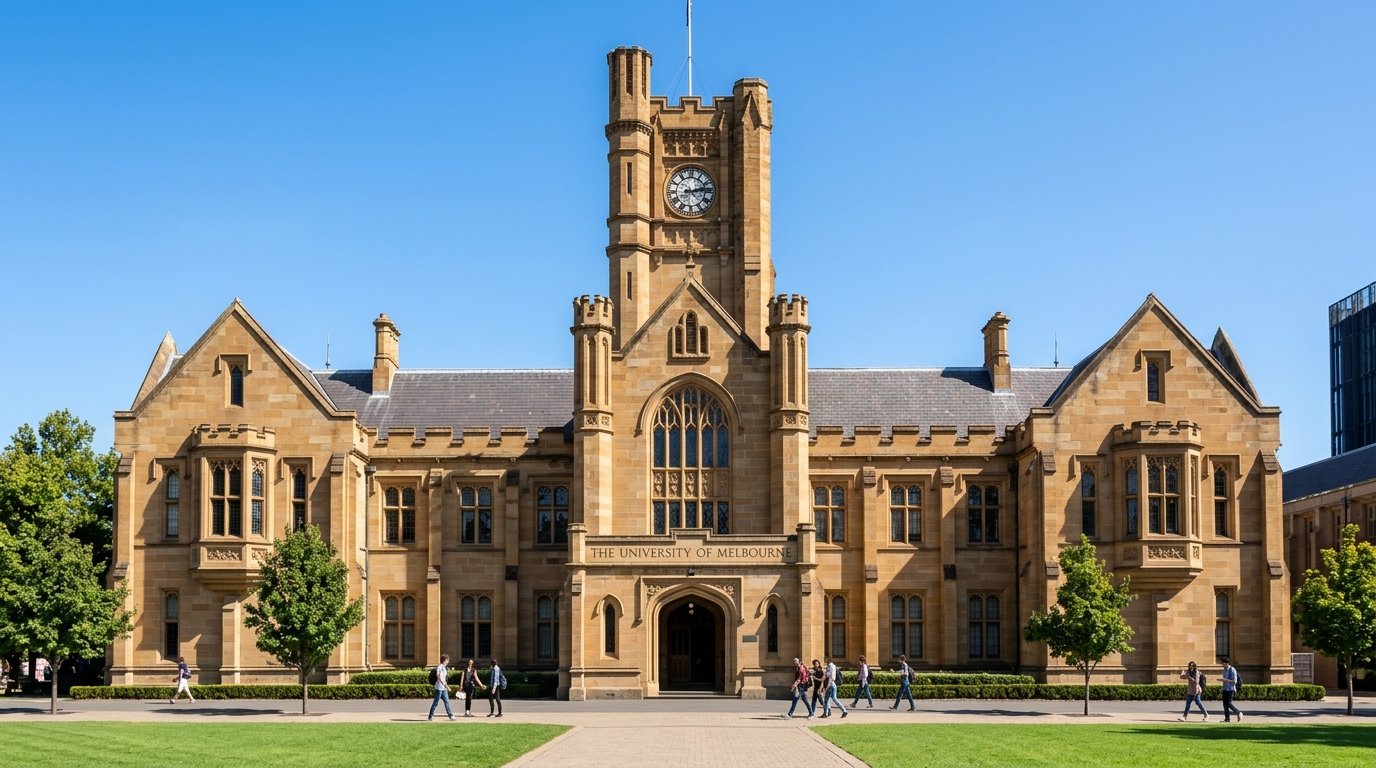
The first major building was the Quadrangle, now commonly called the Old Quadrangle. Construction began in 1854. It provided teaching rooms, administrative areas, research spaces and accommodation associated with the early professors. (The University of Melbourne)
The architecture reflected nineteenth-century European academic traditions. Gothic and classical influences were used to give the university an appearance of permanence and prestige.
The buildings were more than functional structures. They communicated the ambitions of the new institution.
5. The First Classes
Teaching began in April 1855. The university started with only a handful of professors and a very small student body. University records describe the opening classes as involving three professors and 15 students, while other historical records count 16 students at the beginning of instruction. (The University of Melbourne)
The early curriculum was strongly influenced by classical European education. Arts education included subjects such as Latin and Greek.
The foundation professors included William Parkinson Wilson in Mathematics, Martin Howy Irving in Classics and Ancient History, Frederick McCoy in Natural Sciences, and William Edward Hearn in Modern History, Literature and Political Economy. (Aust. Sci. & Tech Heritage Centre)
These academics helped establish the intellectual character of the institution.
William Edward Hearn became especially important because his academic responsibilities included history, literature, political economy and related fields. He later became the foundation Dean of Law. (Faculty of Arts)
Frederick McCoy played an important role in the development of natural science and museum collections. His work helped establish a scientific culture that would become increasingly important to Melbourne.
6. The First Degrees
The university’s first degrees were awarded in 1856. In its earliest period, the institution had a relatively narrow range of academic programs, but expansion began quickly.
Law was introduced in 1857, while engineering and medicine developed during the following years. (Aust. Sci. & Tech Heritage Centre)
This expansion reflected the needs of a growing colony.
Victoria required trained professionals who could construct railways and roads, manage businesses, practice law, provide medical services and support government institutions.
The university consequently became increasingly professional in orientation while maintaining a strong liberal-arts tradition.
7. The Development of Law
Law became one of the university’s earliest professional disciplines.
A law school was established in 1857, and the Faculty of Law was formally established later in the nineteenth century. (Library)
The university’s legal education was closely connected to Melbourne’s growing legal profession.
Many graduates went into careers in courts, government, private practice and politics.
Over time, Melbourne’s law program developed a national reputation and became one of the major pathways into Australia’s legal profession.
8. Medicine and Medical Education
Medicine was another major area of development.
A medical school was established during the 1860s, with the School of Medicine formally developing from 1862. (About us)
Medical education was especially important in a growing colonial city. Melbourne faced public-health problems associated with rapid urbanization, infectious diseases and inadequate sanitation.
The university’s medical community contributed to the development of professional medicine and medical research in Australia.
By the late nineteenth century, Melbourne had become a significant centre for medical education.
One of the most important developments was the education of women in medicine after the university opened its doors to female students.
9. Engineering and the Growth of Science
Engineering education emerged early in the university’s history. A lectureship in Civil Engineering and Surveying was established in 1861, followed by further development of engineering education. (Aust. Sci. & Tech Heritage Centre)
The importance of engineering grew as Victoria developed railways, bridges, roads, mines, ports and industrial infrastructure.
Science also expanded.
Natural history collections became an important part of the university. In 1864, Victoria’s natural history collection was transferred to the university. (About us)
The university also developed museum and scientific facilities, helping establish Melbourne as a centre of scientific study.
10. The System Garden and Scientific Culture
One of the important early scientific spaces was the System Garden.
Established in the nineteenth century, it became a place for teaching botany and studying plants.
The university’s scientific development reflected a broader Victorian-era interest in classification, natural history, geology, chemistry, physics and biology.
The System Garden and museum collections helped transform the university into more than a place where students studied classical texts.
It became a centre for observation, experimentation and scientific research.
11. The University and Aboriginal History
The history of the University of Melbourne cannot be separated from the history of Australia’s Indigenous peoples.
The Parkville campus was established on the lands of the Wurundjeri people of the Kulin Nation. The university today acknowledges the Traditional Owners of the lands on which its campuses and activities are located. (The University of Melbourne)
The university was created during Victoria’s colonial period, and some of its early leaders were prominent members of colonial society. The university itself has acknowledged that its history includes difficult and contested relationships with Aboriginal peoples. (Pursuit)
This aspect of history is increasingly important in understanding the institution.
For much of its early history, Indigenous knowledge and Indigenous voices were marginalized within the formal university system. In the modern period, the university has increasingly focused on Indigenous education, research, representation and reconciliation.
Understanding this transformation requires recognizing both the university’s achievements and the limitations of the colonial system in which it was created.
12. Women Enter the University
One of the most important changes in Melbourne’s history was the admission of women.
The university agreed to admit women in 1879, and women were admitted to study on equal terms with men in 1880. (About us)
This was a major development in Australian higher education.
The first woman to graduate from the university was Julia “Bella” Guerin, who received a Bachelor of Arts in 1883. She became an important symbol of women’s access to university education. (About us)
Women continued to face social and professional barriers, but their admission represented an important change.
The university subsequently became a significant institution in the education of Australian women.
13. Women in Medicine
Women also made significant contributions to medical education.
The first Australian registered female medical students graduated from the University of Melbourne in 1891. (About us)
This development was particularly significant because medicine was traditionally dominated by men.
Female medical graduates went on to serve communities that often had limited access to female doctors.
The university thus contributed to the gradual transformation of professional opportunities for women in Australia.
14. Residential Colleges
Residential colleges became another important part of university life.
Trinity College was established in 1872, and additional colleges followed. (About us)
The residential-college system created communities in which students lived, studied, socialized and participated in cultural activities.
The colleges were influenced by British university traditions, particularly those associated with Oxford and Cambridge.
Over time, they became important centres of student life.
They also became sites of debates about gender, social class, religion and access to education.
15. Wilson Hall
Wilson Hall became one of the university’s most recognizable historic buildings.
Constructed in the nineteenth century, the hall reflected the Gothic architectural style popular in Victorian-era universities. (Library)
It became a major ceremonial and cultural space.
University ceremonies, academic gatherings and public events helped make the historic buildings part of Melbourne’s cultural identity.
16. Student Life and the Birth of Student Representation
For much of the nineteenth century, university life was highly formal.
Students were expected to follow academic rules and participate in an institution dominated by professors and administrators.
However, students gradually developed their own organizations.
In 1906, the Students’ Representative Council was established to represent student interests. (Melbourne Calendar)
Student organizations eventually became important voices on university governance, social issues and political questions.
During the twentieth century, student activism would become increasingly influential.
17. The University at the Beginning of the Twentieth Century
By 1901, student numbers had exceeded 500 for the first time. (About us)
This was a remarkable change from the tiny student population of 1855.
The university was becoming a major Victorian institution.
Its graduates were entering almost every important professional field.
The early twentieth century also brought new academic disciplines, stronger research programs and increasing public expectations.
The university was no longer simply training a small number of colonial professionals. It was becoming part of Australia’s national intellectual infrastructure.
18. The First University Fundraising Campaign
In 1904, the university conducted an important fundraising appeal.
Lady Janet Clarke played a major role in the campaign, which raised £13,326 in seven months to support research projects. (About us)
This event illustrates a continuing feature of university history: the relationship between higher education and private philanthropy.
As universities expanded their research activities, government funding alone was not always sufficient.
Donations from wealthy families and members of the community helped create scholarships, buildings, research programs and student facilities.
19. Melbourne University Press
Melbourne University Press was established in 1921. (Melbourne Calendar)
Its creation strengthened the university’s role in publishing and intellectual life.
University presses provide an important bridge between academic research and the wider public.
Over the twentieth century, Melbourne University Press became associated with scholarly books in history, politics, literature, social sciences and other fields.
The press contributed to Australia’s intellectual culture and helped university scholarship reach readers beyond the campus.
20. The Faculty of Economics and Commerce
Economic and commercial education also developed significantly.
Economics had been taught at the university since William Edward Hearn’s appointment in 1855. (Faculty of Business and Economics)
The Faculty of Commerce was established in 1924, with Professor Sir Douglas Copland as its founding Dean. The Bachelor of Commerce began in 1925. (Faculty of Business and Economics)
This reflected the increasing importance of business and economics in twentieth-century Australia.
Melbourne’s commerce education later became one of the university’s prominent academic areas.
21. The University During the First World War
The First World War affected universities across Australia.
Students and graduates joined military service, while academic and social life was disrupted.
The university became part of the broader national war effort.
The conflict also influenced debates about patriotism, citizenship and national identity.
After the war, the university faced the challenge of rebuilding and expanding.
22. The Interwar Years
The period between the First and Second World Wars was one of intellectual growth.
Australian universities increasingly emphasized research.
At Melbourne, history, science, medicine, law and economics expanded.
The university also became more involved in national debates about Australian society.
Historians began developing distinctive approaches to Australia’s past rather than treating Australian history merely as a minor extension of British history.
This would become especially important in the twentieth century.
23. The History Department and Australian History
History has been taught at Melbourne since the university’s early years.
The formal History program was established in 1854 and became one of Australia’s longest-running university history programs. (Faculty of Arts)
Sir Ernest Scott, Professor of History from 1913 to 1936, helped pioneer the teaching and research of Australian history.
His successor Max Crawford helped make the department one of the most influential history departments in Australia. (Faculty of Arts)
Later historians associated with Melbourne included Manning Clark, Hugh Stretton, Geoffrey Blainey, Margaret Kiddle, Lloyd Robson and Geoffrey Serle. (Faculty of Arts)
Their work had an enormous impact on how Australians understood their country’s past.
24. Australian Historical Studies
In 1940, the History Department launched the journal Historical Studies. It later became Australian Historical Studies. (Faculty of Arts)
The journal became an important platform for historical scholarship.
It helped establish Melbourne as a major centre for historical research.
The university’s historians explored subjects including colonial society, Indigenous history, politics, migration, labour, culture, gender and international relations.
25. The Second World War
The Second World War again transformed university life.
Students and staff became involved in military service, government work and scientific research.
Universities played an increasingly important role in national research during wartime.
Science and medicine became particularly important.
After 1945, universities entered a new era.
Australia faced rapid social change, economic development and increased demand for higher education.
26. The Birth of the Australian PhD
One of the University of Melbourne’s most important achievements occurred in 1948.
The university became the first Australian university to offer the PhD, awarding its first two doctorates that year to Erica Wolff in Arts and R.H. Myers in Science. (About us)
The introduction of the PhD represented a major transformation.
Australian universities were moving toward the research-intensive model common in leading international universities.
Doctoral education created a pathway for advanced original research within Australia.
It also strengthened the university’s international academic standing.
27. Postwar Expansion
The decades after the Second World War brought enormous growth.
Australia’s population increased, migration expanded and professional occupations multiplied.
More young Australians wanted university education.
The University of Melbourne expanded its facilities, academic departments and research programs.
New buildings appeared across the campus.
Libraries, laboratories, lecture theatres and student facilities were developed.
The university also strengthened its relationships with hospitals, government agencies and industry.
28. The Baillieu Library
The Baillieu Library opened in 1959. (Melbourne Calendar)
It became one of the university’s most important academic facilities.
Libraries are central to university life because they provide access to books, manuscripts, journals, archives and other research resources.
Over time, the Baillieu Library became a major repository for rare books, special collections and research materials.
Its role expanded further in the digital age as universities increasingly combined physical collections with electronic databases.
29. The Centre for the Study of Higher Education
In 1968, the university established the Centre for the Study of Higher Education. (Melbourne Calendar)
This reflected the university’s interest not only in teaching academic subjects but also in studying universities themselves.
Higher education had become a major social institution.
Researchers increasingly examined questions about teaching quality, university governance, student participation, academic work and educational policy.
30. The 1960s and Student Activism
The 1960s were a period of major social change.
Across the world, students questioned traditional authority.
At Melbourne, students became increasingly active in debates about university governance, civil rights, international politics and social justice.
The Vietnam War was particularly controversial.
Universities became spaces where students and academics debated Australia’s foreign policy and political responsibilities.
Student demonstrations became an important part of university life.
31. The 1970s: A New University Environment
The 1970s brought further changes.
Australian higher education became more accessible.
The university developed new academic programs and expanded research.
A master plan for university development was established in 1971. (Melbourne Calendar)
The institution was becoming physically larger and organizationally more complex.
At the same time, universities faced debates about funding, governance, academic freedom and the role of higher education in society.
32. The University Assembly
The University Assembly was established in 1974. (Melbourne Calendar)
This was part of broader efforts to create more representative university governance.
The old model of university authority, dominated by senior administrators and professors, was increasingly challenged.
Students and staff wanted a greater voice in institutional decisions.
These debates continued throughout the late twentieth century.
33. New Academic Fields
During the second half of the twentieth century, the university expanded beyond its traditional academic disciplines.
New areas of research developed in computing, environmental science, social sciences, psychology, biomedical research, communications and cultural studies.
Interdisciplinary research became increasingly important.
Instead of treating academic fields as isolated subjects, researchers began working across disciplinary boundaries.
This approach would become especially important in addressing complex global challenges.
34. Indigenous Education and Scholarship
The university’s approach to Indigenous education changed significantly during the late twentieth and early twenty-first centuries.
The institution increasingly recognized the importance of Indigenous knowledge and the need to improve educational opportunities for Aboriginal and Torres Strait Islander students.
Modern university policies emphasize respect for Indigenous peoples and recognition of Traditional Owners.
This is an important transformation from the institution’s nineteenth-century origins.
35. The 1980s and 1990s
During the 1980s and 1990s, Australian higher education underwent significant restructuring.
Universities increasingly competed for students, research funding and international partnerships.
The University of Melbourne responded by expanding its research capacity and developing new relationships with industry and government.
Technology also transformed academic work.
Computers became increasingly important for teaching, research, administration and communication.
By the end of the twentieth century, the university was a much larger and more complex organization than the institution founded in 1853.
36. The University in the Digital Age
The arrival of the internet transformed higher education.
Students gained access to online databases, electronic journals and digital learning resources.
Research became increasingly international.
Academic collaboration could take place across borders almost instantly.
The University of Melbourne adopted digital technologies in teaching, administration and research.
The traditional campus remained important, but it was increasingly connected to a global academic network.
37. The Melbourne Model
One of the most significant educational reforms in the university’s modern history was the Melbourne Model.
Introduced in the 2000s, the model reorganized undergraduate education around broad bachelor’s degrees followed by professional graduate programs and specialized postgraduate study.
The idea was influenced partly by international higher-education models.
The university sought to create graduates with broad intellectual foundations before specialization.
This represented a major change from the traditional Australian undergraduate system.
The Melbourne Model became an important part of the university’s identity.
38. Expansion of Research
Research became one of the central pillars of Melbourne’s modern identity.
The university established and supported research centres, institutes and interdisciplinary programs.
Current university information states that it has more than 70 research centres and institutes across nine faculties. (About us)
Research at Melbourne covers areas ranging from medicine and biotechnology to climate science, artificial intelligence, law, economics, education, humanities and social sciences.
The university’s research strategy increasingly emphasizes collaboration.
Modern problems such as climate change, pandemics, urbanization and technological transformation cannot easily be solved by one discipline alone.
39. Medical and Biomedical Research
Medical research became one of the university’s major strengths.
The university developed extensive partnerships with hospitals and medical research institutes.
Research programs cover areas such as cancer, infectious disease, neuroscience, public health, genetics and biomedical science.
The relationship between academic research and clinical medicine has become a defining feature of modern Melbourne.
Students and researchers can work alongside hospitals and research institutes, connecting laboratory discoveries with patient care.
40. Architecture and the Built Environment
Architecture has also played an important role in the university.
The Parkville campus itself provides a visual history of higher education, combining historic Gothic buildings with modern architecture.
The Faculty of Architecture, Building and Planning has contributed to research and teaching in architecture, urban planning and design.
As Melbourne has grown into a major global city, research into cities and urban development has become increasingly significant.
41. Fine Arts and Music
The university’s creative disciplines also have a long history.
The Conservatorium of Music was established in 1895. (About us)
Today, the Southbank campus is home to the Faculty of Fine Arts and Music and brings together the Victorian College of the Arts and Melbourne Conservatorium of Music. (About us)
Southbank places the university directly within Melbourne’s major arts precinct.
Students can study visual arts, theatre, dance, film, music and related creative disciplines.
42. The Burnley Campus
Burnley has become an important centre for horticulture and environmental research.
The campus is known internationally for teaching and research in urban, environmental and ornamental horticulture. (About us)
Its work is increasingly relevant to climate adaptation, urban greening and sustainable cities.
As cities around the world confront heat, water scarcity and biodiversity loss, this type of research has become more important.
43. Dookie and Agricultural Education
The Dookie campus connects the university with agricultural education and rural research.
Agriculture has long been important to Victoria.
Research at regional campuses allows the university to study farming, food production, environmental management and rural economies.
These campuses demonstrate that the University of Melbourne is not limited to the metropolitan environment.
44. Creswick and Forest Science
Creswick has played a role in forestry and environmental education.
Its location provides opportunities for field-based research.
Field stations and regional campuses allow students and researchers to work directly with natural environments.
This is particularly valuable in environmental science, ecology and land management.
45. Werribee and Veterinary Science
Werribee is associated particularly with veterinary education and research.
The veterinary school has become an important component of Australia’s professional education system.
Veterinary science connects animal health, agriculture, public health and biological research.
The Werribee campus demonstrates how the university’s educational system extends beyond the historic Parkville site.
46. Fishermans Bend
Fishermans Bend represents the university’s continuing expansion into Melbourne’s innovation landscape.
The area is being developed as a major research and innovation precinct.
The university’s involvement reflects a modern emphasis on engineering, technology, advanced manufacturing and industry collaboration.
It demonstrates how the institution continues to adapt to new economic and technological priorities.
47. Parkville: The Historic Heart
Despite expansion, Parkville remains the symbolic heart of the university.
The Old Quadrangle represents the beginning of the institution.
Around it are historic buildings, libraries, laboratories, lecture theatres, student spaces and modern research facilities.
The campus has evolved considerably while retaining visible links with the nineteenth century.
This mixture of old and new is one of the university’s defining characteristics.
48. Architecture as Historical Memory
The university’s buildings preserve memories of different periods.
The Old Quadrangle represents the nineteenth century.
Wilson Hall represents Victorian Gothic traditions.
Later buildings reflect modernist and contemporary architectural ideas.
The campus therefore functions almost like an architectural timeline.
Walking through Parkville provides a visual representation of the university’s development from a small colonial institution to a major research university.
49. Alumni and Public Life
The University of Melbourne has produced graduates who have contributed to politics, law, medicine, science, business, education, literature and the arts.
Its alumni network extends throughout Australia and around the world.
Graduates have served as judges, politicians, doctors, scientists, entrepreneurs, academics, writers and public servants.
The university’s influence therefore extends far beyond its campuses.
50. The University and Australian Politics
Because Melbourne educated many lawyers, economists, academics and public servants, it naturally became connected with Australian political life.
Students and graduates have participated in political parties, government institutions, courts and policy organizations.
The university itself has often been a site of political debate.
Questions about education policy, social inequality, war, environmental issues and human rights have repeatedly generated discussion within the campus community.
51. Academic Freedom
Academic freedom has become a central principle of modern university culture.
Researchers need freedom to investigate controversial questions.
The University of Melbourne’s long history includes debates over political ideas, social questions and academic interpretation.
Its historians, scientists and social scientists have frequently challenged conventional assumptions.
This tradition of inquiry is fundamental to research universities.
52. Internationalization
The university’s transformation into an international institution accelerated during the late twentieth and early twenty-first centuries.
International students became an increasingly important part of the university community.
The university established partnerships with institutions around the world.
Research became increasingly global.
Modern University of Melbourne statistics describe a community of more than 52,000 students and more than 20,000 international students from around 150 countries. (University Chancellors Council)
This represents an extraordinary transformation from the 15 or 16 students who attended the first classes in 1855.
53. Global Rankings and Reputation
The University of Melbourne is consistently placed among leading universities internationally.
The university’s current facts and figures page reports that major international rankings place it first in Australia, with positions including #22 in QS, #37 in ARWU and #37 in Times Higher Education according to the rankings it cites. (About us)
Rankings are only one way of measuring a university, but they illustrate the institution’s international reputation.
Its strongest areas include medicine, law, education, arts and humanities, social sciences, engineering and science.
54. Research Centres and Institutes
Modern research at Melbourne is increasingly organized around centres and institutes.
These organizations bring together researchers from different disciplines.
A biomedical project, for example, may involve medicine, biology, engineering, data science and public health.
Similarly, climate research may involve science, economics, law, policy and urban planning.
This interdisciplinary approach reflects the complexity of twenty-first-century problems.
55. The University During the COVID-19 Pandemic
The COVID-19 pandemic created one of the most significant disruptions to higher education in recent history.
Teaching moved online.
Researchers became involved in studies related to the virus, public health, epidemiology, medicine and social consequences.
Students experienced disruptions to normal campus life.
The pandemic also accelerated the adoption of digital learning technologies.
After the immediate crisis, universities had to reconsider the balance between face-to-face teaching and online education.
56. Technology and Artificial Intelligence
The university now operates in an era of rapid technological transformation.
Artificial intelligence, machine learning, robotics, data science and digital technologies are influencing almost every academic field.
Engineering and information technology researchers work on new computational technologies.
Humanities scholars examine the cultural and ethical consequences of AI.
Law scholars explore regulation.
Medical researchers use advanced data analysis and computational methods.
This interdisciplinary interaction is likely to become increasingly important in the university’s future.
57. Sustainability
Climate change and environmental sustainability are major priorities for modern universities.
Melbourne’s research includes climate science, environmental policy, sustainable architecture, urban planning and ecological research.
The university’s regional campuses provide opportunities for environmental and agricultural studies.
Its urban campuses also serve as living laboratories for sustainable infrastructure.
As Melbourne faces challenges related to population growth, heat and environmental change, the university has an important role to play.
58. Diversity and Inclusion
The modern university is far more diverse than the institution of 1853.
The original university was open only to men.
Today, students come from different countries, cultural backgrounds and socioeconomic circumstances.
The university increasingly focuses on access, inclusion and student support.
This transformation reflects the broader evolution of Australian society.
59. The University and Social Change
Over more than 170 years, the University of Melbourne has both reflected and influenced Australian society.
In the nineteenth century, it helped create the professional class of colonial Victoria.
In the twentieth century, it became a major centre of scholarship and research.
In the twenty-first century, it functions as a global institution addressing international problems.
Its history demonstrates how universities change alongside society.
60. Challenges in the Twenty-First Century
Despite its success, the university faces significant challenges.
Higher education is becoming increasingly competitive.
Universities must balance teaching, research, public service and financial sustainability.
International education is vulnerable to geopolitical and economic changes.
Technology is transforming the meaning of teaching and assessment.
Climate change creates new research demands.
Students increasingly expect flexible education, strong career outcomes and mental wellbeing support.
The University of Melbourne must therefore continue to evolve.
61. The Future of the University
The university’s future will likely be shaped by research, technology, global collaboration and social responsibility.
Artificial intelligence may transform teaching and research.
Biomedical science may produce new approaches to disease.
Climate research may help cities and communities adapt to environmental change.
Engineering may contribute to clean energy and advanced manufacturing.
Humanities and social sciences will remain important for understanding the ethical, cultural and political dimensions of technological change.
The university’s future therefore depends not only on scientific innovation but also on its ability to understand society.
62. A University Built on 170 Years of Change
The story of the University of Melbourne is ultimately a story of transformation.
It began in 1853 as a small colonial university.
Its first classes involved only a tiny number of students.
Its original curriculum was dominated by classical education.
Women were excluded.
Research was limited compared with modern standards.
Yet the institution steadily changed.
It expanded into law, medicine, engineering, science, commerce, education, architecture, music and the arts.
Women were admitted.
Research became central.
The PhD was introduced.
Student representation developed.
New campuses were established.
International students became an important part of the university.
Modern research now crosses traditional disciplinary boundaries.
63. Historical Timeline
1852
The Victorian Legislative Council begins the process of establishing a university.
1853
The University of Melbourne is established by Act of the Victorian Parliament. (Library)
1854
The foundation stone of the first university building is laid.
1855
Teaching begins with a very small group of students and professors. (The University of Melbourne)
1856
The first degrees are conferred.
1857
Law education is established.
1861
Engineering education develops and the ornamental lake is formed.
1862
The School of Medicine is established.
1872
Trinity College becomes the first university college.
1879
The university agrees to admit women.
1880
Women are admitted to study on equal terms with men.
1883
Julia “Bella” Guerin becomes the first woman to graduate from the university.
1891
The first Australian registered female medical students graduate from Melbourne.
1895
The Conservatorium of Music is established.
1901
Student numbers exceed 500.
1904
The School of Dentistry is established and the first major university fundraising appeal takes place.
1906
The Students’ Representative Council is established.
1921
Melbourne University Press is established.
1924
The Faculty of Commerce is established.
1925
The Bachelor of Commerce begins.
1940
The History Department launches Historical Studies.
1948
The University of Melbourne becomes the first Australian university to offer the PhD.
1959
The Baillieu Library opens.
1968
The Centre for the Study of Higher Education is established.
1971
A major university master plan is developed.
1974
The University Assembly is established.
2000s
The Melbourne Model transforms undergraduate education.
Twenty-First Century
The university expands international education, research, innovation and interdisciplinary collaboration.
64. The Importance of the University of Melbourne
The importance of the University of Melbourne can be understood at several levels.
Educational Importance
It has educated generations of Australian and international students.
Scientific Importance
Its researchers have contributed to medicine, science, engineering, agriculture and environmental research.
Cultural Importance
Its humanities, arts and music programs have influenced Australia’s cultural life.
Professional Importance
Its graduates have entered law, medicine, business, government and many other professions.
Historical Importance
Its own history provides a record of Australia’s transition from colony to modern nation.
International Importance
Its research partnerships and international student population connect Australia to the global academic community.
65. Conclusion
The University of Melbourne has undergone an extraordinary transformation since its establishment in 1853.
It began during a period when Victoria was developing rapidly and Melbourne was becoming one of Australia’s major cities. Its founders believed that a university was essential to the colony’s future. The institution they created was small, elite and shaped by nineteenth-century social values.
Yet it did not remain unchanged.
The university expanded its academic disciplines, developed professional education, admitted women, established research programs, created student organizations, expanded its campuses and became increasingly international.
Its history also contains difficult chapters. It was created within a colonial society whose institutions marginalized Aboriginal peoples, and its early admission policies excluded women. Understanding the university honestly requires acknowledging these realities as well as celebrating its achievements.
The introduction of the PhD in 1948 was a landmark in Australian higher education. The growth of research after the Second World War transformed Melbourne into a major research university. Later reforms, including the Melbourne Model, changed its approach to undergraduate education.
Today, the University of Melbourne is a large international institution with tens of thousands of students, extensive research centres, multiple campuses and a global network of alumni. Its historic Parkville campus remains a powerful reminder of its origins, while modern research and innovation facilities demonstrate its continuing evolution. (About us)
The university’s story is therefore much more than the history of a single educational institution. It is also part of the history of Victoria and Australia.
From the first small classes in 1855 to a modern university community of more than 50,000 students, the journey reflects the enormous transformation of Australian society itself.
The University of Melbourne has survived wars, economic crises, political controversies, educational reforms and technological revolutions. Through each period, it has repeatedly reinvented itself while preserving important connections with its past.
Its Old Quadrangle remains a symbol of the university founded in the nineteenth century. Its laboratories, research institutes, hospitals, libraries, creative spaces and modern campuses represent the university of the twenty-first century.
The central challenge for the future will be maintaining the values that have sustained the institution—scholarship, curiosity, research, education and public service—while responding to a rapidly changing world.
After more than 170 years, the University of Melbourne remains one of Australia’s most significant institutions of higher learning. Its history demonstrates that universities are never static. They are living institutions shaped by the people who study, teach, research and work within them, and by the societies they serve.