Stanford University is one of the most influential universities in the world, renowned for its achievements in science, technology, medicine, business, engineering, law, education, and the humanities. Officially known as Leland Stanford Junior University, it was founded in California in 1885 by Leland Stanford and Jane Lathrop Stanford in memory of their only child, Leland Stanford Jr. The university opened its doors to students on October 1, 1891, with roughly 555 students. (Stanford University)
What makes Stanford’s history especially remarkable is that it was created during a period when American higher education was dominated by older institutions with centuries-old traditions. Stanford was designed to be different from the beginning. It was coeducational, non-denominational, practical in its educational philosophy, and strongly connected to the needs and opportunities of the American West. Its founders wanted education to prepare students not only for intellectual achievement but also for useful and productive lives. (Facts)
Over more than 130 years, Stanford developed from a new university on a California stock farm into a major research institution with enormous influence on modern science, technology, medicine, entrepreneurship, and public life. Its location in the heart of what became Silicon Valley helped create an unusually close relationship between academic research and technological innovation.
The following is a detailed history of Stanford University, covering its founding, early development, major challenges, academic transformation, relationship with Silicon Valley, important discoveries, notable people, campus development, and its continuing role in global higher education.
1. California Before Stanford University
To understand Stanford’s history, it is important to understand California in the nineteenth century.
California underwent enormous changes after the discovery of gold in 1848. The Gold Rush transformed the region from a relatively remote territory into a rapidly growing center of commerce, migration, agriculture, transportation, and political activity. Thousands of people arrived from across the United States and around the world.
Leland Stanford was one of the ambitious individuals who came to California during this period. Born in 1824 in New York, Stanford eventually moved west and became involved in business and politics. His career expanded considerably as California developed economically.
Stanford became particularly important in the development of transportation. He was one of the leading figures associated with the Central Pacific Railroad, which played a central role in constructing the western portion of the first transcontinental railroad. In 1869, Stanford participated in the historic completion of the transcontinental railroad at Promontory, Utah. (Facts)
His wealth grew substantially through business and railroad activities. Eventually, the Stanford family became one of the most prominent families in California.
Leland Stanford also entered politics. He served as governor of California and later became a United States senator. His public career gave him considerable influence in the state and nationally. (Facts)
Meanwhile, Leland’s wife, Jane Lathrop Stanford, played a major role in the family’s personal life and eventually in the development and survival of the university.
Together, they would create an institution unlike many universities of their era.
2. The Tragedy That Created Stanford
The origins of Stanford University are deeply connected with personal tragedy.
Leland and Jane Stanford had one child, Leland Stanford Jr., who was born in 1868. The Stanfords were extremely devoted to their son and hoped that he would eventually attend university and perhaps continue the family’s legacy.
In 1884, while traveling with his parents in Europe, Leland Stanford Jr. became seriously ill with typhoid fever. He died in Florence, Italy, on March 13, 1884, at only 15 years of age. (Facts)
The death devastated his parents.
The Stanfords had accumulated considerable wealth, but their personal plans for their son had suddenly disappeared. They began considering how they could create a lasting memorial to him.
Instead of constructing only a monument or memorial building, they decided to establish something much larger: a university.
Their idea was to create an institution that could educate thousands of young people in the future.
This emotional decision became the foundation of Stanford University.
The famous phrase associated with their decision is that, because they could no longer help their own son, “the children of California shall be our children.” Stanford’s historical materials describe this as the inspiration behind the creation of the university. (Stanford University)
The university was therefore born from both grief and an extraordinary sense of public responsibility.
3. The Founding Vision
The Stanfords did not simply want to reproduce an existing university.
They wanted to create a new kind of institution.
Their Founding Grant described the purpose of the university in terms of public welfare, useful education, personal success, and contribution to society. Stanford’s official history explains that the founders wanted graduates to become both educated and useful citizens. (Facts)
Several aspects of the original vision were unusual for the nineteenth century.
Coeducation
Stanford was established as a coeducational university.
At a time when many major private universities were primarily or exclusively male institutions, Stanford admitted women from its earliest days. (Facts)
Non-denominational education
Stanford was also founded without affiliation to a particular religious denomination.
This reflected the founders’ desire for a broad educational environment rather than a narrowly religious institution.
Practical education
Another important feature was the emphasis on practical knowledge.
The founders wanted students to become capable of succeeding in real life rather than simply studying abstract classical subjects.
Public service
The university’s founding philosophy emphasized public welfare.
Education was not supposed to benefit only the individual. It was also intended to benefit society.
These principles became important parts of Stanford’s institutional identity.
4. The Founding Grant of 1885
The formal legal foundation of Stanford University came in 1885.
On November 11, 1885, Leland and Jane Stanford executed the Founding Grant establishing Leland Stanford Junior University. Stanford’s administrative history identifies this document as the foundational legal instrument of the university. (Administrative Guide)
The California legislature had already passed an enabling act earlier that year.
The Stanfords contributed enormous resources to the project.
One of the most important gifts was their Palo Alto Stock Farm.
The property covered approximately 8,180 acres and had originally been used by the Stanford family for breeding and training trotting horses. (Stanford University)
This explains one of Stanford’s enduring nicknames:
“The Farm.”
Even today, Stanford students and members of the university community often use “The Farm” as an informal name for the campus.
The Founding Grant also included important restrictions and principles concerning the university’s land and organization. Among other provisions, land given to the university was not intended to be sold, helping preserve the character of the campus. (Facts)
5. Designing the Stanford Campus
Creating a university required more than money and land.
The Stanfords needed a vision for the physical campus.
They worked with influential architects and landscape designers, including Frederick Law Olmsted, who was famous for designing Central Park in New York City. (Facts)
The resulting campus design was distinctive.
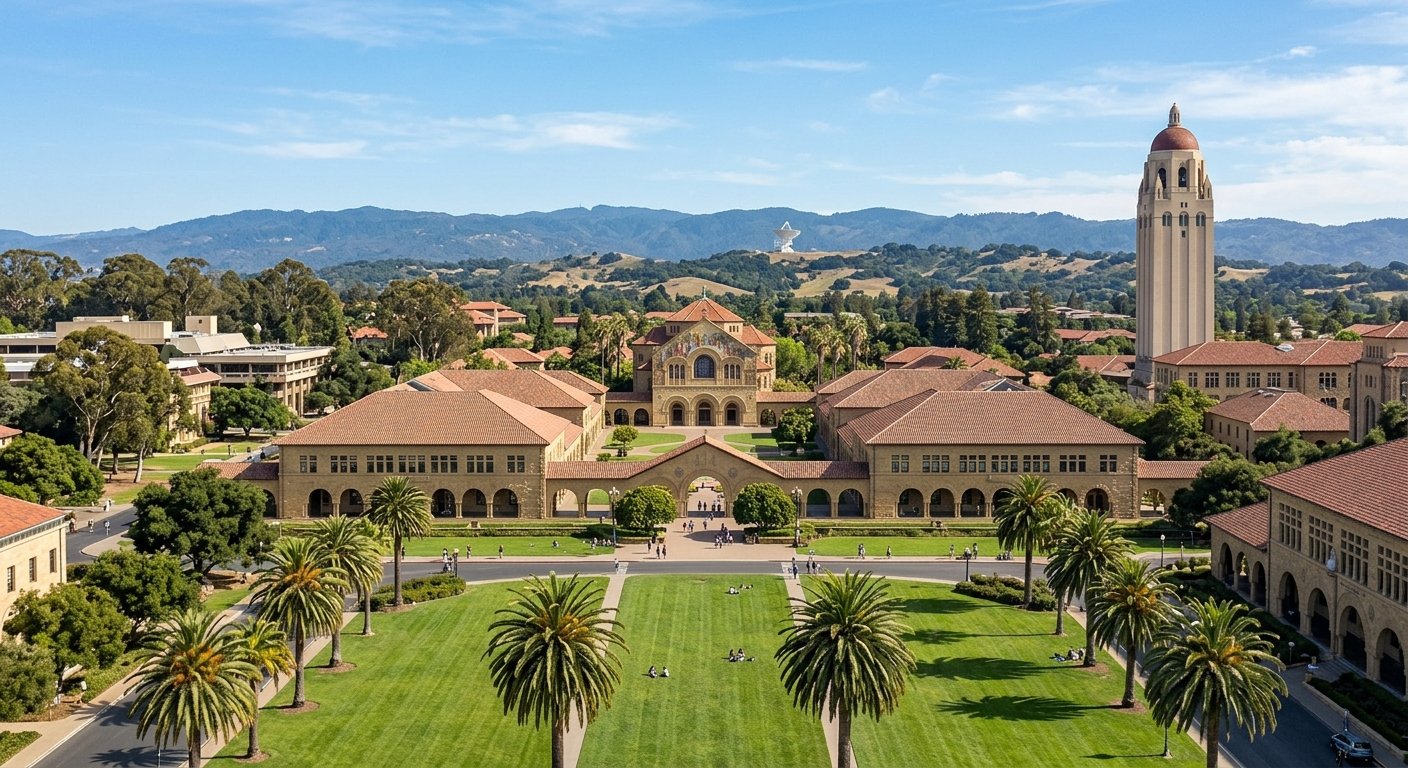
The original university was organized around the Main Quadrangle, commonly called the Main Quad.
Buildings were constructed primarily from local sandstone and featured red-tiled roofs and covered arcades.
The architectural style combined elements associated with Richardsonian Romanesque and California/Mission influences. (Stanford University)
The design was not merely decorative.
The central quadrangle created a strong sense of community and provided space for classrooms, offices, and student activities.
The plan also anticipated future expansion.
Stanford’s early designers imagined additional quadrangles extending from the central campus.
This flexibility later became important as the university expanded.
6. The Cornerstone and Construction
The cornerstone of the university was laid on May 14, 1887.
The date was significant because it would have been Leland Stanford Jr.’s nineteenth birthday. (Facts)
Construction continued for several years.
The Stanfords were deeply involved in the process.
The original campus eventually included the Inner Quadrangle, residence halls, engineering facilities, and other structures necessary for a functioning university.
Construction was ambitious for a new institution.
The Stanfords were essentially creating an entire university almost from scratch.
This included buildings, laboratories, libraries, academic departments, housing, administrative systems, and a faculty.
The scale of the project reflected their enormous financial commitment.
7. Choosing Stanford’s First President
The Stanfords needed someone capable of transforming their vision into a functioning academic institution.
They eventually selected David Starr Jordan as Stanford’s first president.
Jordan had been president of Indiana University and had a strong reputation as an educator and scientist.
He became a crucial figure in shaping Stanford’s early identity.
Jordan believed strongly in scientific education, academic organization, research, and intellectual freedom.
His leadership helped establish Stanford as a serious academic institution rather than simply a memorial to Leland Stanford Jr.
Stanford’s first faculty included scholars recruited from other universities, including Cornell. (hci.stanford.edu)
The early university was therefore connected to broader developments in American higher education.
8. Stanford Opens Its Doors in 1891
Stanford University officially opened on October 1, 1891.
Approximately 555 students were registered during the first year, according to Stanford’s official historical records. (Facts)
The opening was a major event for California.
The university was already unusual because of its coeducational and non-denominational character.
It also emphasized practical education.
The first students became part of what Stanford would later call its pioneer generation.
Among them was Herbert Hoover, who later became the 31st president of the United States. Hoover was a member of Stanford’s first graduating class. (Facts)
The opening of Stanford represented the realization of a vision that had begun with the death of a teenager only seven years earlier.
9. Early Academic Life
From its earliest days, Stanford attempted to combine traditional academic subjects with practical fields.
Students could study sciences, engineering, humanities, social sciences, education, and other disciplines.
This interdisciplinary approach would eventually become one of Stanford’s greatest strengths.
The university’s founders believed education should prepare students for useful careers.
The first president, David Starr Jordan, also emphasized research and scientific investigation.
This helped establish a culture in which professors were expected not merely to teach but also to contribute to knowledge.
That culture became increasingly important during the twentieth century.
10. Stanford’s First Major Crisis: Leland Stanford’s Death
Stanford’s early success was threatened almost immediately.
Leland Stanford died on June 21, 1893, only two years after the university opened. (Facts)
His death created serious financial and legal problems.
The university was closely connected to the Stanford family’s assets.
Because of legal complications surrounding the estate, Stanford’s financial resources became difficult to access.
The federal government also pursued claims involving Leland Stanford’s estate and railroad-related financial matters. (quake06.stanford.edu)
The young university faced the possibility of severe financial instability.
At this point, Jane Stanford became essential to Stanford’s survival.
11. Jane Stanford’s Leadership
Jane Stanford played a much larger role in Stanford’s history than is sometimes recognized.
After her husband’s death, she worked to protect the university.
She helped maintain its financial stability and continued the founders’ vision.
Her leadership was particularly important because Stanford was still a young institution.
Without her support, the university might have struggled to survive.
Jane Stanford remained closely connected to Stanford’s development until her death in 1905. (Facts)
Her influence can also be seen in the university’s continued emphasis on education, culture, museums, and public benefit.
Today, Stanford has formally honored her contributions through features such as Jane Stanford Way, which was renamed in 2019. (Stanford Community Engagement)
12. Stanford’s Early Scientific Culture
Science became an important part of Stanford from its beginning.
The university’s location in California offered opportunities to study geology, biology, agriculture, engineering, and the natural environment.
Stanford also developed a strong relationship with the Pacific coast.
In 1892, the university established the Hopkins Marine Station on Monterey Bay, creating an important center for marine research. (Facts)
This reflected Stanford’s commitment to practical and experimental education.
Research was increasingly becoming a central feature of American universities, and Stanford positioned itself within this emerging research culture.
13. Stanford and the Arts
The Stanfords also believed culture and education should extend beyond science and technology.
The university’s museum tradition began around the time Stanford opened.
The Stanford family had collected art and cultural objects during their travels.
In 1894, the Leland Stanford Jr. Museum opened to the public. (museum.stanford.edu)
The museum became an important cultural institution.
Its collections included archaeological, ethnological, artistic, and cultural materials.
The museum reflected Jane Stanford’s belief that museums could play an important educational role.
The institution later became part of Stanford’s broader arts and museum environment.
14. Stanford and the 1906 Earthquake
One of the greatest disasters in Stanford’s early history occurred on April 18, 1906.
The San Francisco earthquake caused extensive damage across the region.
Stanford’s campus was also seriously affected.
Many buildings suffered structural damage.
The original Main Quad, constructed with sandstone masonry, was particularly vulnerable.
The earthquake forced Stanford to reconsider how its buildings should be constructed.
Some structures were rebuilt or modified.
The disaster influenced Stanford’s architectural development for decades.
Instead of destroying the university, however, the earthquake became part of its long process of rebuilding and modernization.
15. The Growth of Stanford in the Early Twentieth Century
After the earthquake, Stanford gradually rebuilt.
The university expanded its academic programs and research activities.
Professional education also became increasingly important.
Stanford acquired Cooper Medical College in 1908, an important step toward the development of medical education at Stanford. (Facts)
A School of Law was organized later that year.
These developments helped Stanford become more than an undergraduate college.
It was increasingly becoming a comprehensive university.
16. Stanford’s Commitment to Women
Stanford’s coeducational founding was one of its defining characteristics.
Women attended Stanford from its earliest days.
The university also became involved in early women’s athletics.
In 1896, Stanford participated in what Stanford’s historical records identify as the first women’s intercollegiate basketball game. (Facts)
The presence of women in Stanford’s academic and athletic life helped distinguish the institution from many older American universities.
Although gender equality was far from complete in American society, Stanford’s founding structure created opportunities for women to participate in higher education from the beginning.
17. Stanford’s First PhD and Early Graduates
Stanford awarded its first PhD in 1894.
This was significant because doctoral education represented the university’s growing commitment to advanced scholarship and research. (Facts)
The Pioneer Class graduated in 1895.
Among the graduates was Herbert Hoover.
Hoover later became an engineer, businessman, humanitarian, and eventually president of the United States.
His career became one of the earliest examples of Stanford graduates achieving international influence.
18. Stanford Through the First Half of the Twentieth Century
During the first decades of the twentieth century, Stanford continued expanding.
New academic departments were created.
Research became increasingly important.
The university developed stronger programs in engineering, medicine, law, education, sciences, and humanities.
Stanford’s location on the Pacific coast also gave it a distinctive relationship with Asia and the Pacific world.
The university’s geographic position encouraged research and educational connections that differed from those of East Coast institutions.
Stanford gradually established itself as one of America’s major universities.
19. Stanford During World War II
World War II transformed American universities.
Universities became deeply involved in military research, engineering, science, medicine, and national defense.
Stanford was no exception.
Its scientists and engineers contributed to wartime research.
The university’s technical orientation made it particularly well positioned to participate in scientific and engineering projects.
The war also accelerated the growth of American science.
After 1945, universities received increasing federal research funding.
Stanford benefited enormously from this transformation.
20. The Rise of Engineering at Stanford
Engineering became one of Stanford’s most important academic strengths.
The university invested heavily in engineering education and research.
Electrical engineering, mechanical engineering, computer science, materials science, and related disciplines gradually became central to Stanford’s identity.
This development would eventually have enormous consequences for the technology industry.
Stanford researchers were increasingly working on problems involving electronics, communications, computation, and advanced materials.
The university’s culture encouraged collaboration between academic research and industry.
21. Stanford and the Birth of Silicon Valley
Perhaps no part of Stanford’s history has had a greater impact on the modern world than its relationship with Silicon Valley.
The area around Stanford was not always known as Silicon Valley.
Its transformation occurred gradually during the twentieth century.
Stanford played an important role by encouraging technology companies, researchers, and entrepreneurs to interact.
One of the most important figures in this process was Frederick Terman.
Terman became a leading Stanford engineering administrator and strongly encouraged students and researchers to pursue technological entrepreneurship.
He believed Stanford should work closely with industry.
Rather than seeing commercial activity as incompatible with academic life, Terman viewed technology transfer and entrepreneurship as ways to turn university knowledge into practical innovations.
This philosophy became enormously influential.
22. Stanford Research Park
In the 1950s, Stanford helped establish the Stanford Industrial Park, later known as Stanford Research Park.
The idea was to bring technology companies close to the university.
This created a physical and intellectual connection between researchers and industry.
Companies could access Stanford’s talent and scientific environment.
Stanford researchers could interact with engineers and entrepreneurs working on commercial technologies.
The arrangement helped create an innovation ecosystem.
Companies associated with the region included major technology firms such as Hewlett-Packard.
This relationship between Stanford and industry became one of the foundations of Silicon Valley.
23. Stanford and Hewlett-Packard
The story of Hewlett-Packard is especially important.
Bill Hewlett and David Packard were Stanford graduates who worked with Stanford professor Frederick Terman.
Their company, Hewlett-Packard, became one of the most influential technology companies of the twentieth century.
The famous story of HP’s early development illustrates Stanford’s entrepreneurial philosophy.
Rather than simply preparing students for employment, Stanford increasingly encouraged graduates to create companies and new technologies.
This became a defining characteristic of the university.
24. Stanford’s Research Revolution
After World War II, American universities increasingly became centers of federally funded research.
Stanford expanded dramatically in areas such as:
- Physics
- Chemistry
- Engineering
- Medicine
- Computer science
- Mathematics
- Biology
- Earth sciences
- Social sciences
- Economics
The university’s research infrastructure grew.
Laboratories became increasingly important.
Stanford attracted leading scientists from around the world.
This helped transform the university into a major research institution.
25. The Stanford Linear Accelerator Center
One of the most important scientific developments associated with Stanford was the creation of the Stanford Linear Accelerator Center, now known as SLAC National Accelerator Laboratory.
The facility was developed beginning in the 1960s and became a major center for particle physics research.
Its enormous linear accelerator allowed scientists to investigate the fundamental structure of matter.
SLAC became one of the world’s important particle physics laboratories.
The laboratory’s existence strengthened Stanford’s position in fundamental science.
It also demonstrated how universities could collaborate with the federal government on major scientific infrastructure.
26. Stanford Medical School
Medicine became another major part of Stanford’s development.
The acquisition of Cooper Medical College in 1908 laid an early foundation.
Over time, Stanford’s medical education developed into a major medical school.
In the twentieth century, Stanford medicine became increasingly research-oriented.
The university’s medical researchers contributed to developments in genetics, transplantation, cancer research, biomedical engineering, neuroscience, and many other fields.
Stanford eventually developed a major academic medical center associated with Stanford Health Care and Stanford Medicine.
27. Stanford and Computer Science
Computer science became one of Stanford’s defining academic strengths.
As computing developed during the second half of the twentieth century, Stanford invested in computer research and education.
Researchers explored artificial intelligence, computer architecture, programming languages, networking, robotics, databases, and theoretical computer science.
Stanford’s computer science community became closely connected with technology companies.
Graduates and faculty members frequently moved between academia and industry.
This helped create a unique ecosystem where ideas could move rapidly from university laboratories into commercial products.
28. Stanford’s Role in Artificial Intelligence
Stanford became one of the world’s leading centers for artificial intelligence research.
Researchers worked on areas including:
- Machine learning
- Robotics
- Natural-language processing
- Computer vision
- Knowledge representation
- Autonomous systems
- Human-computer interaction
Stanford’s proximity to technology companies helped accelerate the development and commercialization of AI.
Many Stanford researchers eventually became founders, advisors, or leaders in technology companies.
The university’s AI tradition has continued into the modern era.
29. Stanford and Entrepreneurship
Entrepreneurship became central to Stanford culture.
Students were encouraged to experiment.
Professors were increasingly able to collaborate with industry.
Research could become technology.
Technology could become a startup.
A startup could grow into a major corporation.
This cycle became one of Stanford’s most distinctive contributions to modern higher education.
The university developed programs, courses, laboratories, incubators, and research centers that supported innovation.
Stanford’s location near Silicon Valley made these opportunities unusually accessible.
30. The Stanford Technology Ecosystem
The Stanford ecosystem eventually became connected with companies across numerous industries.
Stanford alumni and faculty have been associated with companies including:
- Hewlett-Packard
- Yahoo
- Cisco
- Sun Microsystems
- NVIDIA
- Netflix
- Snapchat
- Tesla
- Nike and many other major organizations through alumni networks and entrepreneurship
The exact relationships vary by company, but collectively they demonstrate Stanford’s extraordinary role in technology entrepreneurship.
The university became famous not only for producing scholars but also for producing founders and innovators.
31. Stanford and Google
One of the most famous Stanford-related technology stories involves Google.
Larry Page and Sergey Brin were graduate students at Stanford when they developed the research that eventually became Google’s search technology.
Their work demonstrated how Stanford research could become a global technology company.
Google grew into one of the world’s most powerful technology companies.
The story reinforced Stanford’s reputation as a place where academic research, entrepreneurship, and technological innovation could intersect.
32. Stanford and Venture Capital
The university also became closely connected with venture capital.
Silicon Valley venture capital firms increasingly looked toward Stanford for ideas, researchers, students, and potential entrepreneurs.
Stanford graduates became founders.
Faculty members developed technologies.
Investors funded startups.
Companies established offices near campus.
This created a reinforcing cycle.
As successful companies emerged, they created wealth and expertise that could be reinvested into new companies and university programs.
The result was one of the world’s most powerful innovation ecosystems.
33. Stanford During the 1960s
The 1960s brought significant social and political changes to American universities.
Stanford students participated in debates over civil rights, war, free speech, and social change.
The university became part of the broader national student movement.
The Free Speech Movement had begun at the University of California, Berkeley, but the wider Bay Area became a major center for political activism.
Stanford students also organized demonstrations and protests.
The university’s relationship with military research became an important subject of debate.
34. Stanford and Student Activism
During the Vietnam War era, Stanford students increasingly questioned the university’s relationship with government and military research.
Demonstrations took place on campus.
Students debated whether universities should conduct research for military purposes.
These debates were part of a much larger national discussion about the responsibilities of universities.
Stanford’s leadership had to balance academic freedom, research funding, student activism, and institutional responsibilities.
The experience contributed to Stanford’s evolving culture of debate and political engagement.
35. Stanford’s Graduate Education
Graduate education became increasingly important during the twentieth century.
Stanford expanded doctoral programs across disciplines.
Graduate students became essential contributors to university research.
The institution’s research culture depended heavily on graduate education.
Departments became increasingly specialized.
Interdisciplinary research also expanded.
Today, Stanford’s reputation is strongly connected to the quality of its graduate programs.
36. Stanford Graduate School of Business
Business education became another major part of Stanford.
The Graduate School of Business developed into one of the world’s leading business schools.
Its programs emphasized entrepreneurship, leadership, innovation, finance, management, and organizational behavior.
The school’s proximity to Silicon Valley created opportunities for students to interact with technology companies, investors, and entrepreneurs.
Stanford business graduates have gone on to become corporate leaders, entrepreneurs, investors, and policymakers.
37. Stanford Law School
Stanford’s law program also became an important professional school.
Legal education at Stanford developed alongside the university’s broader growth.
The law school eventually became known for work in constitutional law, technology law, intellectual property, international law, environmental law, and other areas.
Its location in Silicon Valley also made technology and intellectual property especially significant.
38. Stanford School of Education
Education was part of Stanford’s original academic vision.
The university’s education department existed from the earliest days.
Over time, it developed into a major school focused on educational research and policy.
Stanford researchers have studied teaching, learning, psychology, education policy, technology in education, and educational leadership.
The school has contributed to both academic research and practical educational reform.
39. Stanford Humanities and Social Sciences
Although Stanford is often associated with technology, science, and engineering, humanities and social sciences have always been important.
The university offers major programs in:
- History
- Philosophy
- Literature
- Languages
- Political science
- Economics
- Sociology
- Psychology
- Anthropology
- Communication
- Religious studies
- Music
- Art
These disciplines help create a broader educational environment.
Stanford’s founders did not intend the institution to become only a technical school.
Their vision included educated and useful citizens.
40. Stanford Libraries
Libraries have played a central role in Stanford’s intellectual life.
The university developed major research collections supporting the sciences, humanities, social sciences, medicine, law, and other fields.
Stanford Libraries also became increasingly digital.
The transformation of information technology changed how students and researchers access knowledge.
Stanford was well positioned to participate in this transformation because of its technological expertise.
41. Stanford’s Campus Architecture
The Stanford campus is famous for its distinctive architecture.
The Main Quad remains one of the university’s most recognizable spaces.
The combination of sandstone buildings, red roofs, arcades, courtyards, gardens, and palm trees creates a distinctive California environment.
Memorial Church is located at the center of the Main Quad.
The church was dedicated in 1903 as a memorial to Leland Stanford. (Facts)
The campus has expanded enormously since the nineteenth century, but the original architectural character remains important.
42. Memorial Church
Memorial Church is one of Stanford’s best-known landmarks.
Jane Stanford helped establish the church as a memorial to her husband.
The building became a major part of Stanford’s campus identity.
Although Stanford was founded as a non-denominational institution, Memorial Church became a place for ceremonies, memorials, music, and reflection.
It illustrates the combination of educational and cultural ideals present in Stanford’s founding vision.
43. Stanford and the Muwekma Ohlone
Stanford’s campus occupies land that is part of the ancestral territory of the Muwekma Ohlone Tribe.
Stanford’s official history acknowledges the importance of this land to Ohlone communities.
The university and the Muwekma Ohlone Tribe have developed partnerships involving community-led archaeology, historical interpretation, and a native plant garden. (Facts)
This aspect of Stanford’s history is increasingly important to understanding the university’s relationship with the land on which it was built.
44. Stanford and the Modern Research University
By the second half of the twentieth century, Stanford had become a major research university.
Its research enterprise extended across almost every major academic field.
The university attracted large numbers of graduate students, postdoctoral researchers, faculty members, and visiting scholars.
Its laboratories became centers of innovation.
Stanford’s relationship with government agencies, corporations, foundations, hospitals, and technology companies expanded.
The university increasingly operated at the intersection of scholarship and practical innovation.
45. Stanford’s Seven Schools
Today, Stanford is organized around seven major schools.
These include:
- Graduate School of Business
- Graduate School of Education
- School of Engineering
- School of Humanities and Sciences
- Stanford Law School
- School of Medicine
- Stanford Doerr School of Sustainability
Stanford describes its academic structure as bringing these schools together on one campus. (Stanford University)
This structure encourages collaboration across disciplines.
An engineer can work with a physician.
A computer scientist can collaborate with a psychologist.
A business student can work with an environmental scientist.
A lawyer can study technology policy.
This interdisciplinary environment has become one of Stanford’s greatest strengths.
46. Stanford Doerr School of Sustainability
A major recent development in Stanford’s history was the creation of the Stanford Doerr School of Sustainability.
The school opened in 2022.
Its creation reflects the growing importance of climate change, energy, environmental science, sustainability, and related global challenges. Stanford’s historical milestone records identify the school as a major institutional development in 2022. (Facts)
The school represents the evolution of Stanford’s original practical mission.
The university continues to adapt its academic structure to address major problems facing society.
47. Stanford Presidents
Stanford has had a long succession of influential presidents.
The first was David Starr Jordan, who served from 1891 to 1913.
Later presidents included:
- John Casper Branner
- Ray Lyman Wilbur
- Donald B. Tresidder
- J. E. Wallace Sterling
- Kenneth S. Pitzer
- Richard W. Lyman
- Donald Kennedy
- Gerhard Casper
- John Hennessy
- Marc Tessier-Lavigne
- Richard P. Saller
- Jonathan Levin
Stanford’s 2025 official fact book lists Jonathan Levin as president beginning in 2024. (Facts)
Each administration faced different challenges.
Some focused on expansion.
Others emphasized research, student life, technology, medicine, internationalization, or institutional development.
48. John Hennessy and the Technology Era
John Hennessy served as Stanford president from 2000 to 2016.
His presidency coincided with major developments in technology and globalization.
Hennessy himself was a prominent computer scientist.
His leadership reflected Stanford’s increasingly important role in computing and entrepreneurship.
During this period, Stanford continued expanding its technology programs and international influence.
Stanford’s connections with Silicon Valley became even stronger.
49. Stanford’s Global Influence
Although Stanford is physically located in California, its influence is global.
Its alumni work in countries around the world.
Its research addresses international challenges.
Its faculty collaborate with universities, governments, companies, and organizations globally.
Stanford students come from many countries.
The university’s influence extends across science, business, politics, technology, medicine, education, law, and culture.
50. Stanford and Nobel Prizes
Stanford faculty and alumni have received major international honors, including Nobel Prizes.
Researchers associated with Stanford have been recognized for achievements in physics, chemistry, medicine, economics, and other areas.
These awards reflect the university’s long-term commitment to research.
Stanford’s success is not based only on undergraduate education.
Its research laboratories and graduate programs are major contributors to global knowledge.
51. Stanford and the Computer Revolution
Stanford played an important role in the computer revolution.
During the second half of the twentieth century, computing moved from large institutional machines toward personal computers and eventually smartphones and cloud computing.
Stanford researchers participated in many stages of this transformation.
The university’s computer science community helped advance software, hardware, networks, artificial intelligence, and human-computer interaction.
Silicon Valley companies frequently recruited Stanford graduates.
The university also benefited from partnerships with technology firms.
52. Stanford and Internet Innovation
Stanford’s contribution to internet development is another important chapter.
Researchers worked on computer networks and information systems.
Stanford’s proximity to companies developing networking technologies created opportunities for collaboration.
The rise of internet startups in Silicon Valley further strengthened the university’s entrepreneurial culture.
The Stanford environment became particularly attractive to students interested in building new internet companies.
53. Stanford and Entrepreneurship Education
Stanford’s entrepreneurship programs expanded significantly.
Students could learn how to:
- Identify market opportunities
- Develop products
- Build companies
- Raise investment
- Manage teams
- Protect intellectual property
- Commercialize research
- Understand customers
- Scale technology
This transformed entrepreneurship from an informal activity into a significant part of the academic environment.
54. Stanford’s Influence on Startup Culture
The Stanford model influenced universities around the world.
Other universities began establishing technology-transfer offices, incubators, entrepreneurship centers, and startup programs.
Stanford demonstrated that universities could play an active role in regional economic development.
Its influence became particularly visible in technology hubs around the world.
The concept of connecting universities with industry became an important part of modern innovation policy.
55. Stanford and Medicine in the Modern Era
Stanford Medicine became a major center for medical research.
Its scientists work in areas such as:
- Cancer
- Genetics
- Neuroscience
- Immunology
- Cardiovascular medicine
- Biomedical engineering
- Surgery
- Pediatrics
- Digital health
- Precision medicine
The combination of medicine and engineering has become particularly important.
Stanford’s researchers can work across laboratories, hospitals, engineering departments, and computer science programs.
This interdisciplinary model is a major part of modern biomedical research.
56. Stanford and Biotechnology
Stanford’s medical and scientific research also contributed to biotechnology.
The Bay Area became one of the world’s major biotechnology centers.
Stanford’s researchers and graduates contributed to companies, laboratories, medical technologies, and scientific discoveries.
The interaction between university science, venture capital, hospitals, and biotechnology companies created another innovation ecosystem.
57. Stanford and Climate Research
Environmental science has become increasingly important.
Stanford researchers study:
- Climate change
- Renewable energy
- Energy storage
- Water
- Agriculture
- Environmental policy
- Ocean science
- Sustainable cities
- Carbon reduction
The establishment of the Doerr School of Sustainability demonstrates the university’s commitment to these challenges.
This represents another evolution of Stanford’s founding principle of practical education for public benefit.
58. Stanford During the Digital Age
The internet and digital technology transformed Stanford itself.
Courses became available online.
Researchers collaborated digitally across borders.
Digital libraries expanded.
Online educational programs reached millions of people.
Stanford faculty became influential voices in technology debates.
The university also became an important producer of research about the social consequences of digital technology.
59. Stanford Online Education
Stanford has contributed to the development of online education.
Its online courses have reached learners around the world.
This expanded the university’s educational influence beyond students physically enrolled on campus.
Technology allowed Stanford professors to share lectures, assignments, research, and educational resources with a global audience.
This development fits Stanford’s long tradition of using technology to expand educational opportunity.
60. Stanford and Artificial Intelligence in the Twenty-First Century
In the twenty-first century, artificial intelligence became one of Stanford’s most important research areas.
The university has contributed to machine learning, robotics, natural-language processing, computer vision, AI ethics, and human-centered AI.
Stanford researchers also study the social and economic effects of AI.
This is particularly important because Stanford sits in the same region as many companies developing advanced AI systems.
The university therefore occupies a unique position at the intersection of academic research, technology development, policy, and entrepreneurship.
61. Stanford and Ethics
As technology has become more powerful, Stanford has increasingly focused on ethics.
Researchers examine questions involving:
- Artificial intelligence
- Privacy
- Technology regulation
- Democracy
- Social media
- Biotechnology
- Data
- Automation
- Human rights
This reflects a broader understanding of Stanford’s founding mission.
Innovation is not valuable merely because it is technically possible.
It must also be considered in terms of its impact on society.
62. Stanford’s Student Life
Academic achievement is only one part of Stanford’s history.
Student life has also changed dramatically over the decades.
Students participate in:
- Athletics
- Student government
- Music
- Theater
- Journalism
- Debate
- Research
- Entrepreneurship
- Volunteer organizations
- Cultural groups
- Political activism
Stanford’s residential campus creates opportunities for students from different disciplines to interact.
This environment has contributed to the university’s collaborative culture.
63. Stanford Athletics
Stanford has a major athletic tradition.
Its teams compete in the NCAA at the highest level.
The university is especially well known for excellence in sports such as:
- Swimming
- Tennis
- Volleyball
- Basketball
- Soccer
- Track and field
- Gymnastics
- Water polo
- Rowing
Stanford has produced numerous Olympic athletes.
Athletics have been part of Stanford culture since its early years.
The university’s first recorded victory in the Big Game against the University of California, Berkeley, occurred in 1892. (Facts)
64. The Big Game
The rivalry between Stanford and the University of California, Berkeley is one of the oldest and most famous rivalries in American college sports.
Known simply as The Big Game, the annual contest became an important part of Stanford culture.
It began in the nineteenth century.
The rivalry reflects the relationship between two major California universities.
For generations of students and alumni, The Big Game has represented school identity, tradition, and competition.
65. Stanford’s Alumni
Stanford alumni include people who have become:
- Presidents
- Scientists
- Engineers
- Entrepreneurs
- CEOs
- Lawyers
- Physicians
- Authors
- Journalists
- Athletes
- Artists
- Public officials
Herbert Hoover was among the earliest famous graduates.
Later generations produced leaders in technology, business, science, medicine, government, and culture.
Stanford’s alumni network is one of the university’s most valuable assets.
66. Stanford and Herbert Hoover
Herbert Hoover deserves special attention.
He entered Stanford during its first year and graduated with the Pioneer Class in 1895. (Facts)
Hoover studied geology and later became an internationally successful mining engineer.
He eventually entered public service.
During World War I, he became internationally known for humanitarian relief work.
He later served as U.S. secretary of commerce and became president in 1929.
His career demonstrated the broad opportunities available to Stanford graduates.
67. Stanford’s Financial Model
Stanford’s financial structure has evolved considerably.
In its early years, the university depended heavily on the Stanford family.
Jane Stanford worked to preserve the institution after Leland Stanford’s death.
Over time, Stanford developed a much broader financial foundation.
Today, the university receives support from:
- Tuition
- Research funding
- Endowment income
- Donations
- Grants
- Medical activities
- Investment income
- Other university enterprises
Its endowment supports scholarships, faculty positions, research, buildings, and academic programs.
68. Financial Aid and Access
Stanford has increasingly emphasized financial aid.
The university states that approximately 70 percent of undergraduates receive some form of financial aid. It also states that domestic students from families with incomes below $150,000 pay no tuition under its current policy. (Stanford University)
These programs reflect an ongoing question in Stanford’s history:
How can an elite institution provide access to talented students regardless of their financial background?
The answer has evolved over time.
69. Stanford’s Relationship with Silicon Valley Today
Stanford remains deeply connected to Silicon Valley.
Technology companies recruit Stanford graduates.
Entrepreneurs use Stanford networks.
Researchers collaborate with companies.
Venture capital firms engage with university communities.
Stanford faculty frequently participate in technology discussions.
The university also produces research on the future of technology.
This relationship has become one of Stanford’s defining characteristics.
70. Stanford’s Research Culture
The heart of Stanford’s modern identity remains research.
The university supports research across a huge range of fields.
A Stanford researcher might study:
- Quantum physics
- Artificial intelligence
- Cancer
- Ancient civilizations
- Climate change
- Economics
- International relations
- Robotics
- Literature
- Law
- Education
- Neuroscience
This breadth allows Stanford to address complex problems from multiple perspectives.
71. Interdisciplinary Collaboration
Modern problems rarely fit within one academic discipline.
Climate change requires science, economics, engineering, politics, and law.
Artificial intelligence requires computer science, mathematics, psychology, ethics, economics, and policy.
Biomedical innovation requires medicine, biology, engineering, chemistry, computing, and business.
Stanford’s structure allows researchers from different areas to collaborate.
This interdisciplinary approach is one reason Stanford has remained highly influential.
72. Stanford’s Public Mission
Despite its reputation as an elite university, Stanford continues to emphasize public service.
The founders’ original vision included promoting public welfare.
Modern Stanford research addresses global challenges.
Researchers work on diseases.
Engineers develop new technologies.
Scientists study climate change.
Educators investigate better teaching methods.
Lawyers study legal systems.
Business scholars examine economic development.
The university’s public mission therefore remains connected to its original purpose.
73. Stanford’s Evolution from Farm to Global University
The physical transformation of Stanford is extraordinary.
In the nineteenth century, the university occupied a former horse farm.
Today, the campus contains extensive laboratories, classrooms, libraries, residences, hospitals, museums, athletic facilities, research centers, and technology infrastructure.
Yet the nickname “The Farm” remains.
It provides a symbolic link between the nineteenth-century origins of Stanford and its twenty-first-century identity.
74. Major Historical Milestones
Some of Stanford’s most important milestones include:
1824 — Leland Stanford was born.
1828 — Jane Lathrop Stanford was born.
1868 — Leland Stanford Jr. was born.
1869 — Leland Stanford participated in the completion of the transcontinental railroad.
1884 — Leland Stanford Jr. died of typhoid fever at age 15.
1885 — Stanford University was formally founded.
1887 — The university’s cornerstone was laid.
1891 — Stanford opened its doors.
1892 — Stanford won its first Big Game.
1893 — Leland Stanford died.
1894 — Stanford awarded its first PhD.
1895 — The Pioneer Class graduated.
1903 — Memorial Church was dedicated.
1905 — Jane Stanford died.
1906 — The San Francisco earthquake caused extensive campus damage.
1908 — Stanford acquired Cooper Medical College and organized its law school.
1950s onward — Stanford’s relationship with technology companies and Silicon Valley expanded dramatically.
1960s — Stanford became a major center for advanced scientific research, including particle physics.
Late twentieth century — Computer science, entrepreneurship, biotechnology, and engineering became increasingly central.
Twenty-first century — Stanford expanded its work in artificial intelligence, sustainability, medicine, digital technology, and interdisciplinary research.
2022 — Stanford Doerr School of Sustainability opened.
2024 — Jonathan Levin became Stanford’s president. (Facts)
75. The Importance of Stanford’s Founders
The history of Stanford cannot be understood without Leland and Jane Stanford.
Leland provided financial resources, political influence, and a vision for public education.
Jane provided equally important leadership, particularly after Leland’s death.
Their greatest achievement was not simply building a campus.
It was creating an institution designed to survive beyond their lifetimes.
They wanted Stanford to become a place where young people could develop knowledge and useful skills.
That vision became increasingly important as American society changed.
76. Why Stanford Became Different
Several characteristics explain Stanford’s extraordinary development.
Location
Stanford was located in California rather than the traditional educational centers of the Northeast.
This gave it a different cultural and economic environment.
Entrepreneurship
The university encouraged students and professors to transform ideas into practical applications.
Engineering
Technical education became central to Stanford’s academic identity.
Research
Federal research funding helped create world-class laboratories.
Industry connections
Stanford developed unusually close relationships with technology companies.
Interdisciplinary education
Researchers were encouraged to cross academic boundaries.
California culture
The region’s emphasis on experimentation, migration, entrepreneurship, and technological change influenced Stanford.
Together, these characteristics created a unique university.
77. Stanford’s Place in American Higher Education
Stanford changed the American university model.
It demonstrated that a university could combine:
- Fundamental research
- Practical education
- Entrepreneurship
- Industry partnerships
- Interdisciplinary scholarship
- Public service
- Global engagement
The model influenced many other universities.
Technology transfer became increasingly important.
Universities began creating entrepreneurship centers.
Engineering schools became more closely connected to industry.
Research commercialization became a major part of academic strategy.
Stanford was one of the most important examples of this transformation.
78. Criticism and Challenges
Stanford’s history has not been free of controversy.
Like other major universities, Stanford has faced debates over:
- Academic freedom
- Student protests
- Political expression
- Research funding
- Industry relationships
- Technology ethics
- Diversity and inclusion
- Admissions
- Wealth and inequality
- Campus development
- Environmental concerns
Its close relationship with technology companies has produced both admiration and criticism.
Supporters argue that collaboration accelerates innovation.
Critics sometimes worry that commercial interests can influence academic priorities.
These debates are part of the continuing history of the institution.
79. Stanford’s Future
Stanford’s future will likely be shaped by several major issues.
Artificial intelligence is transforming research and education.
Climate change requires new scientific and technological solutions.
Biotechnology is changing medicine.
Robotics is changing manufacturing and services.
Digital education is changing how knowledge is distributed.
Global political and economic changes are creating new challenges.
Stanford is likely to remain deeply involved in these developments.
Its historic ability to combine academic research with practical innovation gives it a strong position.
80. Conclusion
The history of Stanford University is a remarkable story of tragedy, ambition, innovation, and transformation.
It began with the death of a 15-year-old boy, Leland Stanford Jr., in 1884. His parents, Leland and Jane Stanford, responded to their grief by deciding to create a university for future generations. They established the institution in 1885 and opened it in 1891 on their Palo Alto Stock Farm. (Stanford University)
From its beginning, Stanford was unusual.
It was coeducational.
It was non-denominational.
It emphasized practical education.
It promoted public service.
And it was created in the rapidly developing American West rather than in the traditional academic centers of the East.
The university faced enormous challenges soon after opening. Leland Stanford died in 1893, creating financial difficulties. Jane Stanford helped preserve the institution. The 1906 earthquake severely damaged the campus. Yet Stanford survived and continued to expand. (quake06.stanford.edu)
During the twentieth century, Stanford became increasingly focused on science and research.
Engineering became a major strength.
The university developed important programs in medicine, law, business, education, and the humanities.
Its relationship with technology companies helped transform the surrounding region.
Eventually, Stanford became one of the key institutions behind the development of Silicon Valley.
Its graduates and faculty contributed to companies, technologies, scientific discoveries, and social movements that changed the world.
The emergence of computer science, the internet, artificial intelligence, biotechnology, and modern entrepreneurship further strengthened Stanford’s global reputation.
At the same time, the university has continued to preserve its original commitment to public welfare.
The establishment of the Stanford Doerr School of Sustainability in 2022 is one example of how Stanford continues to adapt its founding mission to modern challenges. (Facts)
More than a century after its opening, Stanford remains a university where research, education, entrepreneurship, and public service intersect.
Its history is therefore not simply the story of an American university.
It is also part of the history of California, American science, Silicon Valley, modern technology, higher education, and global innovation.
From a family tragedy in nineteenth-century Europe to a university influencing science and technology around the world, Stanford’s story demonstrates how a single educational vision can grow far beyond its original expectations.
The Stanfords wanted to build an institution that would benefit future generations.
More than 130 years later, that institution continues to pursue the same broad idea: education and knowledge should not only expand what people know, but also help them contribute something useful to the world. (Stanford University)