Introduction
The University of Hong Kong, commonly known as HKU, is one of Asia’s most historic and internationally respected universities. Located on Hong Kong Island, the university combines more than a century of educational heritage with modern research, innovation, international collaboration, and a strong commitment to serving society. Founded in 1911 and officially opened in 1912, HKU is the oldest tertiary education institution in Hong Kong. Over more than a century, it has developed from a small colonial-era university into a comprehensive international research university with ten faculties, tens of thousands of students, a large global alumni community, and an increasingly important role in science, medicine, technology, business, law, humanities, and social sciences. (hku.hk)
HKU’s story is closely connected with the history of Hong Kong itself. The university was created during a period when Hong Kong was developing into an important international commercial and cultural centre. Its founders envisioned an institution that could provide advanced education while connecting Hong Kong with China and the wider world. From its earliest days, the university had an international outlook, and this characteristic has remained central to its identity.
Today, HKU describes itself as a globally oriented institution rooted in Asia. Its academic environment brings together students and scholars from different parts of the world. English is the principal language of instruction for many programmes, while the university’s location gives students access to one of the world’s most dynamic cities and an important gateway between China and international markets.
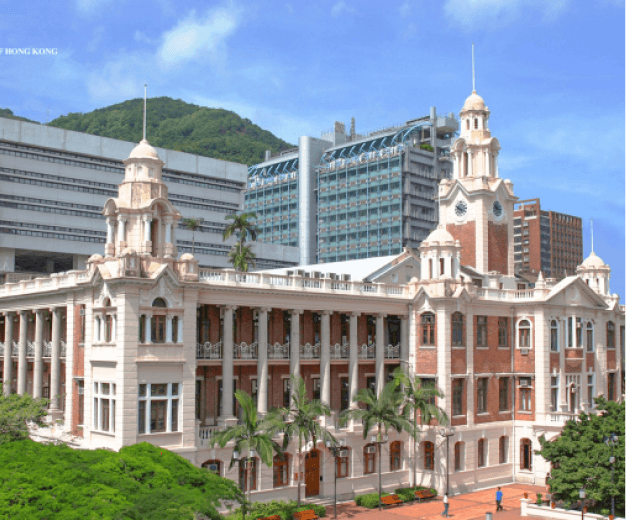
The university’s historical importance is also visible in its architecture. The Main Building, completed around the university’s opening period, remains one of the best-known landmarks of the campus. Historic red-brick buildings stand alongside modern laboratories, lecture halls, libraries, research centres, student residences, and technology facilities. This combination of old and new reflects the university itself: deeply connected to its past while continually adapting to the future.
The Origins of The University of Hong Kong
The roots of HKU go back even further than its formal establishment. One particularly important part of its heritage is the Hong Kong College of Medicine, founded in 1887. The medical institution played an important role in introducing Western medical education to Hong Kong and later became part of the foundation of HKU’s medical tradition.
Among the early students associated with the Hong Kong College of Medicine was Sun Yat-sen, who later became one of the most influential political figures in modern Chinese history. HKU officially recognizes this connection as an important part of the history of its medical education. (hku.hk)
The idea of establishing a university in Hong Kong developed during the early twentieth century. Sir Frederick Lugard, then Governor of Hong Kong, became an important supporter of the project. On March 16, 1910, Lugard laid the foundation stone for the university.
The institution was formally incorporated under the University Ordinance on March 30, 1911. This date represents the legal establishment of the University of Hong Kong.
On March 11, 1912, the university officially opened. Its first three faculties were Arts, Engineering, and Medicine. These disciplines reflected the educational priorities of the period: humanities and culture, technical development, and medical training. (hku.hk)
The creation of HKU was a significant event in the history of Hong Kong. At a time when higher education opportunities in the region were limited, the university created a new centre for advanced learning and professional education.
The Early Years of HKU
The first years of HKU were relatively modest compared with the scale of the modern institution. The university began with a small number of students and a limited academic structure. Nevertheless, it quickly established a reputation for serious scholarship and professional training.
The university held its first congregation in December 1916. Only 23 students graduated at that first graduation ceremony. Although this number seems extremely small compared with today’s student population, those graduates represented the beginning of a tradition that would eventually produce generations of professionals, academics, public servants, business leaders, doctors, engineers, lawyers, educators, researchers, and other influential figures. (hku.hk)
Women were admitted to HKU for the first time about a decade after its establishment. This development was an important step in expanding access to university education.
The university also gradually expanded its academic programmes. Science became an important part of the institution before the Second World War, giving HKU four major faculties: Arts, Engineering, Medicine, and Science.
Medicine continued to be one of HKU’s most important strengths. The opening of Queen Mary Hospital in 1937 provided the university with an important teaching hospital and strengthened its medical education and research environment. Queen Mary Hospital has continued to serve as a teaching hospital associated with the university. (hku.hk)
HKU and the Second World War
The Second World War created one of the most difficult periods in the university’s history. Academic activities were disrupted as Hong Kong became involved in the conflict.
The Japanese occupation of Hong Kong affected virtually every part of society, including education. University activities were interrupted, buildings and facilities faced difficult circumstances, and members of the university community experienced the challenges of wartime life.
The disruption demonstrated how closely HKU was connected to the wider history of Hong Kong. The university was not isolated from major political and social events. Instead, it experienced the same dramatic changes that affected the city and its population.
After the war ended in 1945, HKU began the process of rebuilding. The post-war period became an important stage in the university’s transformation.
Post-War Reconstruction and Expansion
The years after 1945 brought major changes to Hong Kong. The city’s population grew, its economy expanded, and its importance as an international centre increased. HKU also expanded in response to these developments.
The university developed new departments and academic programmes and gradually increased its student population. Scientific research became increasingly important, while professional disciplines continued to grow.
The post-war period also encouraged greater interaction between the university and Hong Kong society. Graduates increasingly entered professions that were essential to the development of the city.
Engineering graduates contributed to infrastructure and industrial development. Medical graduates worked in hospitals and public health. Lawyers entered the legal profession. Teachers helped expand the education system. Business graduates participated in Hong Kong’s rapidly growing commercial sector.
In this way, HKU became more than an educational institution. It became an important part of Hong Kong’s intellectual and professional infrastructure.
The Growth of a Modern University
During the second half of the twentieth century, HKU underwent substantial expansion. New buildings, laboratories, libraries, student facilities, research centres, and academic departments were developed.
The university’s physical environment also changed. Modern buildings were constructed alongside historic structures, creating the distinctive architectural character visible on the campus today.
A major building programme beginning in the 1970s contributed to the development of the modern campus. Many new facilities were added while historic buildings were preserved because of their architectural and cultural value. The Main Building, dating from the university’s early years, remains one of the most important examples of this heritage. (handbook.hku.hk)
The combination of historic architecture and modern facilities is one of the most distinctive characteristics of HKU.
Students can walk through areas containing century-old architecture and then enter modern laboratories or technology-focused academic facilities. This creates an environment in which the history of the institution is physically present while new generations of students work on contemporary problems.
HKU’s Academic Structure
The University of Hong Kong has developed into a comprehensive university offering programmes across a wide range of academic disciplines.
According to HKU’s 2026–27 undergraduate information, the university has ten faculties:
- Faculty of Architecture
- Faculty of Arts
- Faculty of Business and Economics
- Faculty of Dentistry
- Faculty of Education
- Faculty of Engineering
- Faculty of Law
- Li Ka Shing Faculty of Medicine
- Faculty of Science
- Faculty of Social Sciences
The university’s 2025–26 information reports approximately 44,100 students, including undergraduate and postgraduate students, and more than 1,210 professoriate staff. (handbook.hku.hk)
This broad academic structure allows HKU to provide education in subjects ranging from literature and history to artificial intelligence, engineering, medicine, business, law, architecture, and social sciences.
The diversity of disciplines also encourages interdisciplinary work. Many of the world’s major challenges cannot be solved by a single academic field. Climate change, public health, artificial intelligence, urban development, ageing populations, economic inequality, sustainability, and technological transformation require knowledge from multiple disciplines.
HKU’s comprehensive structure provides an environment in which such collaboration can take place.
Faculty of Architecture
Architecture is an important field at HKU because Hong Kong itself provides a unique environment for studying cities.
Hong Kong is famous for its high-density urban landscape, vertical architecture, transportation systems, public housing, commercial districts, historic neighbourhoods, and dramatic relationship between mountains, sea, and buildings.
Students of architecture can therefore study many real-world urban challenges directly around them.
The university’s architectural education combines design, theory, technology, history, urban planning, sustainability, and research. Its location gives students opportunities to understand how architecture responds to geography, economics, population density, culture, and environmental conditions.
Faculty of Arts
The Faculty of Arts represents the humanities and cultural dimensions of HKU.
Arts education is essential because universities are not only places for technological development. They are also institutions where societies examine history, languages, literature, philosophy, culture, identity, and human creativity.
HKU’s position in Hong Kong gives its humanities scholars an especially interesting environment. Hong Kong has historically connected Chinese, British, Asian, and global influences.
Students studying humanities can therefore explore questions involving cultural exchange, colonial history, Chinese civilization, modern Asia, literature, languages, media, and global society.
Business and Economics
Hong Kong is one of the world’s major financial and commercial centres, making business education a natural strength for HKU.
The Faculty of Business and Economics provides education in areas such as economics, finance, management, accounting, marketing, entrepreneurship, and related fields.
The city’s position as an international financial centre gives students exposure to banks, investment companies, multinational corporations, entrepreneurs, financial institutions, and global markets.
Business students can benefit from an environment where economic theory can be connected with real-world business activity.
The international nature of Hong Kong also supports cross-border perspectives. Students can learn about Asian markets while engaging with global business practices.
Dentistry
Dentistry is another important professional field at HKU.
Dental education combines biological sciences, clinical training, technology, patient care, and research. Like medicine, dentistry requires students to develop both theoretical knowledge and practical professional skills.
HKU’s dental education contributes to healthcare training and research in Hong Kong and beyond.
Education
The Faculty of Education plays an important role in preparing teachers, education researchers, administrators, and specialists.
Education is central to the development of every society. Universities help improve education by training teachers and by researching how students learn, how schools operate, and how educational systems can respond to technological and social change.
HKU’s education programmes allow students to explore educational psychology, curriculum development, teaching methods, educational leadership, technology in education, and other areas.
Engineering
Engineering has been part of HKU since the university opened in 1912.
The discipline has evolved dramatically over the last century. Early engineering education focused on areas relevant to the technological needs of the period, while modern engineering encompasses fields such as computer science, electrical engineering, mechanical engineering, civil engineering, biomedical engineering, data science, artificial intelligence, and advanced technologies.
Hong Kong provides an excellent environment for engineering education because the city depends heavily on complex infrastructure.
Transport systems, bridges, tunnels, high-rise buildings, water systems, telecommunications, energy networks, and digital infrastructure all require engineering expertise.
Engineering research at HKU therefore has opportunities to connect academic theory with real urban and technological problems.
Law
Law is another major discipline at HKU.
Hong Kong has a distinctive legal environment shaped by its historical development and international position. Its legal system plays a major role in business, finance, government, commerce, international relations, and civil society.
Students studying law at HKU can explore areas including commercial law, constitutional law, human rights, international law, corporate law, intellectual property, technology law, and other fields.
The university’s location makes legal education especially relevant to questions involving international business and cross-border activity.
Medicine
Medicine is perhaps the discipline most closely connected with HKU’s early history.
The university’s medical heritage can be traced to the Hong Kong College of Medicine, established in 1887. This historical connection predates the formal establishment of HKU by more than two decades. (hku.hk)
The medical school has developed into a major centre for medical education, clinical training, and biomedical research.
Its association with Queen Mary Hospital provides a significant clinical environment for students and researchers.
Modern medical education is increasingly interdisciplinary. Doctors need knowledge of biology, genetics, data science, public health, technology, psychology, and ethics.
HKU’s medical research therefore extends beyond traditional clinical training into areas such as infectious diseases, cancer, neuroscience, public health, precision medicine, biomedical technology, and population health.
Science
The Faculty of Science supports research and education in fundamental scientific disciplines.
Science is the foundation for many modern technologies. Physics, chemistry, biology, mathematics, and environmental sciences contribute to medicine, engineering, computing, climate research, biotechnology, and countless other fields.
Hong Kong’s location also creates opportunities for research involving marine environments, urban ecology, biodiversity, climate, and environmental change.
Social Sciences
The social sciences help explain how societies function.
At HKU, social science education and research can address subjects such as politics, sociology, psychology, economics, geography, social policy, communication, and international relations.
Hong Kong provides a particularly interesting setting for social science research because it is a major international city with complex relationships between local, regional, national, and global forces.
Campus and Location
HKU’s main campus is located around Bonham Road and Pokfulam on Hong Kong Island.
The university’s total land holding is approximately 55 hectares, including about 45 hectares associated with its campuses and around 10 hectares in the New Territories for the Kadoorie Centre. The university has approximately 708,000 square metres of gross floor area covering teaching, research, offices, amenities, and residential accommodation. (handbook.hku.hk)
The Main Campus accommodates five of the university’s ten faculties, as well as important libraries and other facilities.
Its location is one of the university’s greatest advantages. Students are not studying in an isolated academic environment. They are surrounded by one of Asia’s most dynamic cities.
Hong Kong’s financial districts, cultural institutions, transportation networks, technology companies, hospitals, museums, parks, restaurants, and international organisations are all accessible from the university.
The campus also benefits from its proximity to natural landscapes. Hong Kong Island combines dense urban development with mountains, greenery, hiking trails, and coastal environments.
Historic Architecture
One of HKU’s most attractive features is its historic architecture.
The Main Building is one of the best-known symbols of the university. Its historic design reflects the architectural traditions of the early twentieth century.
Historic buildings are preserved alongside newer structures. This approach creates a visual representation of the university’s history.
For visitors, the campus can feel like a journey through different periods of Hong Kong’s development. Older buildings reflect the university’s early decades, while newer facilities demonstrate its modern research and teaching ambitions.
Libraries and Learning Resources
Libraries are central to university life.
HKU has several important library facilities, including the Main Library, Fung Ping Shan Library, and Tin Ka Ping Education Library. (handbook.hku.hk)
These libraries support students and researchers across many disciplines.
Modern university libraries are no longer simply rooms filled with books. They provide access to digital databases, academic journals, research tools, electronic books, study spaces, technology, archives, and specialist collections.
For students, the library environment can become an important part of academic life. It provides places for individual study, group projects, research, writing, and preparation for examinations.
Student Life at HKU
University life is not only about lectures and examinations. HKU offers students opportunities to participate in clubs, societies, sports, cultural activities, volunteering, leadership programmes, student organisations, and international exchanges.
The diversity of the student community means that students can meet people from many cultural and academic backgrounds.
This international environment can help students develop communication skills, cultural awareness, teamwork, and confidence.
Student life in Hong Kong also offers access to a huge range of activities outside the campus. Students can explore museums, art galleries, parks, hiking trails, beaches, cultural districts, restaurants, markets, concerts, sporting events, and other attractions.
International Outlook
Internationalisation has been an important part of HKU’s identity for many years.
The university’s history began with an international orientation, and today its academic community includes people from different parts of the world.
International students can benefit from studying in Hong Kong because the city combines an Asian cultural environment with a highly international economy.
For students from Asia, Europe, North America, Africa, the Middle East, and other regions, HKU provides opportunities to experience Chinese and Asian perspectives while studying in English in many programmes.
International collaboration is also important for research.
Modern science depends heavily on international networks. Researchers collaborate across borders, share data, publish in international journals, attend conferences, and work together on global problems.
Research and Innovation
Research is one of HKU’s most important missions.
The university conducts research across medicine, science, engineering, artificial intelligence, business, law, architecture, social sciences, humanities, and many interdisciplinary fields.
In the modern era, universities are expected not only to teach existing knowledge but also to create new knowledge.
HKU’s research environment reflects this role.
Research can lead to new medical treatments, improved technologies, better urban planning, new business models, environmental solutions, educational methods, and deeper understanding of society.
The university has also identified artificial intelligence and technological transformation as important areas for its future development. An official HKU introduction describes its aspiration to explore the opportunities created by rapid advances in AI while using research and education to address global challenges. (Graduate School, HKU)
Artificial Intelligence and the Future
Artificial intelligence is transforming universities around the world.
HKU is positioned to participate in this transformation because AI requires collaboration among computer science, mathematics, engineering, medicine, business, law, social sciences, and humanities.
For example, AI can support medical diagnosis, drug discovery, financial analysis, urban planning, language technologies, education, scientific research, and environmental modelling.
At the same time, AI raises major questions about privacy, ethics, employment, misinformation, intellectual property, security, and social inequality.
A comprehensive university such as HKU can examine these questions from multiple perspectives.
The future of AI at HKU is therefore likely to involve not only technical research but also ethical, legal, social, and humanistic studies.
HKU and Hong Kong Society
The University of Hong Kong has played a major role in the development of Hong Kong.
Its graduates have entered almost every major profession.
Doctors have contributed to healthcare. Engineers have helped build infrastructure. Lawyers have contributed to the legal system. Teachers have educated generations of students. Business graduates have worked in finance and commerce. Researchers have expanded scientific knowledge. Writers, historians, artists, and social scientists have contributed to the intellectual life of the city.
This relationship between university and society is one of HKU’s defining characteristics.
A university becomes important not simply because of its buildings or rankings but because of the people it educates and the knowledge it creates.
Famous Historical Connections
One of HKU’s most famous historical connections is Sun Yat-sen.
Sun Yat-sen studied at the Hong Kong College of Medicine, the institution whose heritage later became part of HKU’s medical tradition. He is often described by HKU’s historical materials as a major figure in modern Chinese history. (hku.hk)
The university’s long history has also brought it into contact with numerous scholars, public figures, scientists, writers, professionals, and international leaders.
HKU’s official records of honorary graduates include figures from politics, science, literature, medicine, architecture, economics, and other fields. (The University of Hong Kong Calendar)
Alumni Network
A university’s influence often continues through its graduates.
HKU has built a large and international alumni network. Alumni associations operate in different countries and regions, creating opportunities for graduates to maintain connections with one another and with the university.
The alumni community includes professionals working in business, medicine, education, law, technology, government, research, culture, and many other areas.
For current students, an active alumni network can provide professional connections, mentoring opportunities, career advice, and a sense of belonging after graduation.
HKU’s Global Reputation
HKU has become increasingly prominent in international university rankings.
According to HKU’s official website, the university was ranked 11th globally in the QS World University Rankings 2027 and first in the QS Asia University Rankings 2026. The university also reported that 54 of its academics were named Clarivate Highly Cited Researchers in 2025. (hku.hk)
HKU also reported that it retained 11th place globally in the QS World University Rankings 2027, marking a historically high position for the institution. (hku.hk)
Rankings should not be treated as the only measure of university quality. Different rankings use different methodologies, and students should also consider programme quality, teaching, research opportunities, cost, location, campus culture, career outcomes, and personal goals.
Nevertheless, HKU’s position in major international rankings demonstrates its strong global visibility.
Why Hong Kong Is an Important Location for Students
Hong Kong’s location gives HKU a distinctive advantage.
The city sits at the intersection of major economic and cultural networks. It has long served as a bridge between China and the international community.
For business students, Hong Kong provides access to financial markets and multinational companies.
For technology students, the wider Greater Bay Area provides opportunities to engage with major innovation and manufacturing ecosystems.
For medical students, the city offers a sophisticated healthcare environment.
For architecture students, Hong Kong provides a living laboratory for high-density urban development.
For humanities and social science students, the city offers a fascinating case study in culture, history, migration, politics, economics, and globalization.
The Importance of English-Medium Education
HKU has a strong tradition of English-medium higher education.
This feature has helped the university maintain an international academic profile and allows students to participate in global research and scholarship.
English is widely used in international scientific publications, conferences, business, medicine, law, and technology.
At the same time, students studying at HKU are surrounded by Chinese language and culture in everyday life.
This creates a distinctive bilingual and multicultural environment.
A student can therefore gain international academic skills while developing a deeper understanding of Hong Kong and the wider Chinese and Asian context.
Scholarships and Student Opportunities
For prospective students, financial support can be an important consideration.
HKU offers various scholarships and financial assistance opportunities for eligible students. Scholarships may be connected with academic achievement, leadership, special talents, financial circumstances, or specific programmes.
Students considering HKU should always consult the university’s official admissions and scholarship information because eligibility rules, deadlines, and award amounts can change.
Beyond financial assistance, students can also benefit from exchange programmes, internships, research opportunities, competitions, student societies, volunteering, and leadership activities.
These experiences can complement formal classroom education.
Research Impact and Social Responsibility
A modern university is expected to address real-world problems.
HKU’s research mission therefore extends beyond academic publications.
Research can contribute to healthcare, environmental sustainability, economic development, education, urban planning, technological innovation, and social wellbeing.
The university’s location in Hong Kong gives it opportunities to address local problems that may also have international relevance.
For example, Hong Kong’s experience with high-density housing, transportation, ageing populations, public health, environmental management, and financial technology can provide research insights relevant to other cities.
Sustainability
Sustainability has become a major concern for universities around the world.
Universities have responsibilities as educational institutions, research organisations, employers, and large communities.
HKU can contribute to sustainability through research into renewable energy, climate science, green buildings, environmental protection, sustainable transportation, urban planning, biodiversity, and responsible consumption.
Students can also become part of sustainability efforts through campus initiatives and research.
Because Hong Kong has a dense urban environment surrounded by mountains and marine ecosystems, sustainability questions are particularly relevant.
Medicine, Public Health, and Society
The COVID-19 pandemic demonstrated the importance of medical research and public health.
Universities play an essential role during health emergencies by conducting research, training healthcare professionals, communicating scientific information, and developing new approaches to disease prevention and treatment.
HKU’s long medical tradition provides a strong foundation for this role.
Medical research today requires cooperation among doctors, biologists, data scientists, engineers, public health specialists, psychologists, economists, and policymakers.
This is another reason comprehensive universities are important.
Technology and Entrepreneurship
Universities increasingly play a role in entrepreneurship and technology transfer.
Research discoveries can become new technologies, companies, services, and social innovations.
HKU’s research ecosystem provides opportunities for students and researchers interested in entrepreneurship.
Hong Kong’s business environment can also provide access to investors, financial institutions, technology companies, professional services, and international markets.
Students interested in entrepreneurship can therefore study academic subjects while developing practical knowledge of business and innovation.
A University Connected to the Future
Although HKU has more than a century of history, it is not simply a historical institution.
Its current development is focused on emerging areas of research and education.
Artificial intelligence, data science, biotechnology, climate change, advanced engineering, digital transformation, public health, sustainable development, and interdisciplinary research are likely to remain important areas in the coming decades.
The challenge for HKU is to preserve its heritage while continuing to innovate.
This balance is visible throughout the campus. Historic buildings are preserved while new facilities are developed. Traditional academic disciplines coexist with emerging fields. Long-established professional programmes operate alongside new research areas.
Governance and Institutional Independence
HKU operates under a formal legal and governance framework.
The university was established under the University Ordinance of 1911, which was later replaced by the University of Hong Kong Ordinance. Its governance structure includes bodies such as the Court, Council, Senate, and Boards of Faculty. (Graduate School, HKU)
Good governance is important because a university manages complex responsibilities involving education, research, finance, staff, students, facilities, intellectual property, partnerships, and public engagement.
Academic governance also helps protect the quality and integrity of teaching and research.
The University Experience
The HKU experience is shaped by several factors.
First is academic intensity. Students are expected to think critically, conduct research, communicate effectively, and engage seriously with their subjects.
Second is international exposure. Students interact with people from different countries and backgrounds.
Third is location. Living and studying in Hong Kong provides exposure to an international city with strong connections to China and the wider world.
Fourth is heritage. Students become part of an institution with more than a century of history.
Finally, there is the opportunity to participate in research and innovation.
Together, these factors create a distinctive university experience.
Challenges Facing HKU
Like every major university, HKU faces challenges.
One challenge is maintaining academic excellence while expanding access to education.
Another is adapting to rapid technological change.
Artificial intelligence is changing how students learn, how researchers conduct research, and how universities evaluate knowledge.
Climate change creates additional responsibilities.
Universities must also maintain international collaboration in an increasingly complex geopolitical environment.
At the same time, HKU must continue to preserve its historic identity while responding to new social and economic realities.
These challenges are not unique to HKU. They are part of the broader transformation facing universities around the world.
The Meaning of HKU’s Motto and Identity
HKU’s visual identity combines its shield and motto with its English and Chinese names. The university states that its shield and motto were granted by the College of Arms in 1913 and have remained important elements of its identity. (hku.hk)
The Latin motto associated with the university is “Sapientia et Virtus,” commonly translated as “Wisdom and Virtue.”
The combination of wisdom and virtue expresses an important idea about education.
A university should not only produce knowledgeable graduates. It should also encourage responsibility, integrity, service, and ethical leadership.
Knowledge without responsibility can be harmful. Professional skills become more valuable when combined with good judgement and concern for society.
HKU’s Role in Asia
HKU is particularly important because it sits within Asia, one of the world’s most dynamic regions.
Asia includes many of the world’s largest economies, fastest-growing cities, major technology centres, and rapidly developing societies.
Hong Kong provides HKU with a unique position within this environment.
The university can connect Western academic traditions with Chinese and Asian perspectives.
Its research can contribute to regional problems while remaining internationally relevant.
Its graduates can work throughout Asia and around the world.
This combination explains why HKU often presents itself as an international university rooted in Asia.
Why Students Choose HKU
Students choose universities for different reasons.
Some are attracted by academic reputation. Others value a specific programme, research opportunity, location, career prospects, international environment, or cultural experience.
HKU offers a combination of these factors.
Its long history gives it institutional prestige.
Its broad academic structure provides many programme choices.
Its research environment supports advanced study.
Its location in Hong Kong provides access to an international city.
Its international community provides cultural diversity.
Its historic campus provides a distinctive educational environment.
For ambitious students interested in Asia and the wider world, these qualities can make HKU an attractive choice.
The Future of The University of Hong Kong
The future of HKU will be shaped by several major forces.
Technology will continue to transform education and research.
Artificial intelligence may change teaching methods, research processes, administrative systems, and professional careers.
Climate change will require new research and sustainable solutions.
Medical science will continue to develop through genetics, biotechnology, data analysis, and precision medicine.
Business and finance will increasingly depend on digital technologies.
Law will need to respond to new challenges involving AI, data, cybersecurity, intellectual property, and international commerce.
The humanities and social sciences will remain important because technological progress also creates questions about culture, ethics, identity, inequality, and human wellbeing.
HKU’s comprehensive structure gives it an opportunity to respond to these challenges through interdisciplinary research.
Conclusion
The University of Hong Kong is much more than an old university. It is an institution whose history is deeply connected with the development of Hong Kong and whose future is increasingly connected with global education, research, technology, and innovation.
Founded in 1911 and officially opened in 1912, HKU began with three faculties—Arts, Engineering, and Medicine—and gradually developed into a comprehensive university with ten faculties and a student population of more than 44,000 in the 2025–26 academic year. (hku.hk)
Its medical heritage reaches back to the Hong Kong College of Medicine, founded in 1887. Its historic campus preserves buildings from the early twentieth century, while modern laboratories, libraries, classrooms, research centres, and technology facilities support contemporary education and research. (hku.hk)
HKU’s importance comes from the combination of heritage and innovation. It has produced generations of graduates who have contributed to medicine, engineering, business, law, education, government, science, culture, and many other areas.
Its location in Hong Kong gives it a special role in connecting Asia with the international community. Students can experience a city that is simultaneously Chinese, Asian, international, commercial, technological, and culturally diverse.
Its research mission also gives it a responsibility to address major challenges. From artificial intelligence and biotechnology to climate change, public health, sustainable development, and urbanisation, the university has opportunities to contribute knowledge that can benefit Hong Kong and the wider world.
The university’s current global standing further demonstrates its international influence. HKU reported an 11th-place position in the QS World University Rankings 2027 and first place in the QS Asia University Rankings 2026. (hku.hk)
Ultimately, the story of The University of Hong Kong is a story of transformation. It began as a small institution at a time when Hong Kong’s higher education system was still developing. It survived war and major political and social changes. It expanded alongside the city’s economic and population growth. It developed new academic disciplines, strengthened research, and built international connections.
More than a century after its foundation, HKU continues to combine history with modernity.
Its historic buildings remind students of the generations who came before them. Its laboratories and research centres represent the future. Its international community reflects the global nature of modern scholarship. Its position in Hong Kong connects it to one of Asia’s most important cities.
For these reasons, The University of Hong Kong remains a significant institution in Asian and global higher education. Its past provides a powerful foundation, its present demonstrates academic ambition, and its future offers opportunities to contribute to science, technology, culture, education, healthcare, business, and society.
The enduring idea behind HKU is that education should create knowledge, develop people, and serve society. With more than a century of history behind it and a rapidly changing world ahead, the University of Hong Kong continues its journey as one of Asia’s major centres of learning, research, and intellectual exchange.