Introduction
The National University of Singapore, commonly known as NUS, is one of Asia’s most prominent universities and a major center of education, research, innovation, and international collaboration. Located in Singapore, NUS has developed from a small medical school established in the early twentieth century into a comprehensive global university with a broad academic portfolio. Its history is closely connected with the development of modern Singapore and the wider transformation of Southeast Asia.
Today, NUS is known for its strong programs in engineering, computing, medicine, business, law, science, architecture, social sciences, humanities, and interdisciplinary research. The university combines a strong Asian identity with an international outlook, attracting students, academics, researchers, and partners from around the world.
The story of NUS is particularly interesting because the university did not develop in isolation. Its growth reflects Singapore’s transformation from a colonial trading port into an independent, highly developed, technology-driven nation. As Singapore’s economic ambitions expanded, its need for highly educated professionals, scientists, engineers, doctors, entrepreneurs, lawyers, and public leaders also increased. NUS became one of the central institutions supporting that transformation.
This article explores the history of NUS from its earliest origins to its modern role as a leading research university.
1. The Origins of Higher Education in Singapore
The history of NUS can be traced to the beginning of organized higher education in Singapore during the colonial period. At that time, Singapore was an important British trading center and a growing regional hub. However, opportunities for advanced education were limited, especially in professional fields such as medicine.
The need for a medical institution became increasingly clear as Singapore’s population expanded. Public health challenges were significant, and there was a shortage of locally trained medical professionals. Establishing a medical school was therefore considered both an educational and social necessity.
The development of medical education eventually created the foundation from which Singapore’s modern university system would grow.
2. The Establishment of the Straits and Federated Malay States Government Medical School
A major milestone came in 1905 with the establishment of the Straits and Federated Malay States Government Medical School.
The school began with a relatively small number of students and focused primarily on medical education. Its purpose was practical: to train healthcare professionals who could serve communities in Singapore and the surrounding region.
Although its beginnings were modest, the institution represented an important step toward the development of higher education in Singapore.
Medical education required rigorous scientific training, clinical experience, laboratories, and connections with hospitals. As the institution developed, its academic environment gradually became more sophisticated.
The school also helped create a culture of professional education in Singapore.
3. Growth During the Early Twentieth Century
During the first decades of the twentieth century, medical education in Singapore continued to develop. The institution changed names and organizational structures as its responsibilities expanded.
The development of higher education was influenced by broader political and economic changes in Malaya and Singapore. The region was becoming increasingly interconnected, while cities such as Singapore and Kuala Lumpur were developing as important administrative and commercial centers.
The medical school played an important role in producing professionals who contributed to public health and government services.
Its graduates became part of the growing professional class in the region.
4. The King Edward VII College of Medicine
In 1921, the institution became the King Edward VII College of Medicine.
This change reflected the growing importance and institutional development of medical education in Singapore.
The college gradually established a stronger academic reputation. Medical training became more structured, and facilities for teaching and research improved.
The institution also developed stronger relationships with hospitals and healthcare services.
The College of Medicine eventually became one of the most important centers for medical education in Southeast Asia.
5. The Impact of World War II
The development of higher education in Singapore was severely disrupted by World War II.
Singapore fell to Japanese forces in 1942, beginning a difficult period of occupation. Educational institutions faced major disruptions, and normal academic activities were affected.
The war created enormous social and economic challenges. Students and academics experienced uncertainty, while institutions had to operate under difficult circumstances.
The post-war period brought the challenge of rebuilding Singapore’s educational infrastructure.
Despite the disruption, the importance of education became even clearer. Singapore needed trained professionals to rebuild institutions, healthcare systems, businesses, and public administration.
6. The Formation of the University of Malaya
After World War II, the idea of creating a university serving the wider Malayan region gained momentum.
In 1949, the University of Malaya was established through the merger of the King Edward VII College of Medicine and Raffles College.
This was a major turning point.
The new university expanded beyond medicine and liberal arts into a broader institution of higher learning.
The university was initially based in Singapore, and its establishment created a stronger academic foundation for the region.
It became an important institution for educating future professionals and leaders.
7. Raffles College and Its Contribution
Raffles College was another important predecessor of NUS.
Established in 1928, Raffles College focused on subjects including arts and science.
Its creation reflected the growing demand for higher education beyond professional medical training.
The merger of Raffles College with the King Edward VII College of Medicine therefore brought together two major educational traditions.
One emphasized medicine and professional training, while the other focused on arts and science.
Together, they provided the foundation for a comprehensive university.
8. University of Malaya in Singapore
After its establishment, the University of Malaya became an important center of education in Singapore.
The university served students from Singapore, Malaya, and other parts of the region.
Its academic community included scholars from different backgrounds, creating an increasingly international intellectual environment.
During the 1950s, the university became closely connected with the political and social developments of the region.
The period was characterized by debates about independence, identity, language, culture, and the future of Malaya and Singapore.
Universities naturally became places where these ideas were discussed.
9. Singapore’s Road Toward Self-Government
The 1950s brought major political changes to Singapore.
The movement toward self-government accelerated, and education became a major national priority.
Political leaders increasingly recognized that Singapore needed a highly educated population if it was going to develop economically and govern itself effectively.
The university therefore became more than an educational institution.
It was increasingly viewed as part of the future of Singapore.
Graduates entered medicine, law, education, business, government, engineering, and other professional fields.
10. The University and Singapore’s Independence
Singapore became an independent nation in 1965 after separating from Malaysia.
The new country faced significant challenges.
Singapore had limited natural resources and needed to build a strong economy based largely on human capital, trade, manufacturing, technology, and services.
Education became central to this strategy.
A strong university was essential for developing highly skilled professionals and researchers.
The institution that would eventually become NUS was therefore positioned at the center of Singapore’s national development.
11. The Creation of the University of Singapore
Following Singapore’s separation from Malaysia, the Singapore campus of the University of Malaya became the University of Singapore in 1962.
This created a distinct national university for Singapore.
The University of Singapore expanded its academic offerings and developed stronger connections with the country’s emerging industries and public institutions.
Its mission increasingly reflected Singapore’s own national priorities.
The university educated doctors, engineers, scientists, lawyers, business professionals, teachers, and civil servants who would contribute to nation-building.
12. The University of Singapore During the 1960s and 1970s
The 1960s and 1970s were transformative decades for Singapore.
The country moved rapidly toward industrialization.
Manufacturing expanded, infrastructure improved, and Singapore developed into a major international business center.
This economic transformation created demand for technical and professional skills.
The University of Singapore responded by expanding programs in science, engineering, business, social sciences, and other areas.
Research also became increasingly important.
The university was expected not only to educate students but also to contribute knowledge that could help solve national problems.
13. Nanyang University
Another important institution in the history of NUS was Nanyang University.
Nanyang University was founded in 1955 as a Chinese-language university.
It emerged from efforts by Singapore’s Chinese community to establish a university that would provide higher education in Chinese.
For several decades, Nanyang University operated separately from the University of Singapore.
However, Singapore’s changing educational and economic environment eventually encouraged greater integration.
The government increasingly emphasized bilingual education and the development of a unified higher education system capable of serving a rapidly modernizing economy.
14. The Merger That Created NUS
One of the most important events in the university’s history occurred in 1980.
The University of Singapore merged with Nanyang University to create the National University of Singapore.
This merger established the modern NUS.
The new university combined the strengths, traditions, academic communities, and resources of two major institutions.
The creation of NUS represented an important step toward building a comprehensive national university with a strong international orientation.
The university was expected to support Singapore’s economic development while also becoming a world-class center of education and research.
15. The Meaning of the Name National University of Singapore
The name National University of Singapore reflected its role as Singapore’s leading national university.
The institution was expected to serve the country while maintaining a global outlook.
This balance remains central to the university’s identity.
NUS has consistently combined local relevance with international engagement.
Its students come from Singapore and many other countries, while its research addresses both regional and global challenges.
16. Expansion of Academic Programs
After its establishment, NUS continued expanding its academic portfolio.
Traditional areas such as medicine, science, arts, law, and engineering were joined by increasingly specialized fields.
Business education became increasingly important as Singapore developed into an international financial and commercial hub.
Computer science and information technology also became major areas of growth as Singapore entered the digital economy.
Architecture, environmental studies, public policy, communications, and interdisciplinary programs expanded over time.
17. Development of Engineering Education
Engineering has been an important part of NUS’s development.
Singapore’s industrialization created strong demand for engineers.
Engineering education at NUS expanded into areas such as electrical engineering, mechanical engineering, civil engineering, chemical engineering, materials science, computer engineering, and related disciplines.
Research programs increasingly focused on areas important to Singapore and Asia, including advanced manufacturing, infrastructure, energy, electronics, materials, and technology.
NUS engineering graduates have contributed to industries in Singapore and internationally.
18. The Rise of Computing and Technology
The growth of computing transformed universities worldwide, and NUS was no exception.
Computer science and information technology became increasingly important.
NUS developed academic and research programs covering software, artificial intelligence, cybersecurity, data science, computer systems, information systems, and related areas.
Singapore’s emergence as a technology hub further increased the importance of these programs.
The university has developed relationships with technology companies, research institutions, startups, and government agencies.
Technology research has become one of the university’s most visible areas of activity.
19. The Faculty of Medicine and Medical Education
Medicine remains one of NUS’s historic strengths.
The university’s medical tradition extends back to the medical school established in 1905.
Over more than a century, medical education evolved from basic professional training into a sophisticated system involving clinical medicine, biomedical science, public health, and medical research.
The Yong Loo Lin School of Medicine is now an important component of NUS.
Its development reflects Singapore’s broader transformation from a developing healthcare system into a sophisticated modern medical environment.
20. NUS and Healthcare Research
Healthcare research at NUS covers many areas.
Researchers work on diseases, public health, biomedical science, clinical research, healthcare technology, and other subjects.
The university works closely with Singapore’s healthcare institutions.
This collaboration allows scientific discoveries to connect more closely with clinical practice.
The university’s medical and biomedical research has also contributed to Singapore’s broader ambition of becoming a regional biomedical hub.
21. Business Education
Business education has become another major strength of NUS.
The NUS Business School provides education in areas such as finance, accounting, marketing, management, entrepreneurship, and strategy.
Singapore’s position as a global financial and commercial center provides an ideal environment for business education.
Students have opportunities to study Asian markets while also engaging with international business.
The school has developed partnerships with universities and organizations around the world.
22. The Faculty of Law
Legal education has been another historic component of Singapore’s university system.
NUS Law has played a major role in educating lawyers, judges, policymakers, academics, and corporate professionals.
Singapore’s legal system is closely connected with its role as an international business and financial center.
Consequently, legal education at NUS covers both domestic law and international areas.
Programs may address commercial law, corporate law, international law, intellectual property, maritime law, technology law, and other subjects.
23. Architecture and Design
NUS also has a significant tradition in architecture and design.
Singapore’s rapid urbanization created an important environment for architectural education.
The university’s architecture and design programs engage with issues such as sustainable cities, urban planning, housing, transportation, public spaces, and environmental design.
Because Singapore is a densely populated city-state, urban design is particularly important.
Research in these areas can have practical implications for cities throughout Asia.
24. Social Sciences and Humanities
Although NUS is well known for science and technology, social sciences and humanities remain essential parts of the university.
Programs in economics, sociology, political science, psychology, history, geography, communications, philosophy, languages, and related areas help students understand societies and institutions.
These disciplines are particularly important in an Asian context where societies are experiencing rapid economic, demographic, and technological change.
25. NUS Libraries and Knowledge Resources
A major university requires extensive knowledge resources.
NUS has developed libraries and digital resources to support teaching and research.
Students and researchers have access to academic books, journals, databases, archives, and electronic resources.
The development of digital technology has transformed how information is accessed and used.
Modern university libraries are increasingly research centers rather than simply collections of books.
26. Research as a Central Mission
Research has become one of the defining characteristics of modern NUS.
The university conducts research across numerous fields.
These include medicine, engineering, science, computing, sustainability, social sciences, business, public policy, materials science, and many interdisciplinary areas.
Research is supported through collaborations with government agencies, corporations, hospitals, universities, and international organizations.
NUS seeks to address both fundamental scientific questions and practical challenges.
27. Research and Singapore’s Development
NUS research has often been closely connected to Singapore’s national priorities.
Examples include urban development, water security, energy, healthcare, transportation, advanced manufacturing, digital technology, and environmental sustainability.
Singapore’s small size has encouraged researchers to think of the country as a living laboratory.
Solutions developed in Singapore can potentially be applied to other cities and countries.
28. Water Research
Water security is particularly important to Singapore.
The country has invested heavily in water technology and research.
Universities and research institutions contribute to this effort through studies of water treatment, recycling, desalination, environmental engineering, and sustainable water management.
NUS researchers have participated in research related to water technologies and environmental sustainability.
This work illustrates how university research can respond directly to national challenges.
29. Sustainability Research
Climate change and environmental sustainability have become increasingly important areas of research.
NUS researchers study sustainable cities, climate adaptation, renewable energy, environmental systems, green buildings, transportation, biodiversity, and other topics.
Singapore’s urban environment makes sustainability particularly relevant.
The university also works on broader Asian and global environmental challenges.
30. Innovation and Entrepreneurship
NUS has increasingly emphasized innovation and entrepreneurship.
Universities are no longer viewed simply as institutions that produce graduates.
They are also expected to transform research into practical products, companies, technologies, and social solutions.
NUS has developed programs and initiatives supporting entrepreneurship.
Students and researchers can explore startup ideas, develop technologies, seek investment, and collaborate with industry.
31. NUS and the Startup Ecosystem
Singapore has developed a strong startup ecosystem, and NUS is an important part of it.
University students and researchers have created companies in areas such as technology, healthcare, finance, education, artificial intelligence, and biotechnology.
Entrepreneurship programs provide opportunities for students to learn about business development and innovation.
This environment encourages graduates to become job creators as well as job seekers.
32. Internationalization of NUS
From its earliest years, NUS has maintained connections with the wider region.
In the modern era, its international outlook has expanded significantly.
The university collaborates with institutions in North America, Europe, Asia, Australia, and other regions.
International partnerships provide opportunities for research collaboration, student exchanges, joint programs, and academic cooperation.
33. Global Student Community
NUS attracts students from many countries.
This creates a multicultural academic environment.
Students can learn from classmates with different cultural backgrounds, experiences, languages, and perspectives.
Internationalization also helps Singapore maintain its position as a global education center.
For international students, NUS provides an opportunity to study in an Asian city with strong global economic connections.
34. Campus Development
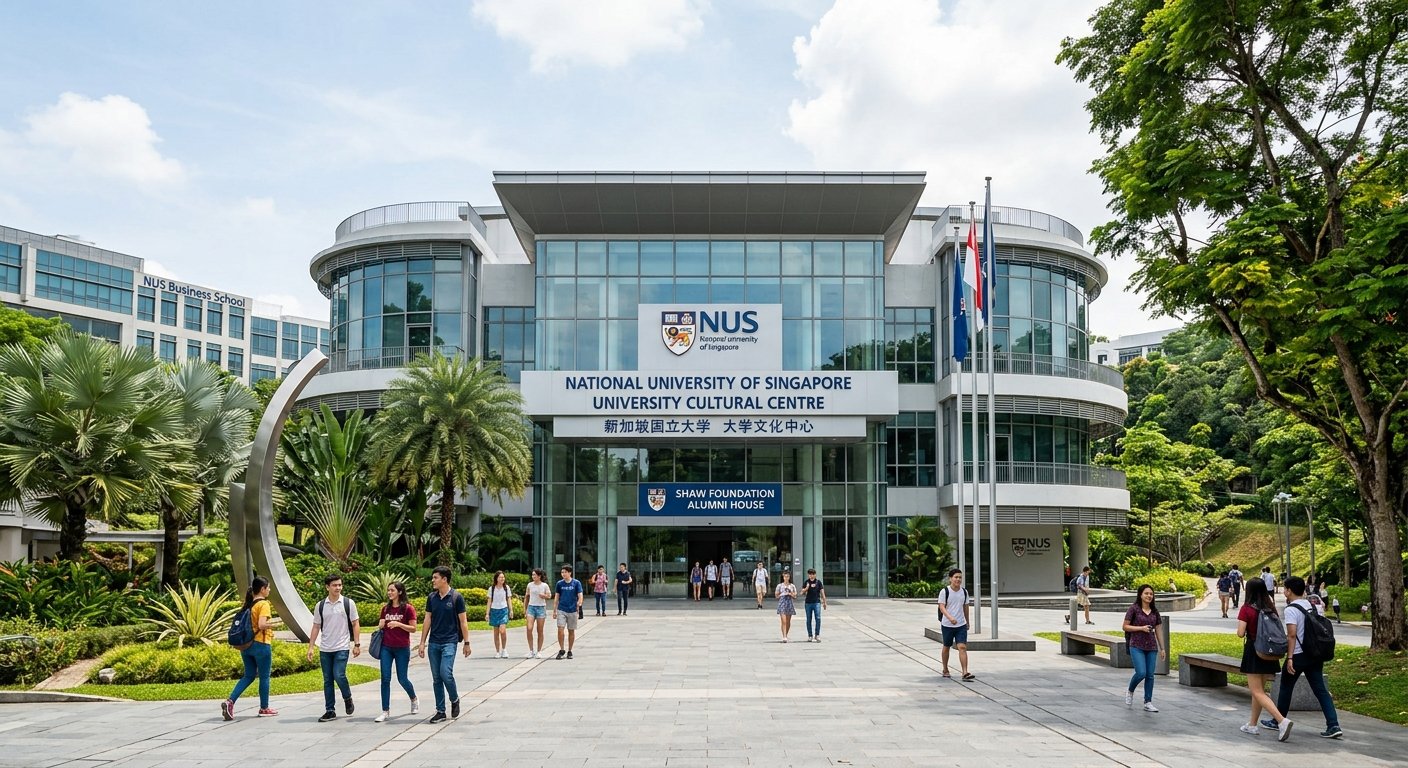
The physical development of NUS has been extensive.
The university’s main campus at Kent Ridge developed significantly as Singapore expanded its higher education infrastructure.
Buildings for classrooms, laboratories, libraries, research centers, student activities, and administration were constructed and modernized.
The campus environment reflects the university’s transformation from a traditional institution into a modern research university.
35. Kent Ridge Campus
Kent Ridge is closely associated with modern NUS.
The campus includes academic buildings, research facilities, residential colleges, libraries, sports facilities, and student spaces.
Its location provides a large environment for university life.
The campus has evolved continuously as new academic fields and research activities have emerged.
36. University Town
University Town, commonly called UTown, became an important addition to the NUS campus.
It was designed to create a more integrated academic and residential environment.
Students can live, study, participate in activities, and interact with faculty within the same broader community.
The development reflects modern approaches to university education, where learning is not limited to classrooms.
37. Residential Education
Residential education is an important component of NUS life.
Students living on campus have opportunities to participate in communities, clubs, events, leadership programs, and interdisciplinary activities.
Residential colleges can encourage students from different academic disciplines to interact.
This creates opportunities for collaboration and personal development.
38. Student Organizations
NUS students participate in many organizations.
These can include academic societies, cultural groups, sports clubs, volunteer organizations, entrepreneurship communities, and student publications.
Such activities allow students to develop leadership, teamwork, communication, and organizational skills.
University education therefore extends beyond formal lectures and examinations.
39. Alumni of NUS
The university has produced a large and influential alumni community.
Graduates have entered government, medicine, business, law, science, engineering, technology, academia, journalism, and other professions.
Many alumni have contributed to Singapore’s development.
Others have built careers internationally.
The alumni network helps strengthen the university’s connections with governments, companies, research institutions, and communities.
40. NUS and Singaporean Leadership
Because of its national role, NUS has educated many individuals who later became influential in Singaporean public life.
Graduates have served in government and public institutions.
The university has therefore contributed to the development of Singapore’s administrative and professional leadership.
Its influence extends beyond campus.
41. NUS and Asian Studies
NUS has a distinctive position for the study of Asia.
Singapore is located at the crossroads of major Asian civilizations and economic regions.
The university therefore provides a strong environment for studying Southeast Asia, China, India, Japan, Korea, and other parts of the region.
Research in Asian history, politics, economics, society, culture, and international relations contributes to global understanding of Asia.
42. Public Policy
Public policy is another important area at NUS.
Singapore’s experience in urban planning, economic development, public housing, healthcare, education, transportation, and governance provides valuable material for policy research.
NUS scholars examine public policies in Singapore and other countries.
The university also engages policymakers and international institutions.
43. NUS and Artificial Intelligence
Artificial intelligence has become one of the major technological areas of modern research.
NUS researchers work on machine learning, computer vision, natural language processing, robotics, data analytics, and related technologies.
AI research connects with many disciplines.
Healthcare, finance, transportation, education, manufacturing, and public services can all benefit from AI research.
44. Biotechnology and Biomedical Science
Singapore has invested heavily in biomedical research.
NUS contributes through research in molecular biology, genetics, medicine, biotechnology, pharmacology, and related fields.
The university’s biomedical research connects with hospitals, research institutes, pharmaceutical companies, and biotechnology organizations.
This has strengthened Singapore’s position as a regional biomedical center.
45. NUS and Industry Collaboration
Modern research universities increasingly work closely with industry.
NUS collaborates with corporations on research projects, technology development, internships, professional education, and innovation.
These partnerships help students understand real-world challenges.
They also allow companies to access university expertise.
46. Technology Transfer
University research can create technologies with commercial potential.
NUS supports the process of moving discoveries from laboratories toward practical applications.
Technology transfer may involve patents, licensing, spin-off companies, and partnerships.
This process can turn academic research into economic and social value.
47. Global Rankings and Reputation
NUS is regularly recognized as one of Asia’s leading universities and is frequently placed highly in major international university rankings.
Rankings consider factors such as academic reputation, research impact, international collaboration, employer reputation, and other indicators.
However, rankings represent only one measure of university quality.
NUS’s broader importance can also be seen in its research output, alumni network, partnerships, educational programs, and contribution to Singapore.
48. NUS as a Global Research University
The modern NUS is no longer simply a national institution.
It is a global research university.
Researchers collaborate internationally, students participate in global programs, and graduates work across many countries.
At the same time, NUS maintains a strong connection to Singapore.
This combination of national responsibility and global engagement is one of its defining characteristics.
49. The Importance of Multidisciplinary Education
Many of the world’s most difficult problems cannot be solved by one academic discipline.
Climate change, artificial intelligence, healthcare, urbanization, aging populations, cybersecurity, and energy require collaboration between different fields.
NUS has increasingly promoted interdisciplinary research and education.
Engineers may work with medical researchers.
Computer scientists may collaborate with social scientists.
Architects may work with environmental researchers.
Business scholars may collaborate with technology specialists.
This approach reflects the changing nature of modern knowledge.
50. NUS and Lifelong Learning
The university’s educational role extends beyond traditional undergraduate education.
Professional and continuing education have become increasingly important.
As industries change rapidly, workers need opportunities to update their knowledge and skills.
NUS provides postgraduate and professional education across numerous disciplines.
This supports Singapore’s broader goal of developing a workforce capable of adapting to technological and economic change.
51. Graduate Education
Graduate education is a major component of NUS.
Master’s and doctoral programs provide advanced training and research opportunities.
Graduate students contribute significantly to university research.
PhD students work with faculty members on projects that may address fundamental scientific questions or practical problems.
The graduate community also contributes to the international character of the university.
52. Doctoral Research
Doctoral education requires students to make original contributions to knowledge.
At NUS, doctoral research covers many disciplines.
Researchers may investigate new materials, medical treatments, computing technologies, economic models, environmental systems, social issues, or historical questions.
The university’s research infrastructure provides opportunities for advanced scholarship.
53. NUS and Global Partnerships
International partnerships are essential to the university’s global strategy.
NUS works with universities and research organizations around the world.
These partnerships may involve joint research, student exchange, faculty collaboration, conferences, and academic programs.
Such connections allow NUS researchers to participate in international knowledge networks.
54. Exchange Programs
Students can benefit from international exchange opportunities.
Studying abroad can expose students to different educational systems and cultures.
NUS’s international partnerships provide students with opportunities to experience universities in different countries.
These experiences can help develop adaptability and global awareness.
55. NUS and Innovation in Education
Higher education has changed significantly with digital technology.
NUS has incorporated digital learning, online resources, technology-enhanced teaching, and new educational approaches.
Modern students can access lectures, academic resources, collaboration platforms, and digital learning tools.
Technology has made education more flexible and connected.
56. The COVID-19 Era
The COVID-19 pandemic created major challenges for universities worldwide.
NUS, like other universities, had to adapt teaching, research, campus operations, and student services.
Digital learning became increasingly important.
The pandemic also highlighted the importance of medical research, public health, data science, and technology.
The experience demonstrated the need for universities to remain flexible during major global disruptions.
57. NUS and the Future of Education
The future of higher education will likely involve increasing use of artificial intelligence, digital learning, interdisciplinary education, and global collaboration.
NUS is well positioned to participate in these changes because of its strong technology, research, and international networks.
The university will likely continue adapting its programs to emerging fields.
58. Challenges Facing NUS
Despite its success, NUS faces challenges.
Competition among global universities is increasing.
Universities must compete for talented students, researchers, faculty, research funding, and international partnerships.
Technological change also creates pressure to update curricula.
At the same time, universities must balance academic freedom, national priorities, financial sustainability, and social responsibility.
59. Competition in Asian Higher Education
Asia has developed many strong universities.
Institutions in China, Japan, South Korea, Hong Kong, Taiwan, Australia, and other countries compete internationally.
NUS must continue investing in research and education to maintain its position.
The rise of new technology-focused universities and research institutions adds further competition.
60. NUS and Singapore’s Future
The relationship between NUS and Singapore remains strong.
Singapore’s future depends heavily on knowledge, innovation, technology, human capital, and international connectivity.
These are all areas in which universities play major roles.
NUS therefore remains important to the country’s long-term development.
61. Contribution to Science
NUS researchers contribute to scientific knowledge in numerous fields.
Research may involve fundamental discoveries or practical technologies.
Scientific work at the university contributes to international academic literature and collaborations.
Its laboratories and research centers attract researchers from around the world.
62. Contribution to Technology
Technology research at NUS has practical significance.
Engineering, computing, materials science, robotics, AI, and other fields contribute to Singapore’s technology ecosystem.
University research can support industries ranging from electronics and manufacturing to healthcare and finance.
63. Contribution to Society
Universities have responsibilities beyond economic development.
NUS contributes to society through education, public engagement, research, community programs, and the development of professionals.
Its graduates serve communities in Singapore and abroad.
The university also provides intellectual resources for understanding social problems.
64. Contribution to Culture
NUS contributes to cultural life through humanities, arts, languages, literature, history, and student activities.
A major university provides a space where different ideas and cultural perspectives can interact.
Singapore’s multicultural society makes this especially important.
65. Diversity at NUS
The university’s international student population contributes to diversity.
Students from different countries bring different experiences and perspectives.
This creates opportunities for cross-cultural learning.
Diversity can also strengthen research because scholars approach problems from different perspectives.
66. The Importance of Academic Excellence
Academic excellence remains central to NUS.
The university attracts high-achieving students and researchers.
Competitive admissions and strong academic programs contribute to its reputation.
However, excellence is not limited to examination performance.
Research creativity, innovation, leadership, communication, and social responsibility are also important.
67. The Role of Faculty
Faculty members are central to the university’s success.
Professors and researchers teach students, supervise graduate research, conduct studies, publish academic work, and collaborate internationally.
Their work shapes the intellectual environment of NUS.
Recruiting and retaining talented faculty is therefore an important priority.
68. NUS and Future Generations
The university’s influence extends across generations.
Students who study at NUS often go on to influence industries, governments, scientific institutions, and communities.
Their contributions can continue long after graduation.
This creates a cycle in which the university’s impact expands through its alumni.
69. Why NUS Matters in Asia
NUS occupies a unique geographical position.
Singapore is located in Southeast Asia but is deeply connected with East Asia, South Asia, Europe, and North America.
This gives NUS an unusual opportunity to function as a bridge between different regions.
Its research and education programs reflect this international environment.
70. NUS as a Symbol of Singapore’s Transformation
Perhaps the most important way to understand NUS is to see it as a reflection of Singapore’s transformation.
The university began with a small medical school.
Over more than a century, it developed into a comprehensive global research university.
Singapore itself followed a similar path, moving from a colonial trading center to an internationally connected, technology-driven economy.
The histories of the country and university are therefore closely connected.
71. From Medical School to Global University
The journey from the 1905 medical school to modern NUS is remarkable.
The original institution was created to address a specific need: training doctors.
Over time, its mission expanded.
It became part of the University of Malaya, then the University of Singapore, and eventually the National University of Singapore.
Along the way, it incorporated different academic traditions and developed into a comprehensive institution.
72. The Importance of the 1980 Merger
The 1980 merger with Nanyang University was particularly significant.
It brought together institutions with different historical and cultural traditions.
The resulting university had greater academic breadth and resources.
The merger helped create the foundation for NUS’s later international development.
73. NUS in the Twenty-First Century
The twenty-first century has been a period of rapid expansion and internationalization.
Technology has transformed research.
Global partnerships have expanded.
New disciplines have emerged.
Interdisciplinary research has become increasingly important.
NUS has positioned itself to respond to these developments.
74. Digital Transformation
Digital technology has changed almost every aspect of university life.
Students use online resources and digital platforms.
Researchers use advanced computing and data analysis.
Administrative processes have become increasingly digital.
Artificial intelligence is beginning to influence teaching, research, and professional work.
NUS must continue adapting to these changes.
75. Sustainability and the Future Campus
Modern universities increasingly focus on environmental sustainability.
NUS has undertaken initiatives related to sustainable buildings, energy efficiency, environmental research, and sustainable campus development.
The university can use its own campus as an environment for testing sustainable solutions.
This is particularly relevant in a dense urban country such as Singapore.
76. NUS and Entrepreneurship Education
Entrepreneurship education helps students understand how ideas can become real businesses.
Students learn about innovation, markets, finance, leadership, product development, and strategy.
NUS’s entrepreneurship environment connects education with Singapore’s broader startup ecosystem.
77. Research Commercialization
Commercialization can increase the real-world impact of university research.
Technologies developed by researchers can potentially become products or services.
Companies can work with researchers to test and develop innovations.
This creates links between academic knowledge and the economy.
78. International Recognition
NUS’s international reputation has grown substantially over the decades.
Its academic programs, research performance, faculty, alumni, and partnerships contribute to this reputation.
The university is now widely recognized as one of Asia’s leading institutions.
Its global standing also strengthens Singapore’s reputation as an education and research hub.
79. NUS and Global Problems
Modern universities are increasingly expected to address global problems.
NUS researchers contribute to work involving climate change, healthcare, energy, food security, urbanization, cybersecurity, and technological transformation.
Many of these issues are especially relevant to Asia.
80. The Role of Research Centers
Specialized research centers allow scholars from different fields to work together.
These centers can focus on specific problems and provide advanced facilities.
They also help connect university research with industry and government.
Research centers therefore play an important role in NUS’s modern research ecosystem.
81. NUS and International Students
International students contribute to the university in many ways.
They bring cultural diversity and different academic experiences.
They also help build connections between NUS and other countries.
After graduation, international alumni can become ambassadors for the university.
82. The NUS Alumni Network
The alumni network extends around the world.
Graduates work in multinational companies, governments, hospitals, universities, research organizations, and startups.
Their professional achievements contribute to the university’s reputation.
Alumni can also provide mentoring and professional connections to current students.
83. NUS and Public Service
Many graduates enter public service.
Singapore’s government has historically placed strong emphasis on professional expertise and education.
NUS has therefore contributed significantly to the country’s public administration.
Graduates have worked in policy development, economic planning, healthcare, education, diplomacy, and other areas.
84. NUS and Business
The university’s relationship with business is also strong.
Singapore’s economy depends heavily on international trade and services.
Business education and research therefore have practical importance.
Graduates work in banking, finance, consulting, technology, logistics, manufacturing, entrepreneurship, and many other sectors.
85. NUS and Healthcare
Healthcare remains connected to the university’s historic identity.
The institution began as a medical school, and medicine remains a major academic strength.
Research and education in medicine, nursing, public health, and biomedical sciences continue to support Singapore’s healthcare system.
86. NUS and Engineering
Engineering has supported Singapore’s industrial development.
Engineers trained at NUS contribute to infrastructure, manufacturing, technology, electronics, energy, and other sectors.
Research in engineering also supports innovation.
87. NUS and Computer Science
Computer science has become one of the university’s most strategically important fields.
The digital economy requires professionals with expertise in software, data, AI, cybersecurity, and computing systems.
NUS has expanded education and research to meet this demand.
88. NUS and Environmental Challenges
Singapore faces environmental challenges associated with urban density, climate change, energy use, and limited land.
NUS research contributes to understanding and addressing these issues.
Its work can also be relevant to other cities facing similar problems.
89. NUS as a Model for Asian Universities
The development of NUS has attracted international attention.
Its combination of government support, international recruitment, strong research, industry collaboration, and global partnerships offers a model that other universities may study.
However, the NUS model is closely connected to Singapore’s unique political, economic, and geographical circumstances.
90. The Future of NUS
Looking ahead, NUS is likely to remain focused on research excellence, innovation, international collaboration, and interdisciplinary education.
Artificial intelligence, biotechnology, sustainability, advanced engineering, digital transformation, and healthcare are likely to remain important.
The university will also need to prepare students for jobs that may not yet exist.
Conclusion
The history of the National University of Singapore is a story of transformation.
Its roots go back to the establishment of a medical school in 1905. From that modest beginning, the institution developed through several major stages. The creation of the University of Malaya, the development of the University of Singapore, and the merger with Nanyang University in 1980 were critical moments in its evolution.
The modern NUS is much more than the institution that began as a medical school.
It is a comprehensive research university with major strengths in medicine, science, engineering, computing, business, law, architecture, social sciences, humanities, public policy, and interdisciplinary research.
Its history is closely connected with Singapore’s development. As Singapore transformed its economy and society, NUS expanded to provide the education, research, and innovation required by a modern knowledge-based nation.
The university has also developed a strong international identity. Students and researchers from many countries contribute to its academic community, while partnerships with institutions worldwide extend its global influence.
NUS’s greatest contribution may be its ability to connect education with real-world challenges. Its researchers work on healthcare, technology, sustainability, urban development, water security, artificial intelligence, and many other issues that affect Singapore, Asia, and the wider world.
From a small medical school to a globally recognized research university, the journey of NUS reflects more than a century of educational development. It represents Singapore’s commitment to knowledge, human capital, innovation, and international engagement.
As the world enters an era shaped by artificial intelligence, climate change, biotechnology, digital transformation, and increasingly complex global challenges, the role of universities will become even more important.
The National University of Singapore is likely to remain at the center of these developments, continuing its long tradition of education, research, innovation, and service to society.
Frequently Asked Questions
When was the National University of Singapore founded?
NUS was established in its present form in 1980 through the merger of the University of Singapore and Nanyang University. Its institutional roots, however, can be traced back to the medical school established in 1905.
What was the original institution behind NUS?
The earliest predecessor was the Straits and Federated Malay States Government Medical School, established in 1905.
When did Nanyang University merge with the University of Singapore?
The merger took place in 1980 and resulted in the creation of the National University of Singapore.
Where is NUS located?
NUS is located in Singapore, with its main campus associated with the Kent Ridge area.
What is NUS known for?
NUS is widely known for education and research in areas including medicine, engineering, computing, science, business, law, architecture, social sciences, and public policy.
Is NUS an international university?
Yes. NUS has a substantial international community and maintains academic and research partnerships with institutions around the world.
Why is NUS important to Singapore?
NUS contributes to Singapore through education, research, innovation, professional training, entrepreneurship, and the development of highly skilled graduates.
What makes the history of NUS unique?
Its history spans more than a century and connects the development of medical education, Singapore’s political transformation, the creation of national higher education institutions, and the rise of Singapore as a global knowledge and technology center.
What is the future direction of NUS?
NUS is expected to continue emphasizing research, technology, artificial intelligence, sustainability, healthcare, innovation, interdisciplinary education, and international collaboration.
Final Thoughts
The National University of Singapore stands as one of the most significant educational institutions to emerge from twentieth- and twenty-first-century Asia. Its development from a small medical school into a comprehensive global university demonstrates how higher education can evolve alongside national development.
Its continuing success will depend on its ability to combine academic excellence with innovation, international cooperation, social responsibility, and a deep understanding of the challenges facing Singapore and the world.
For more than a century, the institution has educated generations of students and contributed to professional, scientific, economic, and social development. Its history is therefore not only the history of a university—it is also an important part of the story of modern Singapore and the wider development of higher education in Asia.