Introduction
University College London, widely known as UCL, is one of the world’s most distinguished research universities and one of the most historically important institutions of higher education in Britain. Located in the heart of London, UCL has developed a unique identity based on intellectual freedom, innovation, inclusion, interdisciplinary research and a willingness to challenge established ideas.
UCL was formally founded on 11 February 1826 under the name “London University.” Its creation represented a major change in British higher education. At a time when Oxford and Cambridge dominated university education and access was strongly influenced by religion, social class and gender, the founders of UCL imagined a different kind of university. They wanted an institution that could provide modern education to a wider section of society and that would welcome students regardless of their religious beliefs. UCL’s own historical account describes this founding vision as an attempt to make higher education accessible to all. (University College London)
The university’s history is therefore much more than a story of buildings, professors and academic departments. It is a story about changing British society. UCL played an important role in expanding access to education, developing new academic disciplines, encouraging scientific research and creating connections between education and the practical problems of society.
In 2026, UCL is celebrating its bicentenary, marking 200 years since its foundation. The university has grown enormously during those two centuries. Today, UCL describes itself as London’s leading multidisciplinary university, with more than 18,000 staff and 51,000 students from more than 150 countries. (University College London)
This article explores UCL’s complete historical journey, from its radical beginnings in the nineteenth century to its position as a global research university in the twenty-first century.
1. London Before UCL
To understand why UCL was founded, it is important to understand the condition of British higher education during the early nineteenth century.
In the 1820s, England’s university system was dominated by the ancient universities of Oxford and Cambridge. These institutions had long traditions, but access to higher education was strongly connected with religion, social position and wealth. For many people who did not belong to the established religious establishment, university education was extremely difficult or impossible.
London was already one of the world’s largest and most important cities. It was the political capital of Britain, an international commercial centre and an important centre of science, medicine, literature and industry. Yet London did not have its own university.
The Industrial Revolution was also transforming Britain. New technologies, expanding industries and scientific discoveries were creating a demand for educated professionals. Traditional university structures did not always provide the practical subjects required by this rapidly changing society.
Reformers therefore began discussing the possibility of establishing a new university in London.
The idea was revolutionary because the proposed institution would not simply copy Oxford and Cambridge. It would offer a modern curriculum and provide educational opportunities to people who had traditionally been excluded.
2. The Founding Vision
One of the important figures associated with the foundation of UCL was Henry Brougham, a lawyer, politician, reformer and supporter of wider educational opportunities. The poet and writer Thomas Campbell also contributed to the early idea of creating a major university in London.
UCL’s official history explains that Campbell proposed the idea of a “great London university” in 1825, while Brougham played a major role in turning that idea into reality. (University College London)
The founders were influenced by liberal and progressive ideas circulating in Britain at the time. They believed education should serve a wider population rather than remain the privilege of a narrow social and religious group.
Another important intellectual influence was philosopher Jeremy Bentham. Bentham’s ideas about utilitarianism, social reform and the practical benefits of knowledge became strongly associated with the intellectual culture of the new institution.
Bentham himself became one of the most famous symbolic figures in UCL’s history. Although he did not personally create the university, his philosophy influenced its founders and its later identity.
The new institution was designed around several important principles:
- Education should be available beyond traditional elites.
- Students should not be excluded simply because of religious belief.
- Practical and modern subjects should be taught.
- Scientific knowledge should be encouraged.
- Universities should contribute to society.
- Intellectual debate should not be restricted by religious orthodoxy.
These principles helped distinguish UCL from Britain’s older universities.
3. UCL Is Founded in 1826
On 11 February 1826, the institution was formally established as the self-styled “University of London.” It was created as a non-sectarian institution and became London’s first university. (University College London)
The new university was controversial from the beginning.
Supporters considered it a symbol of progress and educational reform. Opponents regarded it as a threat to traditional institutions and established religious authority. UCL’s early critics used hostile names such as “the Cockney College” and “the radical infidel College.” (University College London)
The university also initially faced financial and political difficulties. It was established as a joint-stock company, with investors contributing to the development of the institution. The university did not immediately possess the same legal position or degree-awarding powers as Britain’s ancient universities.
Nevertheless, its founders continued their campaign.
The first students entered the institution in 1828, marking the beginning of UCL’s educational life. (University College London)
4. The Early Curriculum
From its earliest years, UCL attempted to provide a broader curriculum than the traditional classical education associated with older universities.
Subjects included areas such as medicine, law, languages, science and mathematics. UCL later became particularly famous for introducing or developing subjects that were relatively new within British university education.
The institution’s approach reflected the needs of an increasingly modern society.
Instead of treating education purely as preparation for traditional professions or classical scholarship, UCL promoted subjects connected to science, engineering, medicine, languages and practical knowledge.
UCL’s own history highlights its early role in teaching subjects such as engineering, architecture and modern languages. (University College London)
This approach eventually became one of the university’s greatest strengths.
5. Medicine and the Development of UCL
Medicine became one of the most important areas of UCL’s academic identity.
The early university developed close relationships with medical education in London. University College Hospital was established in the nineteenth century and became an important centre for clinical training.
According to UCL’s historical records, University College Hospital was established in 1834 as North London Hospital and changed its name to University College Hospital in 1837. (University College London)
The combination of university-based scientific education and clinical medical training helped establish UCL as a major centre for medicine.
Over time, medical research at UCL contributed to important developments in anatomy, physiology, neuroscience, genetics, pharmacology, surgery and other fields.
The relationship between UCL and the hospital sector eventually became one of the foundations of its modern medical research reputation.
6. From University of London to University College London
The name and legal structure of the institution changed during the 1830s.
From 1826 to 1836, the institution was known as the University of London. In 1836, it was incorporated as University College London by Royal Charter. At the same time, a separate University of London was created with degree-awarding powers. (University College London)
This distinction is important because people sometimes confuse UCL with the University of London.
UCL became one of the constituent colleges of the federal University of London, while maintaining its own teaching, research and institutional identity.
The change helped establish the structure that would shape British higher education for generations.
7. The UCL Building and Bloomsbury
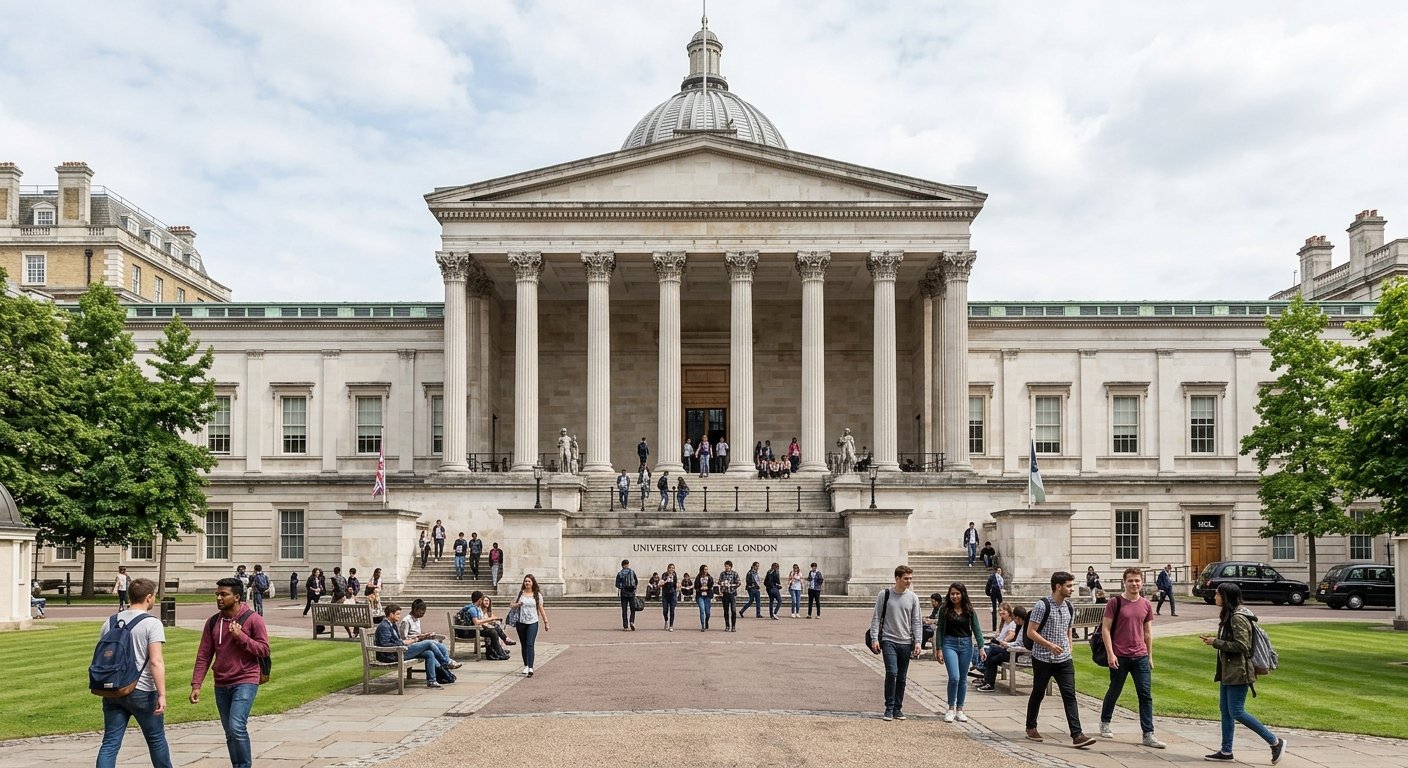
One of the most recognizable features of UCL is its historic campus in Bloomsbury, central London.
The main building, with its famous Portico and Wilkins Building, became a symbol of the institution.
The architecture reflected the ambition of the founders. The university was not supposed to look like a small private school. It was intended to represent a major intellectual institution in the capital.
The Bloomsbury campus also placed students close to London’s museums, libraries, hospitals, government institutions, theatres and cultural organisations.
This location became an important advantage.
UCL students were not studying in isolation from the city. They were studying in one of the world’s great intellectual and cultural centres.
The university’s buildings also evolved over time as new departments, laboratories, libraries and research facilities were created.
In 2026, UCL’s historic buildings remain an important part of its identity, while modern facilities have expanded its physical presence across London.
8. UCL and Religious Equality
One of UCL’s most important historical achievements was its approach to religion.
At its foundation, UCL was established as a non-sectarian institution. It became the first university in England to welcome students regardless of religious background. (University College London)
This was a significant change.
At the time, religious affiliation could determine whether a person could access certain educational institutions. UCL’s policy challenged that model.
The university therefore became associated with religious tolerance and intellectual freedom.
This did not mean that nineteenth-century UCL was free from every form of social inequality. Like other institutions of its period, it reflected many of the limitations and prejudices of Victorian society.
Nevertheless, its founding principle represented a major step toward a more inclusive university system.
9. Women and UCL
Perhaps the most famous example of UCL’s progressive educational history is its role in women’s higher education.
In the nineteenth century, women faced enormous barriers to university education. Many universities either excluded women entirely or prevented them from receiving degrees.
UCL became a pioneer in changing this situation.
In 1878, UCL became the first UK institution to formally admit women to degree study on an equal basis with men. UCL’s historical records describe this as a major milestone in the history of women’s education. (University College London)
Women were allowed to study many subjects that had previously been closed to them.
This decision had consequences far beyond UCL.
Women who studied at UCL entered professions such as medicine, law, science and education, helping to challenge traditional assumptions about women’s intellectual abilities and social roles.
Among the notable women associated with this development was Eliza Orme, who became the first woman to earn a law degree in England. Another was Louisa Aldrich-Blake, an important figure in British medical history. (University College London)
10. College Hall and Women’s Student Life
The admission of women created new challenges.
Women needed accommodation, social support and an environment in which they could study successfully.
College Hall, a women’s residence, opened in 1882. This provided residential support for women students and helped create a more sustainable environment for female higher education. (University College London)
Women’s presence gradually became an established part of university life.
Their success also challenged assumptions about what women could achieve academically.
The history of UCL demonstrates that access to university education can have wider social consequences. Education gives individuals qualifications, but it can also change professional structures, cultural expectations and social opportunities.
11. UCL and Architecture
Architecture became another important part of UCL’s academic history.
The university was an early pioneer in treating architecture as an academic discipline.
UCL’s historical material states that it was the first university to establish architecture as an academic discipline and appointed Thomas Donaldson to the first Chair in Architecture in 1841. (University College London)
This reflected UCL’s wider philosophy.
The founders believed universities should respond to modern professional and technological needs.
Architecture was increasingly important in a rapidly growing industrial city such as London. By teaching architecture within a university environment, UCL helped establish the subject as an academic and professional field.
Today, architecture remains one of UCL’s internationally recognised areas through The Bartlett Faculty of the Built Environment.
12. Science and Scientific Research
Science became central to UCL’s identity during the nineteenth and twentieth centuries.
The university encouraged laboratory-based teaching and research at a time when experimental science was transforming society.
Subjects such as chemistry, physiology, physics, biology and engineering expanded.
The development of scientific laboratories allowed students to learn through experimentation rather than simply reading established texts.
This research culture eventually produced major discoveries and inventions.
UCL’s scientific reputation became increasingly international.
13. The Fleming Valve
One of the most famous inventions associated with UCL is the Fleming valve, developed by UCL professor John Ambrose Fleming.
Fleming’s thermionic valve was patented in 1904. It became an important development in electronics and communication technology. UCL explains that the invention enabled the detection of high-frequency radio signals and helped create technological foundations for radio, television, telephones and early computers. (University College London)
The invention demonstrates the importance of university research to technological development.
It also illustrates UCL’s long-standing relationship between theoretical science and practical application.
The Fleming valve was not simply an academic discovery. It became part of a technological transformation that changed global communication.
14. UCL During the Twentieth Century
The twentieth century brought enormous changes to UCL.
Britain experienced two world wars, economic crises, social transformation, technological revolutions and the decline of the British Empire.
Universities had to adapt.
UCL expanded its research activities and developed new academic disciplines.
The university increasingly became a place where science, medicine, social sciences, engineering, arts and humanities interacted.
Research became more important than ever.
Universities were no longer simply institutions for educating professionals. They were increasingly expected to produce new knowledge and contribute to national scientific and economic development.
UCL responded to these changes by expanding its research capacity.
15. Kathleen Lonsdale and Women in Science
Another important milestone came in 1949, when crystallographer Kathleen Lonsdale became UCL’s first female professor.
Lonsdale had already achieved major recognition for her scientific work and had been elected a Fellow of the Royal Society in 1945, among the first women to receive that honour. (University College London)
Her appointment was significant because senior academic positions remained overwhelmingly dominated by men.
Lonsdale’s career demonstrated the growing role of women in scientific research and helped establish a precedent for future generations of female academics.
Her story also connects UCL’s nineteenth-century commitment to women’s education with the twentieth-century expansion of women’s participation in scientific leadership.
16. Student Life and the Students’ Union
Student life has always been an important part of UCL.
Students established societies, debating organisations, academic clubs and political groups.
UCL’s student culture developed alongside the university itself.
Historical records show that the university’s students formed organisations from its earliest years. A Medical Society and debating society were established during the early period of UCL’s development. (UCL Blogs)
In 1893, UCL became associated with the formation of England’s first students’ union. (University College London)
The Students’ Union eventually became an important part of university democracy and student representation.
Over the decades, UCL students became involved in debates over education, politics, social justice, gender equality and other issues.
17. UCL and Social Change
UCL’s history cannot be separated from wider social change.
Because of its founding philosophy, the university often attracted people interested in reform and new ideas.
Students and academics participated in discussions about:
- Democracy
- Education reform
- Women’s rights
- Science
- Medicine
- Social policy
- International relations
- Equality
- Human rights
- Economic development
This created a distinctive culture in which questioning established assumptions became part of academic life.
UCL’s modern identity continues to emphasise challenging orthodoxy and applying knowledge to real-world problems. (University College London)
18. UCL During the Second World War
The Second World War affected universities throughout Britain.
London was heavily bombed during the Blitz, and UCL’s location in central London meant that the institution was directly exposed to the dangers of wartime.
Academic work continued under difficult circumstances.
Researchers and medical professionals contributed to wartime efforts, while students and staff participated in national service and other forms of support.
The war also accelerated scientific research in areas such as medicine, engineering and communications.
After 1945, universities entered a new era.
The British government increasingly recognised higher education and scientific research as essential to national reconstruction.
19. Expansion After 1945
The decades following the Second World War brought major expansion in British higher education.
More people wanted university education, and the government invested in scientific research and educational infrastructure.
UCL expanded its departments and research activities.
New areas of study developed in response to changing society.
Psychology, neuroscience, computer science, environmental studies, social sciences and many other fields became increasingly important.
The university also developed stronger connections with hospitals, research organisations, industry and public institutions.
20. Interdisciplinary Education
One of UCL’s greatest modern strengths is its multidisciplinary structure.
The university contains faculties covering a very wide range of academic areas.
These include medicine, engineering, life sciences, arts and humanities, social sciences, architecture, laws, mathematical and physical sciences, education and other disciplines.
This diversity allows researchers to work across traditional academic boundaries.
For example, climate change cannot be solved only through environmental science. It also requires economics, politics, engineering, architecture, law, public health and social research.
Similarly, artificial intelligence involves computer science but also ethics, psychology, law, economics and philosophy.
UCL’s multidisciplinary model allows researchers to approach such challenges from multiple perspectives.
21. UCL and the University of London
UCL has maintained an important relationship with the University of London.
Although UCL is an independent university with its own governance and academic identity, it remains a historic constituent institution of the University of London.
The distinction between the two institutions is important for understanding British higher education.
The University of London developed as a federal university, while individual colleges such as UCL became major academic institutions in their own right.
Over time, the colleges gained increasing autonomy.
Today, UCL is internationally recognised independently of the University of London while retaining its historical connection to the federation.
22. UCL Becomes a Global University
During the late twentieth century and early twenty-first century, UCL became increasingly international.
Students and academics arrived from across the world.
London itself became one of the world’s most international cities, making UCL naturally attractive to international students.
Today, UCL states that its community includes people from more than 150 countries. (University College London)
This international character influences research, teaching and student life.
A university with students from many countries can approach global problems from diverse perspectives.
International partnerships also allow UCL researchers to cooperate with institutions around the world.
23. UCL’s Nobel Prize Legacy
UCL has produced and employed many internationally recognised researchers.
According to UCL’s current historical information, there have been 33 Nobel Prize laureates among UCL alumni and current or former staff to date. (University College London)
These Nobel-related achievements span different areas of knowledge.
They demonstrate the university’s contribution to major advances in science, medicine, economics and other fields.
However, the significance of a research university cannot be measured only through Nobel Prizes.
UCL’s wider research community contributes to thousands of scientific papers, discoveries, technologies, public policies and educational developments.
24. UCL and Modern Medicine
Medicine remains one of UCL’s strongest areas.
The university’s medical research is closely connected with hospitals and clinical institutions in London.
Researchers work on areas including:
- Cancer
- Neurology
- Neuroscience
- Genetics
- Immunology
- Cardiovascular disease
- Mental health
- Infectious diseases
- Population health
- Surgery
- Medical technology
The combination of laboratory science, clinical medicine and population research creates opportunities for discoveries to move from research laboratories into healthcare.
This is one of the most important ways a modern university can serve society.
25. Neuroscience and Brain Research
UCL has developed a particularly strong reputation in neuroscience.
The human brain remains one of science’s most complicated subjects.
UCL researchers study areas including memory, cognition, neurodegenerative disease, brain development, artificial intelligence and neurological disorders.
Modern neuroscience requires collaboration between biology, medicine, psychology, computing and mathematics.
This makes neuroscience an excellent example of UCL’s interdisciplinary approach.
26. Engineering and Technology
Engineering has been part of UCL’s identity since the nineteenth century.
Today, engineering at UCL covers areas such as:
- Civil engineering
- Mechanical engineering
- Electronic engineering
- Biomedical engineering
- Chemical engineering
- Computer engineering
- Environmental engineering
Modern engineering research addresses problems ranging from sustainable infrastructure to robotics and artificial intelligence.
UCL’s engineering tradition therefore connects its nineteenth-century commitment to practical knowledge with twenty-first-century technological innovation.
27. Artificial Intelligence and Digital Research
Artificial intelligence has become one of the most important research areas of the modern era.
UCL’s multidisciplinary environment allows AI research to connect with medicine, engineering, law, economics, psychology, education and the arts.
The university’s researchers are involved in areas such as machine learning, robotics, medical AI, human-computer interaction and data science.
The development of AI also raises major ethical and social questions.
Questions about privacy, employment, bias, accountability and human rights cannot be answered through computer science alone.
This is where UCL’s multidisciplinary structure becomes particularly valuable.
28. UCL and Climate Change
Climate change is another major area of modern UCL research.
Researchers investigate climate systems, environmental policy, sustainable architecture, renewable energy, urban planning, economics and public health.
London provides a natural laboratory for studying urban sustainability.
A major city must deal with transport, housing, pollution, energy consumption, flooding and changing weather patterns.
UCL’s research therefore connects global environmental science with practical urban problems.
29. The Bartlett Faculty of the Built Environment
The Bartlett is one of UCL’s best-known academic divisions.
It focuses on the built environment, including architecture, planning, construction, urban design, development and related fields.
Its roots can be connected to UCL’s nineteenth-century decision to establish architecture as an academic subject.
Today, the Bartlett takes a broad approach to cities and the built environment.
Researchers investigate how cities can become more sustainable, inclusive and resilient.
This work is particularly important because the world’s population is increasingly urban.
30. UCL East
One of the most important recent developments in UCL’s history is the expansion into east London.
UCL East, located at Queen Elizabeth Olympic Park in Stratford, represents a major expansion of the university.
UCL officially opened UCL East in 2023, describing it as the university’s largest expansion since its foundation. (University College London)
The campus provides space for research, education and collaboration.
It also connects UCL more closely with east London and the wider Olympic Park development.
The new campus reflects the university’s ambition to create new models of interdisciplinary research.
31. UCL’s Bicentenary in 2026
The year 2026 is historically significant because it marks UCL’s 200th anniversary.
On 11 February 2026, UCL celebrated two centuries since its foundation. (University College London)
The bicentenary provides an opportunity to reflect on the university’s long history.
From a controversial nineteenth-century experiment to a major global research university, UCL has undergone enormous transformation.
The anniversary also encourages the university to consider its future.
UCL’s bicentenary programme includes exhibitions, lectures, events and activities examining the university’s history and future.
32. UCL’s Academic Reputation
Today, UCL is considered one of the world’s leading universities.
UCL’s current institutional information states that it is ranked among the world’s top universities, including 8th in the 2027 QS World University Rankings. (University College London)
Rankings are only one measure of academic quality, but they provide an indication of UCL’s international reputation.
Its strengths include research performance, internationalisation, academic breadth and interdisciplinary work.
The university’s location in London also provides opportunities for partnerships with governments, hospitals, museums, businesses, charities and cultural organisations.
33. UCL’s Global Community
Modern UCL is a highly international university.
Students come from many different countries and cultural backgrounds.
This diversity affects classroom discussions, research collaborations and student organisations.
International students also become part of the wider UCL alumni community after graduation.
For a university based in London, internationalisation is particularly significant.
London is a global centre for finance, politics, culture, science and business, and UCL students have access to this environment.
34. Famous Alumni
UCL has educated people who have made important contributions to many areas of society.
Its alumni include scientists, writers, politicians, entrepreneurs, doctors, artists, academics and public figures.
The university’s alumni network extends around the world.
Some graduates have become leaders in government and public service, while others have made major contributions to medicine, technology, business and culture.
This broad alumni profile reflects UCL’s multidisciplinary educational tradition.
35. UCL and the Arts and Humanities
Although UCL is famous for science and medicine, the arts and humanities have always been important.
The university teaches subjects such as history, philosophy, languages, literature, archaeology, classics and cultural studies.
These disciplines provide different ways of understanding human society.
A modern research university cannot focus only on technology.
Scientific discoveries often create ethical, cultural and political questions.
Humanities scholars help society understand these questions.
36. UCL and Social Sciences
Social sciences have also become a major component of UCL.
Researchers study economics, politics, sociology, education, psychology, geography and related subjects.
These disciplines are essential for understanding social problems.
For example, solving poverty requires more than economic policy. It also requires understanding education, health, housing, employment, family structures and political institutions.
UCL’s multidisciplinary model encourages researchers to connect these areas.
37. UCL Institute of Education
Education has a particularly important place within UCL through the UCL Institute of Education.
Education research addresses questions about schools, universities, children, teachers, learning, inequality and education policy.
Because education affects almost every part of society, research in this area can have enormous social impact.
The Institute of Education has strengthened UCL’s position as a major centre for educational research.
38. UCL and Equality
Equality has remained an important part of UCL’s institutional identity.
The university’s historical founding principles challenged some of the religious and social barriers that existed in nineteenth-century Britain.
Modern UCL continues to focus on widening participation and supporting students from different backgrounds.
The university states that it invests significantly in bursaries and activities intended to help students from diverse backgrounds access and succeed in higher education. (University College London)
This continues a theme that can be traced back to UCL’s original mission.
39. UCL and Innovation
Innovation is another central feature of modern UCL.
University research can produce new knowledge, but it can also create businesses, technologies and public services.
UCL has supported the development of spinout companies and partnerships designed to move research into practical applications.
This is particularly important in fields such as medicine, biotechnology, artificial intelligence and engineering.
The modern university therefore acts not only as a place for education but also as an engine of innovation.
40. UCL and Entrepreneurship
Entrepreneurship has become increasingly important in higher education.
Students and researchers can develop ideas into companies or social enterprises.
UCL’s location in London provides access to investors, businesses, hospitals and technology organisations.
Entrepreneurial activity allows academic discoveries to reach wider society.
However, UCL’s approach also emphasises the importance of responsible innovation.
New technologies must be considered in relation to ethics, equality and public benefit.
41. UCL Libraries and Collections
Libraries and archives are fundamental to university research.
UCL holds extensive collections covering historical documents, manuscripts, scientific materials, art, archaeology and other forms of knowledge.
These collections support both teaching and advanced research.
The university’s historical records also allow researchers to study UCL itself.
This is particularly valuable during the bicentenary year because historians can examine two centuries of institutional development.
42. UCL Museums and Public Engagement
UCL has a long tradition of connecting academic knowledge with the public.
Museums, exhibitions, lectures and public events allow people outside the university to engage with research.
This reflects the founding idea that knowledge should serve society.
A university is not simply an institution for enrolled students.
It can also act as a public intellectual resource.
Through public engagement, UCL researchers can communicate scientific discoveries, historical knowledge and social research to wider audiences.
43. UCL’s Economic Impact
A modern university can have a substantial economic influence.
UCL states that it contributes close to £10 billion in economic impact each year to London and the UK. (University College London)
Its economic influence comes from many sources.
These include:
- Employment
- Student spending
- Research funding
- Innovation
- Spinout companies
- Partnerships
- Construction
- International education
- Graduate employment
This makes UCL an important institution not only academically but economically.
44. UCL and London
The relationship between UCL and London is one of the defining features of its identity.
The university was created because reformers believed London needed a major university.
Two centuries later, the relationship remains strong.
UCL’s campuses are integrated into the city.
Students can access museums, hospitals, libraries, theatres, businesses and public institutions.
At the same time, UCL contributes knowledge, employment, research and cultural activity to London.
It is therefore difficult to understand UCL separately from the city in which it was founded.
45. UCL’s Research Culture
Research is central to UCL’s modern mission.
Researchers work on fundamental questions as well as practical problems.
Examples include:
- How does the human brain work?
- How can cancer treatment be improved?
- How can cities become sustainable?
- How can artificial intelligence be developed responsibly?
- How can climate change be addressed?
- How can education become more equitable?
- How can new technologies improve healthcare?
These questions demonstrate why interdisciplinary research is increasingly important.
46. The Importance of Academic Freedom
Academic freedom is another important part of university life.
UCL’s history is connected to challenging established ideas.
The institution was created partly because its founders believed existing educational structures were too restrictive.
Over two centuries, this culture of questioning became part of the university’s identity.
Academic freedom allows scholars to investigate controversial questions and challenge accepted theories.
However, academic freedom also comes with responsibilities involving evidence, professional standards and respect for others.
47. UCL’s Changing Identity
UCL’s identity has changed dramatically since 1826.
The original institution was relatively small and controversial.
Modern UCL is a huge international research university with tens of thousands of students and staff.
Yet some themes remain consistent:
Innovation: UCL has consistently embraced new subjects and ideas.
Inclusion: The university’s founders challenged religious barriers, while modern UCL continues to work on access and equality.
Research: Scientific and intellectual discovery has been central throughout its history.
London: The university remains deeply connected to the city.
Interdisciplinarity: Modern UCL increasingly combines different fields to solve complex problems.
48. Challenges Facing UCL
Despite its achievements, UCL faces significant challenges.
Modern universities must deal with rising costs, increasing student demand, research funding pressures, technological change and global competition.
Universities must also consider sustainability.
Large campuses consume energy and resources, while students and staff travel internationally.
UCL therefore faces the challenge of balancing growth with environmental responsibility.
Another challenge is maintaining educational quality while operating at a very large scale.
The university must continue to provide students with strong academic support while expanding its research and international activities.
49. The Future of UCL
The next chapter of UCL’s history will probably be shaped by several major developments.
Artificial intelligence will transform education and research.
Climate change will require new approaches to engineering, medicine, architecture and public policy.
Medical research may produce new treatments for diseases that currently have limited options.
Urbanisation will create new challenges for London and other global cities.
Education itself will also change as digital technologies become increasingly important.
UCL’s multidisciplinary structure places it in a strong position to address these challenges.
The university’s future will depend on its ability to combine its historical values with new technologies and changing social needs.
50. Why UCL’s History Matters
UCL’s history matters because it demonstrates how universities can influence society.
The university began with a simple but revolutionary idea: higher education should not be limited to a narrow religious or social elite.
From that beginning, UCL helped expand access to education, supported women’s higher education, developed modern academic disciplines and contributed to major scientific discoveries.
Its history also demonstrates that universities are constantly changing.
The subjects taught at UCL in 1826 are not identical to those taught today.
Research methods have changed.
Technology has changed.
The student population has changed.
London has changed.
Yet the need for knowledge has remained.
51. Major Milestones in UCL History
A simplified timeline helps illustrate the university’s development:
1826 – Foundation: The institution is founded as the self-styled University of London.
1828 – First students: UCL opens its doors to its first students. (University College London)
1834 – Medical development: North London Hospital is established.
1836 – Royal Charter: The institution becomes University College London, while the University of London is separately established. (University College London)
1837 – University College Hospital: North London Hospital becomes University College Hospital. (University College London)
1841 – Architecture: UCL establishes an early academic chair in architecture.
1878 – Women admitted to degree study: UCL becomes the first UK institution to formally admit women to degree study alongside men. (University College London)
1882 – College Hall: Women’s residence opens.
1893 – Students’ Union: England’s first students’ union is formed at UCL. (University College London)
1904 – Fleming valve: John Ambrose Fleming patents the thermionic valve. (University College London)
1949 – First female professor: Kathleen Lonsdale becomes UCL’s first female professor. (University College London)
1970s – Social change: UCL students become involved in new movements concerning equality, sexuality and social politics. (University College London)
2023 – UCL East: The university officially opens its major new east London campus. (University College London)
2026 – Bicentenary: UCL celebrates 200 years since its foundation. (University College London)
52. UCL’s Legacy
The greatest legacy of UCL may not be any single building or discovery.
Its most important legacy is the idea that universities can challenge social barriers.
The university’s founders created an institution that was deliberately different from traditional universities.
Over time, this philosophy contributed to the expansion of higher education in Britain.
UCL helped demonstrate that a modern university could be:
- Secular
- Scientific
- International
- Multidisciplinary
- Professionally focused
- Socially engaged
- Open to wider groups of students
These characteristics are now common across modern universities, but in the 1820s they were highly innovative.
Conclusion
University College London has travelled an extraordinary journey since its foundation in 1826.
It began as a controversial educational experiment created by reformers who believed London needed a new kind of university. The institution challenged the traditional educational system by welcoming students regardless of religious belief and by introducing a curriculum that reflected the changing needs of nineteenth-century society.
Its history includes major milestones in women’s education, medicine, architecture, engineering, science and technology.
UCL’s pioneering approach to women’s higher education was particularly important. The decision to admit women to degree study in 1878 helped open professional and academic opportunities for generations of women. (University College London)
Scientific research also became a defining feature of the institution. The Fleming valve is one famous example of UCL research contributing to technological change. Other areas of research have subsequently influenced medicine, neuroscience, engineering, architecture, education and the social sciences.
During the twentieth century, UCL developed from a London college into an increasingly international research institution. In the twenty-first century, it has continued to expand its global research and educational activities while maintaining a strong connection with London.
The opening of UCL East in 2023 represented one of the most significant physical expansions in the university’s history. (University College London)
Now, in 2026, UCL has reached an extraordinary milestone: 200 years of history. The university’s bicentenary provides an opportunity to look back at two centuries of achievements while also considering the challenges of the future.
Today, UCL has more than 18,000 staff and 51,000 students from more than 150 countries, demonstrating how far the institution has grown from its nineteenth-century beginnings. (University College London)
The story of UCL is ultimately a story of continuous change. Its founders challenged the educational conventions of their time. Later generations of academics and students continued to question established assumptions and develop new fields of knowledge.
That spirit remains central to UCL.
As the university moves beyond its bicentenary, its future will be shaped by artificial intelligence, climate change, medical discovery, technological innovation, urban development, global education and new forms of interdisciplinary research.
The institution that began in 1826 as a radical alternative to traditional higher education has therefore become one of the world’s leading universities.
Its history shows how powerful an idea can become when generations of students, teachers and researchers continue to build upon it.
From its foundation in nineteenth-century London to its global role in the twenty-first century, University College London represents two centuries of education, discovery, innovation and social change.