Introduction
The California Institute of Technology, commonly known as Caltech, is one of the world’s most respected private research universities. Located in Pasadena, California, Caltech has built an extraordinary reputation for excellence in science, engineering, mathematics, astronomy, physics, chemistry, biology, and related fields. Although it is relatively small compared with many major universities, its influence on modern science and technology is remarkably large.
Caltech’s history is closely connected with the development of modern scientific research in the United States. From its early beginnings as a vocational school to its transformation into a world-class research institution, Caltech has consistently emphasized rigorous education, experimental discovery, collaboration, and intellectual curiosity. Its scientists and alumni have contributed to discoveries involving space exploration, quantum physics, chemistry, biology, computing, geology, engineering, and many other fields.
The university is particularly famous for its close relationship with the Jet Propulsion Laboratory (JPL), which Caltech manages for NASA. Through this partnership, Caltech researchers have played important roles in robotic missions to planets, moons, asteroids, and other destinations throughout the solar system.
Caltech’s story is therefore not simply the history of a university. It is also part of the broader story of American science, technological development, space exploration, and scientific innovation.
1. The Early Origins of Caltech
The institution that eventually became Caltech began in the late nineteenth century in Pasadena, California. Pasadena itself was developing rapidly during this period, and local leaders wanted to establish an educational institution that could serve the growing community.
In 1891, businessman and civic leader Amos G. Throop founded Throop University. The institution was named after him and initially offered a broad educational program. At the time, it was not yet the specialized scientific university that the world would later know as Caltech.
During its early years, the institution experienced several changes in organization and educational direction. The school eventually became known as Throop Polytechnic Institute. The word “Polytechnic” reflected an increasing interest in practical education, engineering, and technical subjects.
The development of Pasadena also helped shape the institution’s future. Southern California was becoming an important center for agriculture, industry, transportation, and commerce. As the region developed, there was a growing need for technically trained professionals and scientifically educated individuals.
However, the institution’s transformation into a major research university required visionary leadership.
2. George Ellery Hale and the Scientific Transformation
One of the most important figures in Caltech’s history was George Ellery Hale, an influential astronomer and scientific organizer.
Hale recognized the potential of creating a major scientific institution in Southern California. He believed that the region could support an institution dedicated to advanced scientific research and education.
Hale was already famous for his work in astronomy. He played a major role in the development of large astronomical observatories and helped establish Southern California as an important center for astronomical research.
His involvement with Throop Polytechnic Institute contributed greatly to its transformation.
Hale believed that a successful scientific institution required outstanding faculty, advanced laboratories, strong research programs, and a culture that encouraged scientific discovery. Rather than simply training students for existing professions, he wanted the institution to participate directly in the creation of new knowledge.
This philosophy became one of the defining characteristics of Caltech.
3. The Arrival of Arthur Amos Noyes
Another important figure in Caltech’s development was Arthur Amos Noyes, a distinguished chemist.
Noyes joined the institution in the early twentieth century and helped strengthen its scientific foundation. His expertise in chemistry and his understanding of scientific education contributed to the development of rigorous academic programs.
Noyes supported the idea that undergraduate education should be closely connected with research. Students should not simply memorize established information; they should learn how scientists investigate unanswered questions.
This approach became central to Caltech’s educational philosophy.
4. Robert Andrews Millikan and the Rise of Modern Caltech
Robert Andrews Millikan was another major figure in Caltech’s history.
Millikan was an internationally recognized physicist whose research contributed to understanding the electric charge of the electron and the photoelectric effect. He received the Nobel Prize in Physics in 1923.
Millikan became one of the most influential leaders of the institution during a critical period of its development.
Under his leadership, the school expanded its scientific programs and strengthened its reputation as a research institution. He helped recruit highly talented scientists and promoted an environment in which fundamental scientific research was highly valued.
During this period, the institution increasingly became known for physics, chemistry, astronomy, and engineering.
In 1920, the institution adopted the name California Institute of Technology, marking its evolution into the modern university.
5. Why Caltech Became Different
From the beginning of its modern development, Caltech followed an unusual model.
Many large universities had thousands or tens of thousands of students. Caltech, by contrast, remained relatively small.
This small scale allowed professors and students to interact closely. Undergraduate students could become involved in sophisticated research relatively early in their academic careers.
The university also emphasized difficult scientific and mathematical training.
Caltech developed a reputation for demanding coursework. Students were expected to understand fundamental principles deeply rather than simply memorize information.
This philosophy continues to influence Caltech’s educational culture.
6. Caltech and Albert Einstein
Caltech became increasingly connected with leading scientists from around the world.
Albert Einstein visited Caltech during the 1930s. His visits reflected the institution’s growing international importance.
The presence and interaction of internationally recognized scientists helped strengthen Caltech’s reputation as a place where major scientific ideas were discussed and developed.
During this era, physics was undergoing revolutionary changes. Quantum mechanics, relativity, nuclear physics, and particle physics were transforming scientists’ understanding of nature.
Caltech became an important participant in these developments.
7. Richard Feynman and the Golden Age of Physics
One of Caltech’s most famous professors was Richard P. Feynman.
Feynman was a brilliant theoretical physicist and one of the most influential scientific thinkers of the twentieth century. He made major contributions to quantum electrodynamics and received the Nobel Prize in Physics in 1965.
Feynman was also famous for his teaching style.
His lectures emphasized intuition, problem-solving, and understanding rather than simple memorization. His work at Caltech contributed to the institution’s reputation for exceptional physics education.
His books and lectures have influenced generations of students and scientists worldwide.
Feynman’s presence at Caltech represents an important aspect of the university’s culture: major scientists are expected not only to conduct research but also to teach and communicate ideas.
8. Linus Pauling and Chemistry at Caltech
Linus Pauling was another extraordinary scientist associated with Caltech.
Pauling made major contributions to chemistry, molecular biology, and our understanding of chemical bonds and molecular structures.
He received the Nobel Prize in Chemistry in 1954 and later the Nobel Peace Prize in 1962, making him one of the rare individuals to receive two Nobel Prizes in different categories.
His work demonstrated the interdisciplinary nature of modern science.
Chemistry could not be isolated from physics, biology, mathematics, and medicine. Understanding molecules required knowledge from multiple scientific disciplines.
Caltech became an important environment for this kind of interdisciplinary research.
9. The Role of Mathematics
Mathematics has always been central to Caltech.
Scientific research increasingly depends on mathematical modeling, statistics, computation, differential equations, probability, geometry, and other mathematical methods.
Caltech’s mathematics programs have contributed to fields ranging from theoretical physics to computer science and engineering.
The university’s emphasis on fundamental mathematical understanding has helped students develop the tools needed to solve complex scientific problems.
10. Astronomy and Astrophysics
Caltech has a particularly strong history in astronomy and astrophysics.
George Ellery Hale’s influence was crucial to the development of astronomical research in Southern California.
Caltech later became associated with major observatories and astronomical facilities.
One of the most important is the Palomar Observatory, located in Southern California. The 200-inch Hale Telescope became one of the world’s most important astronomical instruments when it was completed in the twentieth century.
The telescope allowed astronomers to study distant galaxies, stars, nebulae, and other objects with unprecedented detail.
Caltech astronomers have contributed to discoveries involving the expansion of the universe, galaxies, stellar evolution, black holes, exoplanets, and cosmology.
11. Caltech and the Expansion of the Universe
Caltech researchers have played important roles in observational cosmology.
Astronomers have studied distant galaxies and supernovae to understand the history and structure of the universe.
One of the most important discoveries in modern cosmology was evidence that the expansion of the universe is accelerating.
Researchers associated with Caltech and other institutions contributed to the observations that led to this groundbreaking conclusion.
This work transformed our understanding of the universe and earned the scientists involved the 2011 Nobel Prize in Physics.
12. The Jet Propulsion Laboratory
Perhaps the most famous research institution connected with Caltech is the Jet Propulsion Laboratory.
JPL began as a group of researchers working on experimental rocketry at Caltech. During the twentieth century, it developed into one of the world’s leading centers for robotic space exploration.
Today, JPL is a federally funded research and development center operated by Caltech for NASA.
Its missions have included spacecraft sent to Mars, Jupiter, Saturn, Uranus, Neptune, asteroids, and other destinations.
JPL has helped develop technologies for navigation, robotics, planetary science, imaging, communications, and autonomous spacecraft operations.
13. Caltech and NASA
Caltech’s relationship with NASA is historically significant.
Through JPL, Caltech researchers and engineers have participated in numerous NASA missions.
Among the most famous are the Voyager missions, which explored the outer solar system and continue to provide scientific information from extraordinary distances.
Other important missions include Mars rovers, planetary orbiters, telescopes, and spacecraft designed to study asteroids and other celestial bodies.
This connection gives Caltech a unique position in American space science.
14. Voyager and Deep-Space Exploration
The Voyager missions represent one of the greatest achievements associated with JPL.
Voyager 1 and Voyager 2 were launched in 1977 to study the outer planets.
The spacecraft provided spectacular information about Jupiter, Saturn, Uranus, and Neptune.
They discovered moons, studied planetary atmospheres, observed rings, and transformed scientific understanding of the outer solar system.
Voyager 2 remains the only spacecraft to have visited Uranus and Neptune.
The missions also demonstrated the value of long-term scientific projects.
15. Mars Exploration
Caltech and JPL have played a central role in Mars exploration.
Robotic missions have investigated the planet’s atmosphere, geology, climate, and potential habitability.
Mars rovers have traveled across the planet’s surface, collecting scientific information and photographing landscapes.
The success of these missions required expertise from many fields, including mechanical engineering, electrical engineering, computer science, planetary science, geology, physics, and chemistry.
This multidisciplinary approach reflects the broader Caltech philosophy.
16. Caltech’s Contribution to Engineering
Engineering is another major area of Caltech excellence.
The university offers programs and research opportunities in mechanical engineering, electrical engineering, aerospace engineering, chemical engineering, materials science, and other areas.
Caltech engineers often work closely with scientists.
This relationship allows theoretical discoveries to become practical technologies.
For example, research in physics can contribute to new sensors, computing systems, spacecraft instruments, medical technologies, and energy systems.
17. Biology and Bioengineering
Although Caltech is historically famous for physics and astronomy, biology has become increasingly important.
Researchers investigate genetics, neuroscience, molecular biology, cellular systems, evolution, and biological engineering.
Caltech’s approach often combines biology with physics, chemistry, mathematics, and engineering.
Bioengineering research can involve designing new technologies inspired by biological systems or developing methods for understanding disease at the molecular level.
18. Neuroscience
Caltech has also developed strong programs in neuroscience.
Researchers investigate how brains process information, how neural systems control behavior, and how biological networks produce perception and decision-making.
Modern neuroscience increasingly relies on computational methods.
Caltech’s strength in mathematics, physics, computing, and engineering provides useful tools for understanding complex biological systems.
19. Computer Science
Computer science has become another important component of Caltech’s research environment.
Computing is now essential for virtually every major scientific discipline.
Scientists use computational methods to simulate physical systems, analyze astronomical data, model biological processes, design engineering systems, and process enormous datasets.
Caltech researchers have contributed to theoretical computer science, algorithms, artificial intelligence, computation, and scientific computing.
20. Interdisciplinary Research
One of Caltech’s greatest strengths is interdisciplinary research.
Modern scientific problems rarely fit neatly into a single academic department.
Climate science, artificial intelligence, biotechnology, space exploration, quantum information, renewable energy, and medical technology all require knowledge from multiple fields.
Caltech encourages researchers to collaborate across disciplinary boundaries.
A physicist may work with a biologist. An engineer may collaborate with an astronomer. A computer scientist may work with a neuroscientist.
This culture encourages unexpected discoveries.
21. Caltech’s Undergraduate Education
Caltech’s undergraduate program is known for its rigorous curriculum.
Students generally receive strong foundations in mathematics, physics, chemistry, biology, computer science, and other fundamental areas.
The purpose is to give students a broad scientific foundation before they specialize.
The academic environment can be demanding, but it is also highly collaborative.
Students often work together to understand difficult concepts and solve challenging problems.
22. Research Opportunities for Students
Research is a major part of the Caltech student experience.
Undergraduate students can participate in research projects with faculty members and research groups.
This gives students experience with real scientific questions.
Instead of only studying completed discoveries, students can participate in investigations where the answers are not yet known.
This approach helps develop scientific creativity and independence.
23. Graduate Education
Caltech’s graduate programs are internationally recognized.
Graduate students work closely with faculty members and research laboratories.
Doctoral programs focus heavily on original research.
Students may spend years investigating specialized questions in physics, chemistry, biology, astronomy, engineering, mathematics, computer science, or other fields.
The small academic community can allow close interaction between students and professors.
24. Caltech Faculty
Caltech has attracted many internationally recognized scholars.
The university’s faculty includes Nobel laureates, members of national academies, leading researchers, engineers, and scientific innovators.
Faculty members are often deeply involved in research.
This means students learn directly from people who are actively advancing their fields.
25. Nobel Prize Legacy
Caltech has an impressive Nobel Prize history.
Scientists associated with the institution have received Nobel Prizes in physics, chemistry, economics, and other areas.
These awards reflect the university’s impact on fundamental scientific research.
However, the importance of Caltech cannot be measured only by awards.
Many researchers contribute important discoveries without receiving major international prizes.
The deeper significance of the Nobel legacy is that it reflects a long-standing culture of ambitious research.
26. The Caltech Honor Code
Caltech has a distinctive honor system.
The Honor Code emphasizes trust, responsibility, and academic integrity.
Students are expected to behave honestly in academic and community activities.
Such systems can help create a culture in which students and faculty treat each other as members of an intellectual community.
Trust is especially important in research.
Scientific progress depends on accurate reporting, honest analysis, and responsible conduct.
27. Student Life
Although Caltech is academically intense, student life includes many activities beyond classrooms and laboratories.
Students participate in clubs, athletics, arts, social events, technical organizations, and community activities.
The residential house system is an important part of student life.
Students live and socialize within residential communities, creating strong friendships and traditions.
28. Caltech Houses
The undergraduate houses provide students with communities where they can live, study, eat, and participate in activities.
These houses contribute to Caltech’s distinctive social environment.
Students from different academic interests interact regularly.
This can encourage friendships and collaborations that continue after graduation.
29. Diversity and International Community
Caltech attracts students and researchers from around the world.
The international nature of the university contributes to its intellectual environment.
Students bring different perspectives, experiences, languages, and educational backgrounds.
Scientific research is inherently international, and collaboration across countries is increasingly important.
Caltech participates in global research networks involving universities, governments, companies, laboratories, and scientific organizations.
30. Women in Science at Caltech
Women have played increasingly important roles in Caltech’s academic and scientific community.
Over time, the institution has expanded opportunities for women in science, engineering, mathematics, and technology.
Female scientists associated with Caltech have contributed to astronomy, biology, physics, chemistry, engineering, and other disciplines.
Efforts to improve diversity remain an important part of the broader scientific community.
31. Caltech and the Modern Technology Industry
Caltech’s influence extends beyond academic research.
Its alumni and researchers have contributed to the technology industry, biotechnology, aerospace, energy, computing, finance, and other sectors.
The university’s location in Southern California places it near a major ecosystem of technology and aerospace organizations.
Graduates have founded companies, developed technologies, become research leaders, and contributed to public institutions.
32. Entrepreneurship
Although Caltech is primarily known for fundamental science, entrepreneurship has become increasingly important.
Scientific discoveries can create opportunities for new technologies and businesses.
Caltech supports innovation through research partnerships, technology transfer, entrepreneurship programs, and collaborations with industry.
Students and researchers can explore how scientific ideas might become practical products or services.
33. Caltech and the Aerospace Industry
Southern California has historically been one of the world’s major aerospace regions.
Caltech’s engineering and scientific research has contributed to this environment.
Research involving propulsion, materials, robotics, sensors, aerodynamics, control systems, and spacecraft technology has supported aerospace development.
JPL is particularly important because it connects academic research with major national space missions.
34. Scientific Culture
Caltech’s scientific culture is characterized by curiosity and intellectual ambition.
Researchers often work on questions that may not have immediate practical applications.
Fundamental research can appear abstract, but history demonstrates that basic scientific discoveries can eventually produce transformative technologies.
For example, research into quantum mechanics eventually influenced electronics, lasers, computing, communications, and medical imaging.
Caltech’s commitment to fundamental science reflects this long-term perspective.
35. The Importance of Small Size
Caltech’s relatively small size is one of its defining characteristics.
Large universities can provide enormous resources and broad academic choices.
Caltech provides a different advantage: close intellectual interaction.
Students can often interact directly with professors and researchers.
Research groups may be small enough to allow meaningful participation.
This environment can create a strong sense of academic community.
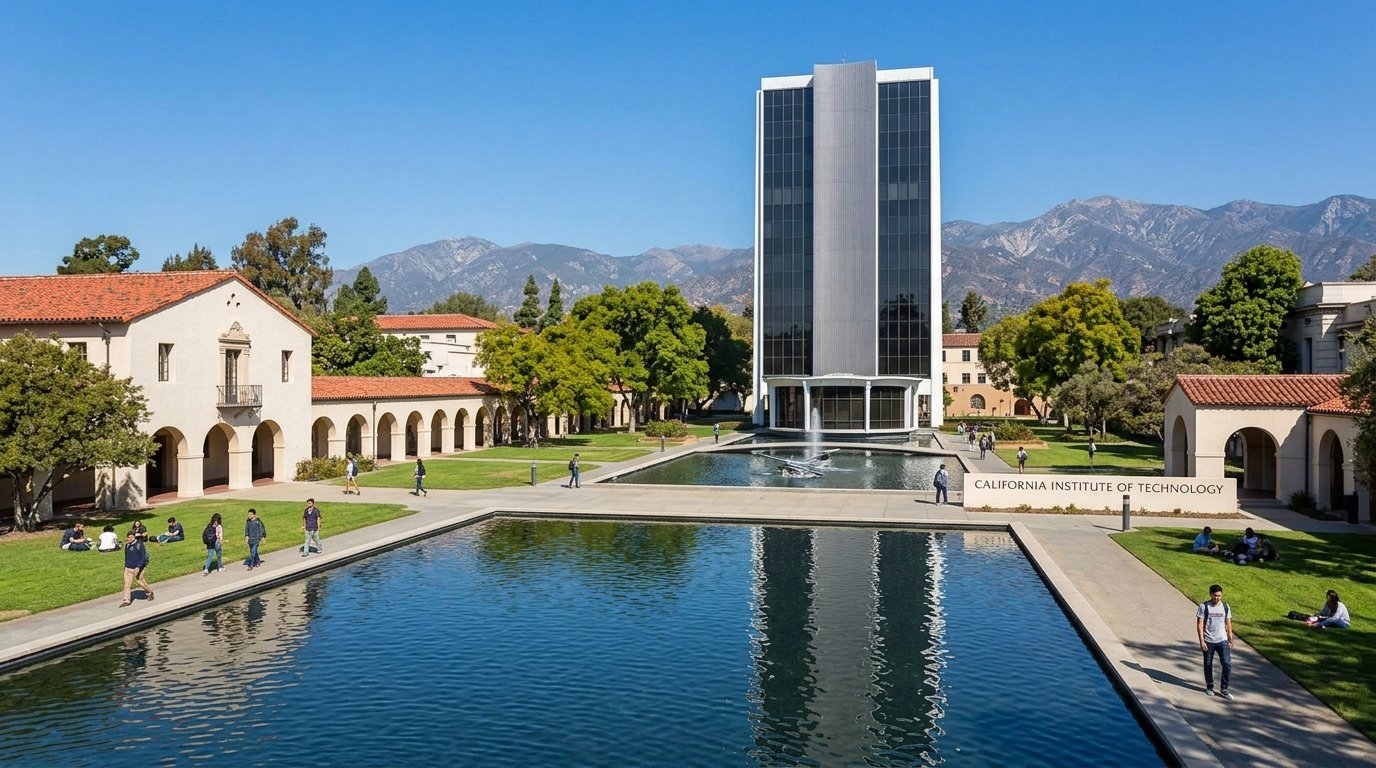
36. Caltech’s Campus
Caltech’s campus is located in Pasadena.
The campus combines historic buildings with modern scientific facilities.
Laboratories, classrooms, libraries, research centers, student residences, and public spaces create an environment designed around academic and scientific activity.
Pasadena itself provides a unique setting.
The city is located near Los Angeles but has a distinctive identity and history.
37. Pasadena and Caltech
Pasadena has played an important role in Caltech’s development.
The city provided financial, cultural, and civic support during the institution’s growth.
The region’s climate and location also attracted scientists and researchers.
Today, Caltech remains deeply connected with Pasadena.
The university contributes to the city’s cultural, educational, and economic life.
38. The Beckman Institute
The Beckman Institute at Caltech is an important center for interdisciplinary research.
It supports research involving chemistry, biology, physics, materials, and related scientific fields.
Institutes like this demonstrate Caltech’s emphasis on crossing traditional academic boundaries.
39. The Resnick Sustainability Center
Modern Caltech research increasingly addresses environmental and energy challenges.
Research in sustainability can involve solar energy, batteries, materials, climate science, carbon management, and water systems.
The university’s scientific expertise provides tools for investigating major environmental problems.
40. Caltech and Climate Research
Climate science is another area in which Caltech researchers contribute to global knowledge.
Scientists investigate atmospheric processes, ocean systems, climate modeling, environmental chemistry, and planetary climate.
Understanding climate change requires extensive scientific data and mathematical modeling.
Caltech’s interdisciplinary structure is well suited to this challenge.
41. Quantum Science
Quantum science has become an increasingly important research area.
Researchers investigate quantum mechanics, quantum information, quantum materials, and quantum technologies.
These areas have potential implications for computing, communications, sensing, and fundamental physics.
Caltech’s historical strength in physics makes it a natural center for quantum research.
42. Materials Science
Modern technology depends heavily on advanced materials.
Researchers investigate materials with unusual electrical, magnetic, mechanical, optical, or chemical properties.
New materials can lead to improvements in electronics, energy storage, solar cells, sensors, aerospace components, and medical technologies.
Caltech’s materials research often combines chemistry, physics, engineering, and computation.
43. Energy Research
Energy is one of the major scientific challenges of the modern world.
Caltech researchers investigate renewable energy, energy storage, fuel technologies, materials, and energy conversion.
Solar energy is particularly relevant in Southern California.
Scientific advances in energy systems could help reduce emissions and improve access to reliable power.
44. Caltech and Medical Research
Caltech’s biological and engineering research also contributes to medicine.
Scientists study disease mechanisms, cellular processes, neuroscience, imaging, biomaterials, and biological systems.
Some research can eventually contribute to new diagnostic technologies and therapeutic approaches.
The university’s emphasis on fundamental science provides the foundation for such advances.
45. Alumni Contributions
Caltech alumni have made significant contributions across science, engineering, academia, business, and public service.
Many graduates become professors and researchers.
Others join technology companies, aerospace organizations, laboratories, and government agencies.
Some become entrepreneurs.
The common connection is a strong scientific and analytical education.
46. Caltech’s Global Reputation
Caltech consistently ranks among the world’s leading research universities.
Its reputation is based on research productivity, faculty quality, scientific discoveries, academic rigor, and global influence.
The university is especially recognized in science and engineering disciplines.
Its small student population makes comparisons with large comprehensive universities complicated, but its research impact is extraordinary relative to its size.
47. Challenges Facing Caltech
Like every major institution, Caltech faces challenges.
Modern scientific research is increasingly expensive.
Large experiments, telescopes, spacecraft, laboratories, computing systems, and research equipment can require enormous financial resources.
Universities must also address issues involving climate change, technological ethics, academic integrity, diversity, research security, and responsible innovation.
Caltech must balance its traditional commitment to fundamental science with emerging social and technological needs.
48. The Future of Caltech
The future of Caltech will likely involve increasingly interdisciplinary research.
Artificial intelligence, quantum technology, biotechnology, climate science, space exploration, advanced materials, and renewable energy are likely to remain important areas.
Space exploration is also expected to remain central because of Caltech’s relationship with JPL.
Future spacecraft may explore Mars, icy moons, asteroids, exoplanets, and other destinations.
Caltech scientists and engineers will continue contributing to these missions.
49. Why Caltech Matters
Caltech matters because it demonstrates how a small research university can have a global impact.
Its influence comes from its people, research culture, laboratories, scientific partnerships, and commitment to difficult questions.
The university has helped advance humanity’s understanding of the universe, matter, life, mathematics, technology, and engineering.
Its researchers have contributed to discoveries that have changed textbooks and transformed industries.
50. Conclusion
The California Institute of Technology has developed from a small educational institution in Pasadena into one of the world’s leading centers for science and engineering.
Its history includes remarkable scientists such as George Ellery Hale, Robert Millikan, Arthur Amos Noyes, Linus Pauling, and Richard Feynman. Their work helped establish a culture in which research, education, and intellectual curiosity are closely connected.
Caltech’s contributions extend across physics, chemistry, biology, mathematics, engineering, astronomy, computer science, neuroscience, and planetary science. Its connection with the Jet Propulsion Laboratory has made it a major participant in space exploration, while its academic programs have educated generations of scientists and engineers.
Perhaps the most important feature of Caltech is its belief in fundamental discovery. The university encourages researchers to investigate difficult questions even when the immediate practical benefits are uncertain. History has repeatedly shown that such curiosity-driven research can eventually produce revolutionary technologies and new ways of understanding the world.
From the study of subatomic particles to the exploration of distant planets, Caltech has helped expand the boundaries of human knowledge.
Its legacy is therefore much larger than its physical campus in Pasadena. Through its scientists, alumni, laboratories, discoveries, and partnerships, Caltech has become an important part of the history of modern science.
As humanity faces new challenges involving climate change, energy, artificial intelligence, biotechnology, space exploration, and quantum technology, institutions such as Caltech will continue to play an important role.
The story of Caltech is ultimately a story of curiosity, persistence, experimentation, and the belief that even the most difficult scientific questions can be approached through careful thinking and discovery.