Introduction
The University of California, Berkeley, commonly known as UC Berkeley or simply Berkeley, is one of the most respected public research universities in the world. Located in Berkeley, California, across the bay from San Francisco, the university has played a remarkable role in the development of higher education, science, technology, social movements, public policy, and culture in the United States. From its establishment in the nineteenth century to its position as a global research powerhouse, UC Berkeley has built a reputation for intellectual ambition, academic freedom, innovation, and public service.
Berkeley is the flagship campus of the University of California system and has historically been associated with some of the most important developments in modern science and society. Researchers connected with Berkeley have contributed to discoveries in physics, chemistry, computer science, engineering, mathematics, biology, economics, political science, and many other disciplines. The university has also educated influential leaders, entrepreneurs, scientists, writers, activists, public officials, and scholars.
The history of UC Berkeley is closely connected with the history of California itself. California’s transformation from a recently acquired American territory into one of the world’s largest economies created a need for an institution capable of educating professionals, conducting advanced research, and serving the public. Berkeley grew alongside that transformation. Its campus became a center where new ideas could be developed, challenged, and applied to real-world problems.
One of Berkeley’s defining characteristics is its combination of academic excellence and public mission. As a public university, Berkeley has traditionally emphasized the idea that higher education and research should benefit society. This principle has influenced its approach to teaching, scientific discovery, public policy, environmental research, technological innovation, and community engagement.
Today, UC Berkeley is recognized internationally for its rigorous academic programs, distinguished faculty, major research centers, historic campus, vibrant student life, and influential alumni. Its story, however, began long before it became a global symbol of academic achievement.
1. The Origins of UC Berkeley
The origins of UC Berkeley can be traced to the early development of California as an American state. California became part of the United States in the nineteenth century, and after statehood in 1850, its leaders began thinking about how to create institutions capable of supporting the new state’s economic and intellectual development.
In the early years of statehood, California’s population was growing rapidly. The Gold Rush had transformed the region, attracting immigrants, entrepreneurs, workers, scientists, and adventurers. San Francisco became a major commercial center, while agriculture, mining, transportation, and trade expanded throughout the state.
The state’s leaders recognized that California needed an institution of higher learning. In 1868, the California legislature created the University of California. The university’s founding charter established an institution intended to provide instruction and research across a broad range of subjects.
The original University of California campus was established in Oakland temporarily before the university moved to its permanent Berkeley location. In 1873, the university opened its new Berkeley campus.
The selection of Berkeley was significant. The campus was located near San Francisco Bay and surrounded by the natural beauty of Northern California. The university’s setting would eventually become one of its most recognizable characteristics.
From its earliest years, Berkeley was intended to combine classical education with practical and scientific knowledge. This philosophy became increasingly important as California’s economy developed.
2. The Founding Vision
The founders of the University of California wanted more than a traditional college. They envisioned a university that would serve the needs of a rapidly developing state.
The institution was influenced by several important ideas about education. One was the belief that universities should preserve knowledge and teach established disciplines. Another was the emerging idea that universities should conduct original research and contribute directly to scientific and technological progress.
Berkeley eventually became a leading example of the American research university model.
The university’s public character also became central to its identity. Unlike many famous private universities in the United States, Berkeley was created as a public institution. This meant that its educational mission was closely connected with the interests of California and the wider public.
Over time, the university developed a reputation for providing access to talented students while maintaining exceptionally demanding academic standards.
3. Early Campus Development
During its first decades, Berkeley remained relatively small compared with the enormous institution it would eventually become. Nevertheless, the university steadily expanded its academic programs and physical campus.
The late nineteenth century was an important period for American higher education. Universities were increasingly establishing specialized departments, laboratories, professional schools, libraries, and research programs.
Berkeley followed this trend.
The university developed programs in the sciences, humanities, engineering, agriculture, law, and other fields. Scientific laboratories became particularly important as research became a central component of university life.
Berkeley also benefited from California’s unique geography. The state offered opportunities for research in geology, agriculture, forestry, marine science, environmental studies, astronomy, and other fields.
The university’s location near the Pacific Ocean and the San Francisco Bay Area later became an important advantage for research and innovation.
4. The University in the Early Twentieth Century
By the beginning of the twentieth century, UC Berkeley was becoming a major American university.
The campus expanded physically, and its academic reputation grew. New buildings were constructed, departments became more specialized, and faculty recruitment became increasingly important.
The university attracted scholars who were interested not only in teaching but also in research.
One of Berkeley’s most important developments was the growth of scientific research. The twentieth century would transform science dramatically, and Berkeley became an important participant in that transformation.
Physics, chemistry, mathematics, engineering, and biology grew substantially. Laboratories became essential parts of academic life.
Berkeley also developed strong programs in the humanities and social sciences. This combination of scientific and humanistic education helped create the university’s broad intellectual culture.
5. Berkeley and the Development of Modern Science
UC Berkeley has played an extraordinary role in modern scientific history.
During the twentieth century, researchers associated with Berkeley contributed to major developments in nuclear physics, chemistry, particle physics, computer science, mathematics, astronomy, and other fields.
The university became particularly famous for its work in nuclear science.
One of the central figures in this history was physicist Ernest O. Lawrence. Lawrence joined Berkeley’s faculty and became a major force in experimental physics.
In the early 1930s, Lawrence developed the cyclotron, a revolutionary device for accelerating charged particles. The technology became extremely important in nuclear physics and later contributed to medical applications and other scientific fields.
Lawrence’s work established Berkeley as an important center for experimental physics.
6. The Lawrence Berkeley National Laboratory
The scientific legacy of Berkeley also became connected with the Lawrence Berkeley National Laboratory, which developed from Lawrence’s research activities.
Although the laboratory is distinct from the university, the two institutions have maintained a close relationship.
The laboratory became a major center for scientific research, especially in physics, energy, materials science, biology, and other fields.
Its history demonstrates how university research can develop into large-scale national scientific infrastructure.
Berkeley researchers and laboratory scientists have participated in discoveries that changed scientific understanding and technological capabilities.
The partnership between academic researchers and national laboratories has been one of Berkeley’s important strengths.
7. Nuclear Chemistry and the Discovery of New Elements
Berkeley became particularly influential in nuclear chemistry.
Researchers working at Berkeley helped identify and study new chemical elements. Several elements were named in ways that recognize Berkeley’s scientific contributions.
These discoveries demonstrated the importance of advanced particle accelerators and experimental laboratories.
The work also reflected the increasingly international nature of twentieth-century science. Researchers from different backgrounds collaborated in laboratories where physics and chemistry were closely connected.
Berkeley’s reputation in nuclear science became one of the foundations of its international academic prestige.
8. Berkeley During World War II
World War II dramatically changed American universities.
UC Berkeley, like many major research institutions, became involved in wartime research.
Scientists contributed to projects related to physics, chemistry, engineering, medicine, communications, and national defense.
Some Berkeley researchers participated in activities associated with the Manhattan Project, the American-led effort to develop nuclear weapons during World War II.
The wartime period demonstrated both the power and complexity of university research.
Scientific discoveries could contribute to medical and technological progress, but they could also be applied to military purposes.
After the war, Berkeley continued to expand its research capabilities, partly because the United States increasingly invested in scientific research during the Cold War.
9. The Cold War and the Growth of Research
The Cold War era was an important period in Berkeley’s development.
The United States invested heavily in science, engineering, mathematics, computing, aerospace, and defense research.
Berkeley benefited from this environment while also developing independent research traditions.
The university expanded laboratories, graduate programs, research centers, and interdisciplinary projects.
The development of advanced scientific equipment allowed researchers to investigate increasingly complex questions about matter, energy, biology, and the universe.
Berkeley’s scientific culture became one of its defining characteristics.
10. Berkeley and Computer Science
UC Berkeley has also played an important role in the history of computing.
Computer science grew rapidly during the second half of the twentieth century. Berkeley researchers contributed to operating systems, computer architecture, networking, programming languages, databases, artificial intelligence, and other areas.
One of Berkeley’s best-known contributions to computing was the Berkeley Software Distribution, commonly called BSD.
BSD became highly influential in the development of Unix-like operating systems and later influenced technologies used across the computing industry.
Berkeley also became connected with the development of the RISC approach to computer architecture. Research in reduced instruction set computing contributed to important changes in processor design.
These contributions helped strengthen the university’s connection to Silicon Valley and the broader technology industry.
11. Berkeley and Silicon Valley
The relationship between UC Berkeley and Silicon Valley is one of the most important examples of university-industry collaboration in modern technology.
Silicon Valley developed south of San Francisco as a global center for electronics, computing, software, biotechnology, and entrepreneurship.
Berkeley’s location in the Bay Area placed it close to this growing technology ecosystem.
Faculty members, researchers, alumni, and students have contributed to technology companies and startups. Berkeley research has also supported innovations in areas such as artificial intelligence, software engineering, biotechnology, robotics, energy, and materials science.
The university has helped create an environment where academic discoveries can become commercial technologies.
At the same time, Berkeley’s public mission means that research is not limited to commercial applications. Many researchers focus on challenges such as climate change, public health, education, poverty, environmental sustainability, and social inequality.
12. The Free Speech Movement
Perhaps no event is more strongly associated with Berkeley’s modern identity than the Free Speech Movement.
During the 1960s, Berkeley became a major center of student activism.
In 1964, students protested restrictions on political activity on campus. The conflict developed into a major movement demanding greater freedom for political expression.
The Free Speech Movement became a defining moment in the history of American higher education.
Students argued that universities should allow political discussion, organization, and activism. The movement eventually changed campus policies and influenced student activism across the United States.
Berkeley’s reputation as a center of political activism grew significantly during this period.
13. The Berkeley Campus as a Center of Debate
The political culture of Berkeley has continued to evolve.
Students and faculty have participated in debates over civil rights, war, environmental protection, economic inequality, immigration, gender equality, labor rights, and many other issues.
The campus has frequently been a place where controversial ideas are discussed and challenged.
This culture has sometimes produced tension.
Supporters argue that Berkeley’s tradition of protest and debate reflects the university’s commitment to academic freedom and civic engagement.
Critics have sometimes argued that campus politics can become polarized.
Regardless of perspective, political and intellectual debate remains an important part of Berkeley’s history.
14. Academic Excellence
UC Berkeley offers a broad range of academic programs.
Its colleges and schools cover disciplines including:
- Engineering
- Computer science
- Business
- Economics
- Law
- Chemistry
- Physics
- Biology
- Mathematics
- Environmental science
- Political science
- Sociology
- Psychology
- History
- Philosophy
- English
- Architecture
- Public policy
- Education
- Journalism and media-related studies
Berkeley’s academic structure allows students to explore specialized subjects while also participating in a large research university environment.
The university is especially recognized for programs connected with science, engineering, economics, computer science, business, public policy, environmental studies, and the social sciences.
15. Berkeley’s College of Engineering
The College of Engineering is one of Berkeley’s most prominent academic units.
Engineering at Berkeley has contributed to major developments in electrical engineering, computer science, mechanical engineering, civil engineering, bioengineering, materials science, and related disciplines.
The college emphasizes both theoretical knowledge and practical innovation.
Students often work on complex problems involving energy, transportation, robotics, artificial intelligence, communications, biomedical technology, and sustainable infrastructure.
Berkeley engineering graduates have gone on to careers in academia, industry, government, entrepreneurship, and research.
16. Computer Science at Berkeley
Berkeley’s computer science community has achieved international recognition.
Research areas include artificial intelligence, machine learning, computer systems, cybersecurity, databases, computer architecture, theoretical computer science, robotics, and human-computer interaction.
The university’s computer science culture is closely connected with the broader Bay Area technology ecosystem.
Many students participate in research projects, internships, startups, and technology organizations.
Berkeley has also produced influential open-source software and research projects that have affected the computing world.
17. Haas School of Business
The Haas School of Business is Berkeley’s major business school.
It offers programs in areas such as management, finance, entrepreneurship, marketing, strategy, and business analytics.
Haas has strong connections with the Bay Area business community.
Students can benefit from proximity to technology companies, venture capital firms, financial institutions, consulting organizations, and startups.
Entrepreneurship is particularly important because of Berkeley’s location near Silicon Valley.
The school emphasizes leadership, innovation, analytical thinking, and responsible business practices.
18. Berkeley Law
Berkeley Law is another important part of the university.
The law school has contributed to legal scholarship and professional education in areas such as constitutional law, environmental law, technology law, intellectual property, international law, business law, and civil rights.
Its location in California provides opportunities for students to study legal issues related to technology, environmental policy, immigration, entertainment, business, and public administration.
Graduates have pursued careers in private practice, government, public interest organizations, academia, and business.
19. Environmental Research
California’s geography makes environmental research particularly important at Berkeley.
The university has extensive work in climate science, energy systems, conservation, environmental policy, forestry, agriculture, water resources, and sustainability.
Researchers study problems such as climate change, drought, wildfires, renewable energy, biodiversity loss, pollution, and sustainable development.
California itself provides an enormous natural laboratory for environmental research.
The state experiences a wide variety of ecosystems and environmental challenges, from coastal regions and forests to deserts and agricultural areas.
20. Berkeley and Climate Change Research
Climate change has become one of the major research priorities at universities around the world.
Berkeley researchers work on both the scientific and policy dimensions of climate change.
Scientists study atmospheric processes, energy systems, ecosystems, and climate modeling.
Engineers investigate renewable energy, batteries, efficient buildings, transportation technologies, and other solutions.
Social scientists examine climate policy, economics, public behavior, and environmental justice.
This interdisciplinary approach demonstrates how modern research increasingly crosses traditional academic boundaries.
21. Student Life at Berkeley
Student life at Berkeley is diverse and active.
The university attracts students from across California, the United States, and many countries around the world.
Students participate in academic organizations, cultural groups, sports, political organizations, volunteer projects, arts groups, entrepreneurship clubs, and research activities.
Because Berkeley is located in a major metropolitan region, students can also take advantage of opportunities throughout the Bay Area.
The campus itself contains libraries, academic buildings, museums, recreational spaces, student organizations, dining facilities, and historic landmarks.
22. The Berkeley Campus
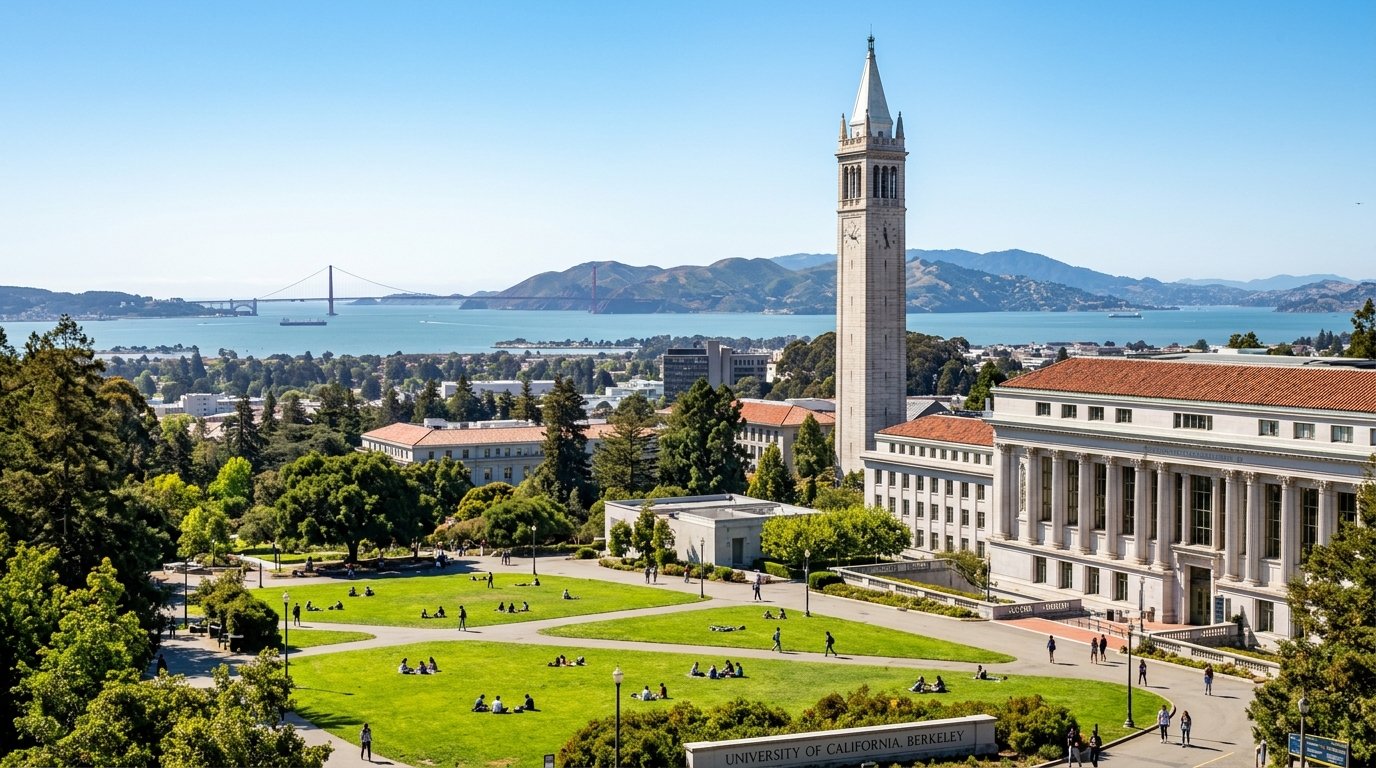
The Berkeley campus is known for its distinctive architecture and natural environment.
The campus contains historic buildings as well as modern research and teaching facilities.
Sather Tower, commonly called the Campanile, is one of Berkeley’s most recognizable landmarks.
The tower overlooks the campus and the surrounding Bay Area.
Berkeley’s landscape also includes trees, gardens, pathways, and open spaces.
The combination of architecture and natural surroundings gives the university a distinctive character.
23. Sather Tower
Sather Tower was completed in the early twentieth century and became a symbolic feature of the campus.
The tower’s design reflects European architectural traditions while becoming strongly associated with Berkeley.
It contains bells and serves as a visual landmark visible from many parts of the university and surrounding area.
For generations of students, the Campanile has been one of the defining images of Berkeley.
24. The Bancroft Library
The Bancroft Library is one of the major research libraries at UC Berkeley.
It contains important collections related to California history, Western history, literature, manuscripts, rare books, maps, photographs, and other historical materials.
Libraries such as Bancroft are essential to the university’s humanities and social science research.
They preserve primary sources that allow scholars to study the past directly.
The library’s collections contribute to research not only at Berkeley but also to scholarship worldwide.
25. Berkeley’s Nobel Prize Legacy
UC Berkeley has been associated with numerous Nobel laureates and Nobel-recognized scholars.
The university’s strongest Nobel traditions have particularly involved physics, chemistry, economics, and related scientific fields.
Nobel recognition reflects the university’s ability to attract and support researchers working on fundamental questions.
However, Berkeley’s academic achievements extend far beyond Nobel Prizes.
Researchers and graduates have received many other major honors in science, mathematics, literature, public service, engineering, and the arts.
26. Notable Scientists
Berkeley’s scientific history includes figures such as Ernest Lawrence, Glenn Seaborg, Emilio Segrè, Robert Oppenheimer, and many other prominent researchers.
These scientists worked in fields ranging from nuclear physics to chemistry.
Their research contributed to major changes in scientific understanding during the twentieth century.
The university’s scientific legacy is therefore not based on one individual but on generations of researchers working across disciplines.
27. Berkeley and Robert Oppenheimer
J. Robert Oppenheimer is one of the most famous scientists connected with Berkeley.
Oppenheimer served as a professor of physics at Berkeley and became an important figure in twentieth-century theoretical physics.
He later served as scientific director of the Manhattan Project’s Los Alamos Laboratory.
His life became a symbol of the complicated relationship between scientific discovery, government power, national security, and ethics.
Oppenheimer’s Berkeley years are an important part of the university’s scientific history.
28. Glenn T. Seaborg
Glenn T. Seaborg was another major Berkeley scientist.
He made important contributions to nuclear chemistry and helped discover several transuranium elements.
His scientific career was closely connected with Berkeley and the Lawrence Berkeley Laboratory.
Seaborg also became involved in national science policy and public affairs.
His career illustrates how Berkeley scientists have sometimes combined research with public service.
29. Women at Berkeley
The history of Berkeley also includes the changing role of women in higher education.
Women attended the university from its early history, although opportunities and social conditions were very different from today.
Over the decades, women increasingly entered scientific, academic, professional, and leadership positions.
The university has produced many distinguished women scholars and leaders.
Modern Berkeley emphasizes diversity and broad participation in higher education, although questions about equality, representation, and access remain ongoing challenges.
30. Diversity and International Students
UC Berkeley is an international university.
Students and scholars come from many parts of the world.
International students contribute to campus life through cultural organizations, research collaborations, academic programs, and community activities.
Berkeley’s global connections also extend through partnerships, research projects, conferences, and alumni networks.
For international students, studying at Berkeley can provide access to a major research environment and the broader Bay Area innovation ecosystem.
31. Berkeley’s Admissions Reputation
Admission to Berkeley is highly competitive.
As a major public research university, Berkeley receives applications from a large and diverse pool of students.
Academic preparation, intellectual interests, extracurricular activities, personal experiences, and other factors may play important roles in admissions depending on the program and applicant category.
Because demand is high, gaining admission can be difficult.
The university’s reputation attracts applicants interested in science, technology, business, public policy, humanities, social sciences, and many other fields.
32. Graduate Education
Graduate education is central to Berkeley’s research mission.
The university offers advanced degrees across a wide range of disciplines.
Graduate students frequently work directly with faculty members on research projects.
They may conduct laboratory experiments, analyze data, write scholarly papers, teach undergraduate courses, and participate in international conferences.
Berkeley’s graduate programs have contributed significantly to its global reputation.
33. Research at Berkeley
Research is one of UC Berkeley’s defining characteristics.
The university conducts research in laboratories, institutes, departments, and interdisciplinary centers.
Projects range from basic scientific questions to applied problems.
Examples include:
- Artificial intelligence
- Quantum science
- Climate research
- Renewable energy
- Biotechnology
- Cancer research
- Materials science
- Economics
- Public policy
- Education
- Social inequality
- Urban development
- Computer systems
- Astronomy
This broad research portfolio allows Berkeley to contribute to both fundamental knowledge and practical solutions.
34. Entrepreneurship and Innovation
Entrepreneurship is an important part of Berkeley’s modern identity.
Students and researchers have founded or contributed to technology companies, biotechnology firms, software startups, financial companies, and social enterprises.
The Bay Area provides access to investors, entrepreneurs, engineers, designers, and business leaders.
Berkeley’s entrepreneurship ecosystem helps students transform ideas into projects and companies.
At the same time, university research often generates intellectual property that can be developed commercially.
35. Berkeley and Artificial Intelligence
Artificial intelligence has become one of the most important areas of modern technological research.
Berkeley researchers work in machine learning, robotics, computer vision, natural language processing, reinforcement learning, and related areas.
The university’s location in the Bay Area provides connections to the global AI industry.
Berkeley’s research contributes to both theoretical advances and practical applications.
AI research also raises questions about ethics, employment, privacy, security, education, and social impact.
These questions reflect Berkeley’s broader tradition of combining technical research with social inquiry.
36. Berkeley and Public Policy
UC Berkeley has long contributed to public policy.
Researchers study government, economics, education, healthcare, urban planning, environmental regulation, international affairs, and social policy.
Because California is one of the world’s largest economies and a major policy laboratory, Berkeley researchers have opportunities to study policies with large-scale effects.
University scholars have often participated in public discussions and advised governments and organizations.
37. Berkeley Economics
Berkeley’s economics community is internationally recognized.
Research has addressed labor markets, economic development, public finance, inequality, macroeconomics, political economy, environmental economics, and many other topics.
Economics at Berkeley has frequently interacted with other disciplines.
For example, economists may collaborate with political scientists, sociologists, environmental scientists, and data scientists.
This interdisciplinary approach helps researchers address complex social problems.
38. Berkeley and the Humanities
Although Berkeley is famous for science and technology, the humanities remain an important part of the university.
Students study literature, philosophy, history, languages, art history, music, and cultural studies.
Humanities research helps society understand human experience, culture, language, ethics, and historical change.
Berkeley’s broad academic structure means that scientific innovation exists alongside humanistic inquiry.
39. Arts and Culture
Berkeley has a strong connection with the arts.
Students and faculty participate in music, theater, visual arts, literature, film, and other creative activities.
The surrounding Bay Area also provides access to museums, theaters, galleries, concert venues, and cultural institutions.
This environment supports students who want to combine academic education with creative work.
40. Athletics
Berkeley’s athletic teams compete as the California Golden Bears.
The university participates in major collegiate sports, including football, basketball, baseball, soccer, swimming, rowing, gymnastics, and track and field.
Athletics contribute to university traditions and community identity.
The Golden Bears have achieved notable success in various sports and have produced athletes who competed at national and international levels.
41. Berkeley’s Alumni
UC Berkeley has a large and influential alumni community.
Graduates have become scientists, engineers, entrepreneurs, politicians, writers, artists, educators, business leaders, lawyers, journalists, and public servants.
The alumni network extends across the United States and around the world.
Many graduates maintain connections with the university through professional organizations, fundraising, mentoring, research collaborations, and alumni events.
42. Famous Alumni and Their Contributions
Berkeley alumni and former students have contributed to numerous fields.
Notable figures associated with Berkeley include Steve Wozniak, co-founder of Apple; Jennifer Granholm, former governor of Michigan and U.S. energy secretary; Robert McNamara, former U.S. Secretary of Defense and World Bank president; and numerous Nobel laureates, scientists, writers, and public officials.
These individuals represent only a portion of Berkeley’s wider alumni community.
The university’s influence is often visible through the work of its graduates rather than through the campus itself.
43. Berkeley’s Relationship with California
The university has a particularly close relationship with California.
Berkeley has educated generations of Californians and contributed research to issues affecting the state.
Researchers have worked on California’s water supply, agriculture, earthquakes, wildfire risk, energy systems, transportation, housing, education, and environmental challenges.
The university’s public mission encourages research that can improve the lives of people throughout California.
44. Earthquake Research
California’s location along major geological faults makes earthquake science extremely important.
Berkeley researchers have contributed to understanding earthquakes, seismic hazards, structural engineering, and risk reduction.
This research has practical implications for building codes, infrastructure, emergency planning, and public safety.
The work demonstrates how university research can address immediate regional problems while also contributing to global scientific knowledge.
45. Berkeley and Public Service
Public service is an important part of Berkeley’s institutional identity.
Students and graduates work in government agencies, nonprofit organizations, schools, hospitals, international institutions, and community organizations.
The university encourages students to think about how knowledge can be used to address social problems.
This emphasis is particularly visible in public policy, education, environmental studies, law, and social sciences.
46. Academic Freedom
Academic freedom is one of Berkeley’s most important traditions.
The university’s history of debate and protest has made free expression an important part of campus culture.
Academic freedom allows researchers to investigate controversial questions and students to engage with competing viewpoints.
Maintaining a balance between free expression, safety, inclusion, and responsible academic conduct can be challenging.
Berkeley’s history demonstrates that universities are not simply places for transmitting information; they are also places where societies debate difficult questions.
47. Berkeley in the Digital Age
The twenty-first century has brought major changes to higher education.
Berkeley has responded by expanding digital research, online learning, data science, artificial intelligence, biotechnology, and interdisciplinary programs.
Digital technology has changed how students learn and how researchers collaborate.
Berkeley’s proximity to major technology companies gives it a particularly strong connection to these changes.
At the same time, the university continues to maintain traditional forms of teaching, laboratory research, seminars, libraries, and face-to-face academic discussion.
48. Berkeley’s Global Influence
UC Berkeley’s influence extends far beyond California.
Researchers collaborate with universities and organizations around the world.
Graduates work in international companies, governments, research institutes, universities, nonprofit organizations, and global institutions.
Berkeley research is frequently published in international academic journals and presented at global conferences.
The university therefore functions as part of a worldwide network of knowledge production.
49. Challenges Facing UC Berkeley
Despite its achievements, Berkeley faces significant challenges.
One challenge is affordability.
Living in the Bay Area can be expensive, and housing costs can create difficulties for students and employees.
The university must also balance the financial needs of a major research institution with its public mission.
Other challenges include maintaining infrastructure, supporting mental well-being, managing enrollment, addressing environmental concerns, and ensuring access to education.
Technology and artificial intelligence also create new questions about teaching, research, academic integrity, and employment.
50. The Future of Berkeley
The future of UC Berkeley is likely to be shaped by several major areas.
Artificial intelligence, climate change, biotechnology, quantum science, clean energy, cybersecurity, and data science are expected to remain important.
The university will also continue to face questions about affordability and access.
Berkeley’s greatest strength may be its ability to combine disciplines.
Future problems will rarely fit neatly into one academic department.
Climate change, for example, requires science, engineering, economics, law, politics, sociology, and public communication.
Berkeley’s broad academic structure gives it the opportunity to approach these challenges from many directions.
51. Why UC Berkeley Is Important
UC Berkeley is important because its history reflects the evolution of the modern American university.
It began as a public institution designed to educate and serve a growing state.
It became a research university capable of making major scientific discoveries.
It became a center of political and cultural debate.
It contributed to the development of computing and the technology economy.
It educated generations of influential people.
And it continues to produce research addressing some of the world’s most difficult problems.
Its importance therefore cannot be measured by rankings alone.
Berkeley’s deeper influence comes from its combination of education, research, public service, innovation, and intellectual freedom.
52. Berkeley’s Educational Philosophy
At the heart of Berkeley’s educational mission is the idea that students should not simply memorize information.
They should learn how to investigate questions, evaluate evidence, communicate arguments, and create new knowledge.
This approach is especially important at a research university.
Students may encounter professors who are actively conducting research in their fields. This creates opportunities to learn not only established knowledge but also how new knowledge is produced.
Research-based education can encourage curiosity and independent thinking.
53. The Importance of Berkeley’s Research Community
A major university is more than its classrooms.
Berkeley’s research community includes undergraduate students, graduate students, faculty, postdoctoral researchers, laboratory scientists, engineers, librarians, staff, and visiting scholars.
This community creates a continuous exchange of ideas.
A student studying computer science may encounter research in biology.
An environmental scientist may collaborate with an economist.
An engineer may work with a public policy researcher.
Such connections can produce discoveries that would be difficult to achieve within a single discipline.
54. Berkeley’s Role in Innovation
Innovation at Berkeley occurs in many forms.
Sometimes it involves a scientific discovery.
Sometimes it is a new computer program.
Sometimes it is a medical technology.
Sometimes it is a new approach to public policy or education.
Innovation can also occur in the humanities through new interpretations of historical and cultural materials.
This broad definition of innovation is important because universities contribute to society in many different ways.
55. Berkeley and the Knowledge Economy
Modern economies increasingly depend on knowledge.
Universities produce skilled workers, research discoveries, intellectual property, entrepreneurs, and public leaders.
Berkeley is a major contributor to California’s knowledge economy.
Its graduates enter industries ranging from technology and biotechnology to education, finance, government, law, media, and environmental organizations.
Research generated at Berkeley can lead to patents, startups, public policies, and new scientific fields.
56. The Berkeley Experience
For students, studying at Berkeley can be demanding.
The academic environment is competitive, and students are surrounded by peers who have strong academic backgrounds.
However, the university also provides opportunities for intellectual exploration.
Students can join research laboratories, student organizations, cultural groups, sports teams, volunteer projects, and entrepreneurship programs.
The campus environment encourages students to develop both academic and personal interests.
57. The Meaning of the Berkeley Name
The name “Berkeley” has become internationally associated with academic excellence, scientific discovery, free expression, and innovation.
When people hear Berkeley, they may think of the Free Speech Movement, Silicon Valley, nuclear science, computer science, environmental research, or public education.
This wide range of associations is unusual for a university.
It demonstrates how deeply Berkeley has influenced different aspects of modern life.
58. Berkeley’s Continuing Legacy
The legacy of UC Berkeley is not simply a collection of old buildings, famous professors, or historical events.
Its legacy continues through current students and researchers.
Every generation adds something new.
A student may develop a technology that changes an industry.
A researcher may discover a new scientific principle.
A historian may reinterpret the past.
A public policy scholar may help improve government.
An entrepreneur may create jobs.
An activist may draw attention to an overlooked social problem.
The university’s continuing influence comes from this process of renewal.
59. UC Berkeley as a Symbol of Public Higher Education
Berkeley represents the possibilities of public higher education.
Its history demonstrates that a publicly supported university can achieve international research excellence while maintaining a broad educational mission.
The university has shown that public institutions can compete with the world’s most prestigious universities in science, technology, humanities, and social sciences.
At the same time, the university’s history shows that public higher education requires continuous investment.
Libraries, laboratories, faculty, student services, scholarships, housing, and research infrastructure all require substantial resources.
60. Conclusion
The University of California, Berkeley, is one of the most influential universities in American and global history.
Founded in the nineteenth century to serve the growing state of California, Berkeley developed into a major public research institution with worldwide influence.
Its history includes extraordinary achievements in science, engineering, computing, economics, law, environmental research, public policy, and the humanities.
Berkeley scientists helped transform nuclear physics and chemistry. Its researchers contributed to the development of modern computing. Its students played a major role in the Free Speech Movement. Its graduates have influenced business, government, technology, science, education, and culture.
The university’s location in the San Francisco Bay Area has strengthened its relationship with technology and entrepreneurship, while its public mission has encouraged research addressing broader social and environmental problems.
Perhaps Berkeley’s most important characteristic is its culture of intellectual ambition. The university encourages people to ask difficult questions, challenge established ideas, conduct original research, and use knowledge to improve society.
Its future will undoubtedly bring new challenges. Climate change, artificial intelligence, biotechnology, energy, economic inequality, public health, cybersecurity, and other global issues will require cooperation across academic disciplines.
UC Berkeley is well positioned to participate in these efforts because interdisciplinary research has been central to its identity for generations.
From its early beginnings as a young California university to its modern role as a global research powerhouse, Berkeley has demonstrated the extraordinary potential of higher education.
Its story is therefore not only the history of one university. It is also a story about the development of modern science, technology, public education, social activism, and intellectual life.
For students who dream of studying at one of the world’s leading public universities, researchers searching for an environment of discovery, and readers interested in the history of American higher education, UC Berkeley remains a remarkable institution.
Its famous campus, distinguished faculty, accomplished alumni, groundbreaking research, and tradition of public engagement have made it an enduring symbol of academic excellence.
The University of California, Berkeley continues to evolve while preserving the principles that have shaped it for more than a century: education, research, innovation, public service, intellectual freedom, and the pursuit of knowledge.
These principles explain why Berkeley remains one of the world’s most recognized and influential universities and why its contributions are likely to continue shaping science, technology, culture, and society for generations to come.